Sculptural Gold Dominates SS26 as Chanel, Saint Laurent Lead the Way
Sculptural gold ruled every SS26 runway from Chanel to Saint Laurent. Three silhouette rules explain why - and how to wear it in real life.
The Architecture of Now
Something shifted on the SS26 runways that went beyond a trend cycle ticking over. Jewelry stopped being the afterthought and became the argument. From Chanel's Paris Fashion Week presentation to Acne Studios' oversized earring moment, the message arrived with the kind of unanimity that only happens when an industry has genuinely changed its mind. "Subtle is over," as FashionTimes put it, and the evidence was stacked in yellow gold.
What made this season's statement so legible was that the shift wasn't arbitrary maximalism - it was structural. The pieces that commanded attention at Chanel, Saint Laurent, Valentino, Ralph Lauren, and Acne Studios all obeyed the same three unspoken rules of scale, texture, and placement. Understanding those rules is the difference between wearing sculptural gold and being worn by it.
Rule 1: Scale Wins by Standing Alone
The first rule is the hardest for jewelry lovers to follow: choose one piece and commit to it entirely. Chanel's planetary bangles from the SS26 collection made this principle impossible to ignore. A single bangle of that architectural mass doesn't need a partner. It doesn't need rings, a companion bracelet, or a layered chain. It needs a plain white tee and clean trousers, a bare wrist, and the confidence to stop there.
FashionTimes identified this as "intentional, curated maximalism: one large sculptural gold piece paired with pared-back clothing." The intentionality is the key word. This is not the maximalism of more - it is the maximalism of weight. A chunky yellow-gold cuff worn as a single statement carries more visual authority than three stacked delicate bangles, because it reads as a decision rather than an accumulation.
For a real-life translation, the choice breaks into two directions:
- The statement piece route: One oversized yellow-gold cuff, worn on a bare forearm against a fitted long-sleeve crewneck or a sleeveless column dress. Nothing else on the wrists. Nothing competing at the neckline.
- The layered basics route: An oversized link chain worn at collarbone length, paired with simple gold studs - small enough to disappear. The chain takes the sculptural role; everything else recedes.
Both approaches honor the rule. Only one piece scales up. The rest of the jewelry real estate stays empty.
Rule 2: Texture Is the Whole Point
Saint Laurent, Valentino, and Acne Studios all leaned into oversized earrings for SS26, but the detail that separated these pieces from ordinary statement hoops was surface. FashionTimes described the defining quality precisely: "thick hoops with hammered texture, asymmetrical drops that frame the face with genuine dramatic intent, and sculptural forms that read from across a room." The architecture of the surface, not just the size, is what makes the piece.
This matters for buying decisions. A thin, high-polish hoop at a large diameter is not the same object as a thick hoop with a hammered or irregular finish. The hammered texture catches light differently at every angle, creating movement without the piece actually moving. An asymmetrical drop works on the same principle: the variation in weight and form makes the earring look alive on the face.
The neckline and hair pairings follow from this. To showcase an earring that "arcs like a small sculpture," the area around it needs to be clear:
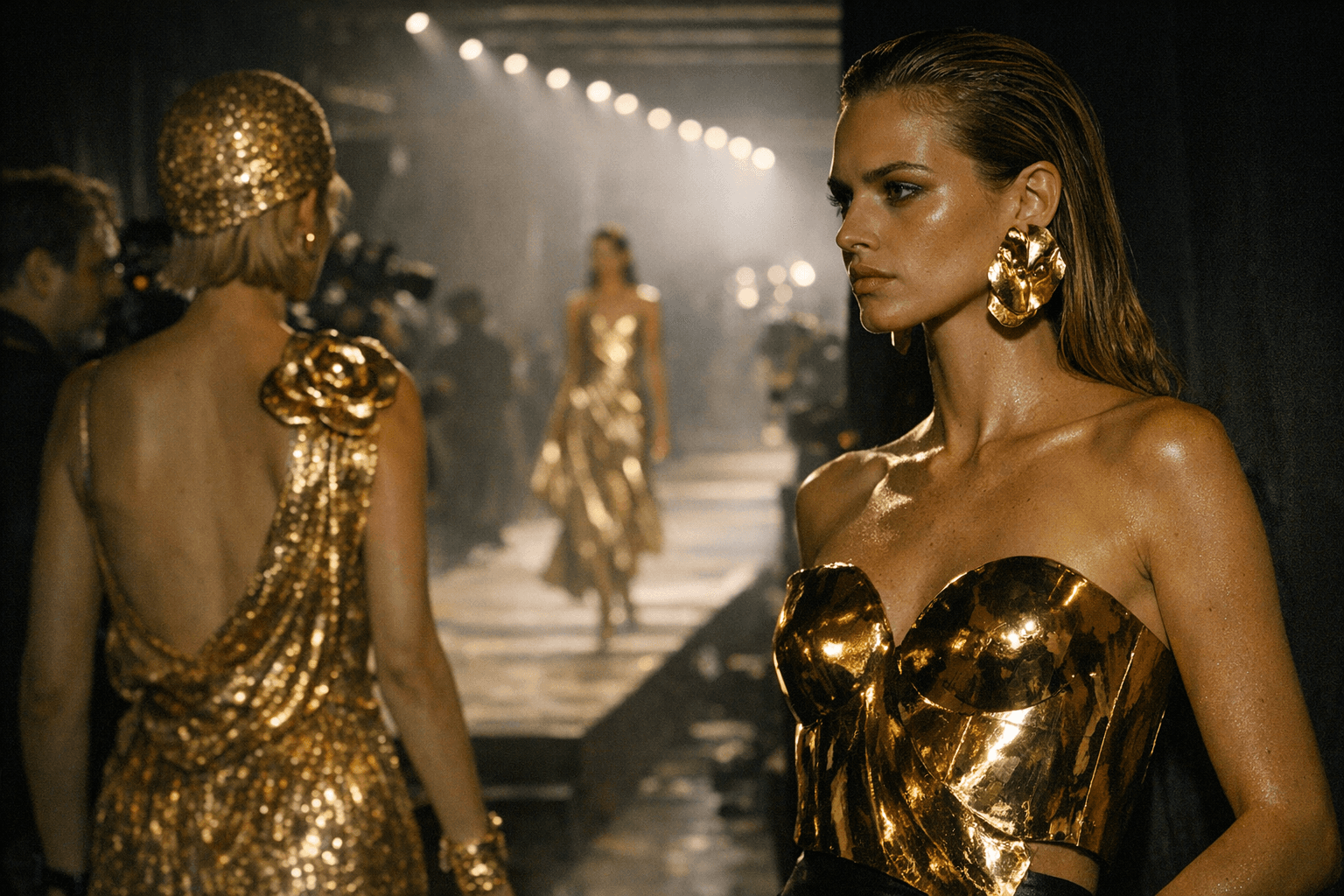
- Hair: Worn up, always. A low bun or a sleek ponytail removes competition and lets the earring occupy its full visual territory. This is not a styling preference - it is the reason the earring was designed at that scale.
- Neckline: A deep V-neck, a boatneck, or a bare shoulder lets the jaw-and-ear frame sit without interference. Turtlenecks close off the architecture. High-necked knits compress it. The earring needs air.
Rule 3: Placement Tells the Story
Ralph Lauren's silver pendants at Paris Fashion Week demonstrated something the other runway pieces confirmed: where a piece lands on the body determines what it says. A pendant worn at chest height against a clean, open neckline functions as a focal point. The same pendant buried inside a layered necklace stack becomes noise.
FashionTimes described the broader design language as pieces offering "weighted, architectural presence" with "bands that bulge unexpectedly" and "rings that play with proportion in ways that feel more art object than accessory." That object-like quality depends on context. An architectural ring worn on a hand that is otherwise unadorned reads as sculpture. Worn among four other rings, it reads as clutter.
The practical outfit formulas that honor this rule are specific:
- Pendant necklace: Open-collar button-down or scoop-neck top, nothing else at the neck, no earrings louder than small gold huggies or simple studs.
- Architectural ring: One ring, dominant hand, ideally on the index or middle finger where it has maximum visibility. Paired with a wide-cuff or plain-sleeve silhouette so the hand gets its close-up.
- Sculptural cuff: Short sleeves or sleeveless, so the piece sits in open air rather than disappearing into fabric.
Why the Industry Moved in One Direction
The convergence of houses as different as Chanel and Acne Studios around the same sculptural vocabulary is not coincidental. Jillian Sassone, founder of Marrow Fine Jewelry, identified the consumer appetite driving it: "people want pieces that feel collected, expressive, and a little unexpected." That demand for pieces that feel chosen rather than assembled has pushed both independent designers and major houses to move gold away from "discrete, quiet-karat pieces" and toward statement sculpture.
The candy-colored beaded necklaces and reimagined pearls that also appeared across SS26 runways operate within the same logic: they are unexpected, deliberate, and readable as individual taste. The beaded necklace that blends gold with nostalgic, playful motifs is not quiet luxury's pearl strand - it is a personality on a chain. The reimagined pearl is not an heirloom; it is an opinion.
This season's jewelry conversation even caught the attention of broader editorial culture. Tiffany & Co.'s move to cast Natalie Portman as brand ambassador, with diamonds positioned at the center of the campaign, signals that even the heritage end of the market is leaning into the idea that jewelry should be seen and recognized, not quietly appreciated.
The runway's verdict for SS26 is clear, and it has three practical rules behind it. Scale up and commit to one piece. Choose texture over polish. Give the piece the context it needs to land. "The 2026 interpretation is not about delicate gold whispers," FashionTimes noted. "It is about weighted, architectural presence." That presence, it turns out, is entirely achievable with a single well-chosen piece and the discipline to leave everything else in the drawer.
This article was produced by Prism’s automated news system from verified source data, official records, and press releases, then run through automated quality and moderation checks before publishing. The system is built and supervised by the people who set the standards it runs under. Read our full AI policy.
Did this article answer your question?