Tremont Auctions March Sale Features 546 Lots Including 18K Etruscan Revival Locket
A mid-19th century 18K gold locket attributed to Eugene Fontenay, with fine bead and wirework, drew $2,000–$3,000 estimates at Tremont Auctions' 546-lot March sale.

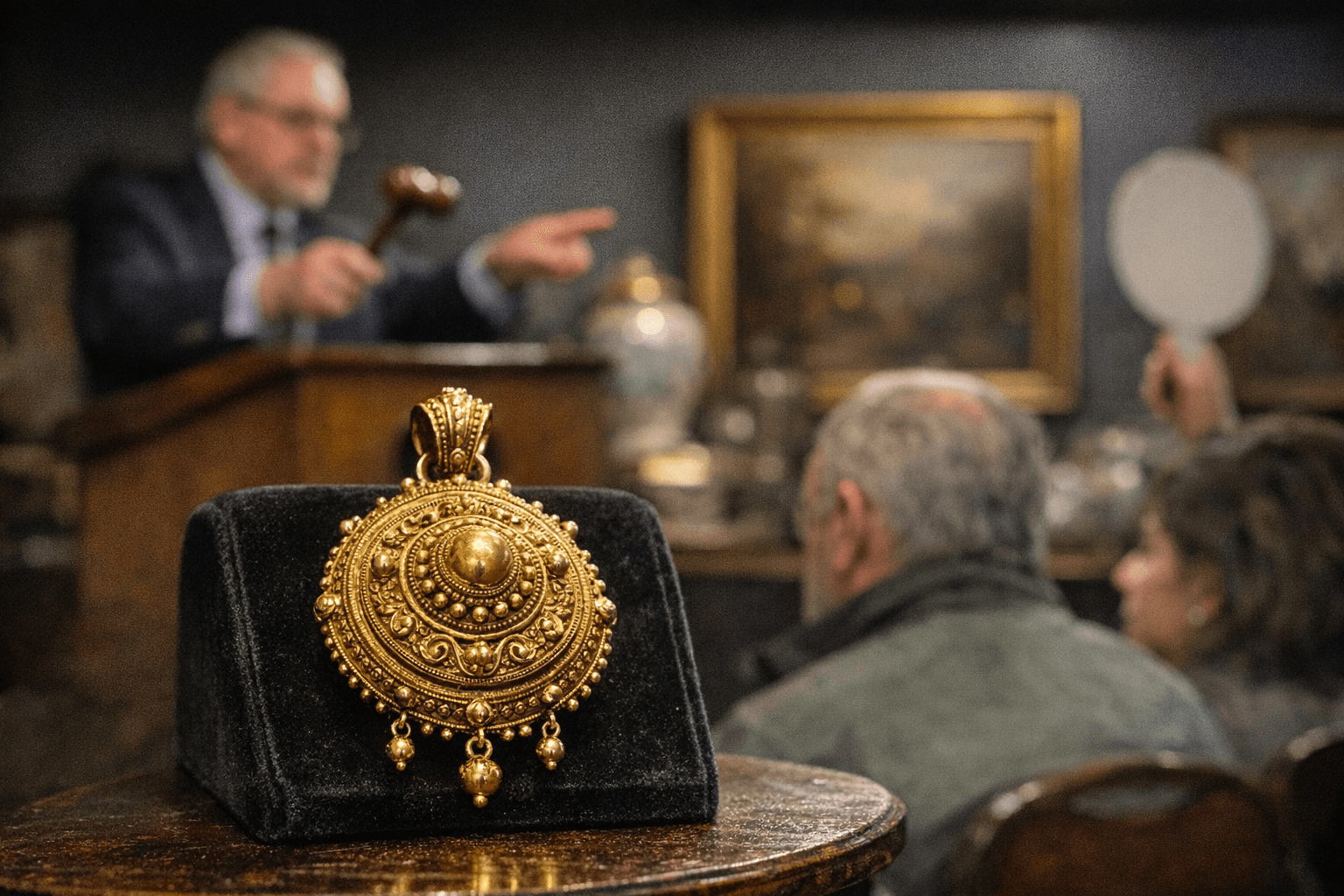
Among the 546 lots that crossed the block at Tremont Auctions' March Fine Arts, Antiques and Jewelry sale, one piece carried the kind of pedigree that stops serious collectors cold: an 18K gold Etruscan Revival locket attributed to Eugene Fontenay, the Parisian goldsmith who defined the movement's most refined iteration in mid-19th century France. The auction, held March 1 at 10:00 AM EST from Tremont's base at 615 Boston Post Road in Sudbury, Massachusetts, drew bidders across gold jewelry, estate pieces, decorative arts, and Continental silver.
The Fontenay locket is the sort of object that rewards close inspection. Its surface carries fine bead and wirework decoration, the granulation and twisted wire techniques that Fontenay and his contemporaries revived directly from ancient Etruscan and Greek originals excavated in the mid-1800s. The catalog lists the attribution explicitly as "attributed to Eugene Fontenay" — a careful distinction worth noting, since no provenance documentation is reproduced in the listing. Condition notes are candid: several scattered small dents, one missing bead on the front cover, and a crack to the glass. For a piece of this age and construction type, the bead loss and glass damage are not unusual, but they bear on the final price. Tremont estimated the locket at $2,000 to $3,000 with a starting bid of $1,000.
The supporting cast across the 546-lot catalog was substantial. Lot 15, a vintage 14K gold solitaire ring set with a round old mine cut diamond measuring 7.2mm in diameter and weighing approximately 1.40 carats, carried an $800 to $1,200 estimate. The band, weighing 3.3 grams and sized 6.5, showed partial hallmarks and a worn inscription — the traces of a previous life that collectors either prize or look past. Lot 16 moved into silver: a Victorian Gorham coin silver five-piece tea set with a Gothic style finial, beaded borders, and engraved and relief floral decoration, the coffee pot standing 13.125 inches tall. Its estimate ran $3,500 to $4,500.
The jewelry roster extended further. A 14K gold ring set with a black opal described as showing a red reflection across approximately 70 percent of the stone's surface at different angles — the stone measuring 1 by 11/16 inches — appeared alongside a 14K gold 2.30-carat round brilliant cut diamond solitaire, the diamond measuring 8.4mm in diameter with an engraved date of 2-14-10, sized 7.25. The catalog also listed an important Gustave Baugrand silver ewer shown at the 1867 Paris Exposition, decorated in champleve enamel in the Etruscan Revival style — a companion piece, in spirit, to the Fontenay locket — as well as a large Chinese cloisonne charger from the 18th or 19th century decorated with magpies on flowering branches.
Tremont has run comparable mixed-category sales for more than a decade, with past events including 100 lots of fine sterling silver in the Spring 2021 auction, important Jensen silver in a June 2016 summer sale, and estate jewelry alongside Picasso and Miro works in its December 2022 holiday event. The house is also accepting consignments for the 2026 spring season. Bidders who register directly through Tremont's own website save 3 percent on the buyer's premium compared to third-party platforms. The auction house can be reached at (617) 795-1678 or info@tremontauctions.com.
For the Fontenay locket specifically, the condition report's transparency is actually an argument for its legitimacy as a serious lot rather than a polished-up candidate. Pieces that have been untouched enough to carry original glass, however cracked, and retain the majority of their original surface granulation are rarer than pristine restorations. Whether the attribution holds up to further provenance scrutiny is the question that will follow this piece beyond the sale room.
This article was produced by Prism’s automated news system from verified source data, official records, and press releases, then run through automated quality and moderation checks before publishing. The system is built and supervised by the people who set the standards it runs under. Read our full AI policy.
Did this article answer your question?