Wealthy Buyers Turn to Jewelry, Rare Gemstones as Inflation Hedge
Christie's set an auction record in December as gold surpassed $5,000 an ounce, pushing ultra-wealthy buyers toward rubies, sapphires, and emeralds as inflation hedges.

When the gavel came down at Christie's in December, it didn't just close a sale. It created, as industry insiders describe it, a buzz that rippled through the auction world and crystallized a shift already underway among the ultra-wealthy: high-end jewelry and rare colored gemstones are increasingly being treated not as accessories but as hard assets.
Gold surpassed $5,000 per ounce for the first time and hit a record high of $5,589.38 in January 2026, and that relentless climb has reframed how a certain class of buyer thinks about what sits in a vault or on a wrist. Gold surged 66% in 2025, its best annual gain since 1979. For wealth managers and their clients, that kind of momentum makes the gemstone case almost self-evident.
"Whenever you have macroeconomic volatility, the appeal of hard asset investing goes up," said Thorne Perkin, president of investment management firm Papamarkou Wellner Perkin. "Tangible assets, they tend to retain their value or even increase when inflation rises."
Mario Ortelli, managing partner at strategic advisory firm Ortelli&Co., agreed, noting a clear "defensive element" to the trend. "I think the view of jewelry — gold jewelry, diamond and gemstone jewelry — being viewed as an investment is enhanced by, obviously, the almost daily increase in the gold price," Ortelli said.
The appetite is most acute for colored gemstones. Rubies, sapphires, and emeralds have become the stones of the moment among ultrarich collectors, and auction results are bearing that out: some high-quality colored gems have sold for two to three times their pre-sale estimates. The Marie-Thérèse Pink diamond, believed to have ties to the French royal family, hammered down for $13.98 million, a new record benchmark for a diamond in that hue. The Magnificent Jewels event saw 100 percent of its offerings sold in the highest total ever for a various-owner jewelry auction in Christie's Americas division.
Part of the draw is scarcity in its most literal form. Ankur Daga, founder and CEO of Angara, framed it in terms that resonate especially sharply right now: "No two [colored gemstones] are exactly alike, and I think that's what makes them so interesting to today's market. In a world where we are seeing lab-grown diamonds being made, and it kind of feels like this conveyor belt ... you can't do that with a sapphire or ruby or emerald."
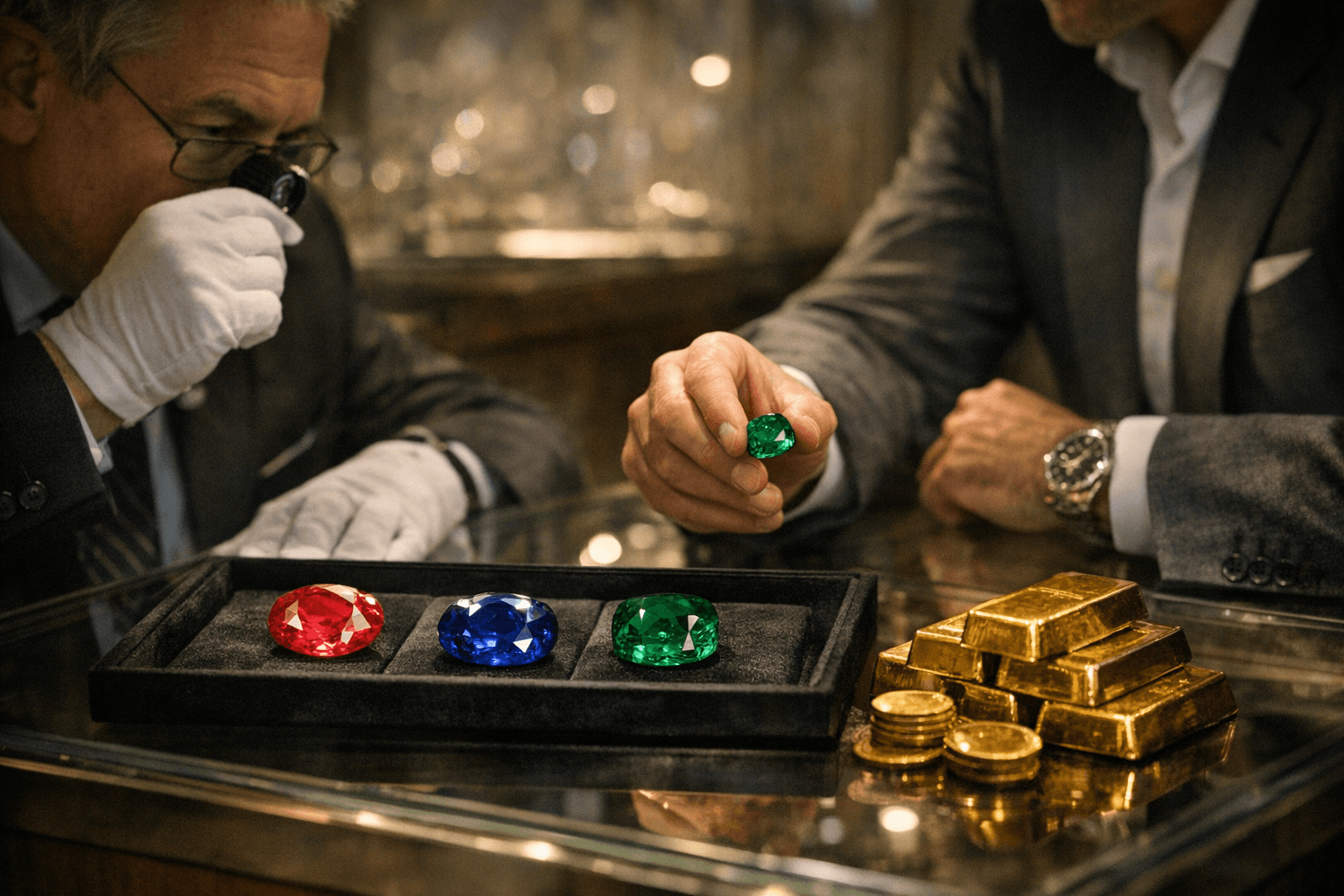
That contrast with the lab-grown diamond market is shaping purchasing decisions across the upper end of the category. Where diamonds can be replicated with increasing precision and at decreasing cost, a Burmese ruby or a Kashmir sapphire carries a provenance that no laboratory can manufacture.
The comparison extends beyond gemstones to luxury goods more broadly. Andrew Brown, founder and CEO of resale platform MyGemma, put it plainly: "Leather does not have a lot of inherent value. As gold is appreciating, people are understanding more and more that this is a very valuable asset." Branded jewelry, with its durability and established resale infrastructure, is increasingly being positioned as a more defensible store of value than even the most coveted luxury handbags.
Total gold demand in 2025, including over-the-counter transactions, exceeded 5,000 tonnes for the first time, yielding an unprecedented value of $555 billion, a 45% increase year over year, a figure that underscores how broadly the flight to hard assets has registered. Jewelry sits at an interesting intersection of that dynamic: it is simultaneously a financial instrument, a collectable, and an object of desire, which makes it uniquely resilient in a portfolio conversation.
Prices are expected to push toward $5,000 per ounce by the fourth quarter of 2026, with $6,000 per ounce a possibility longer term, according to J.P. Morgan Global Research, which suggests the macro conditions supporting jewelry's investment case are nowhere near resolved. For buyers willing to prioritize provenance and gemological quality, the argument for treating a Kashmir sapphire or a Burmese ruby as part of a serious portfolio has rarely been more legible.
This article was produced by Prism’s automated news system from verified source data, official records, and press releases, then run through automated quality and moderation checks before publishing. The system is built and supervised by the people who set the standards it runs under. Read our full AI policy.
Did this article answer your question?