Ancient Egyptian jewelry reveals the meaning behind layered adornment
Ancient Egyptian stacks were built for protection, status, and spirituality, and their symbols still map neatly onto today’s intentional layering trend.
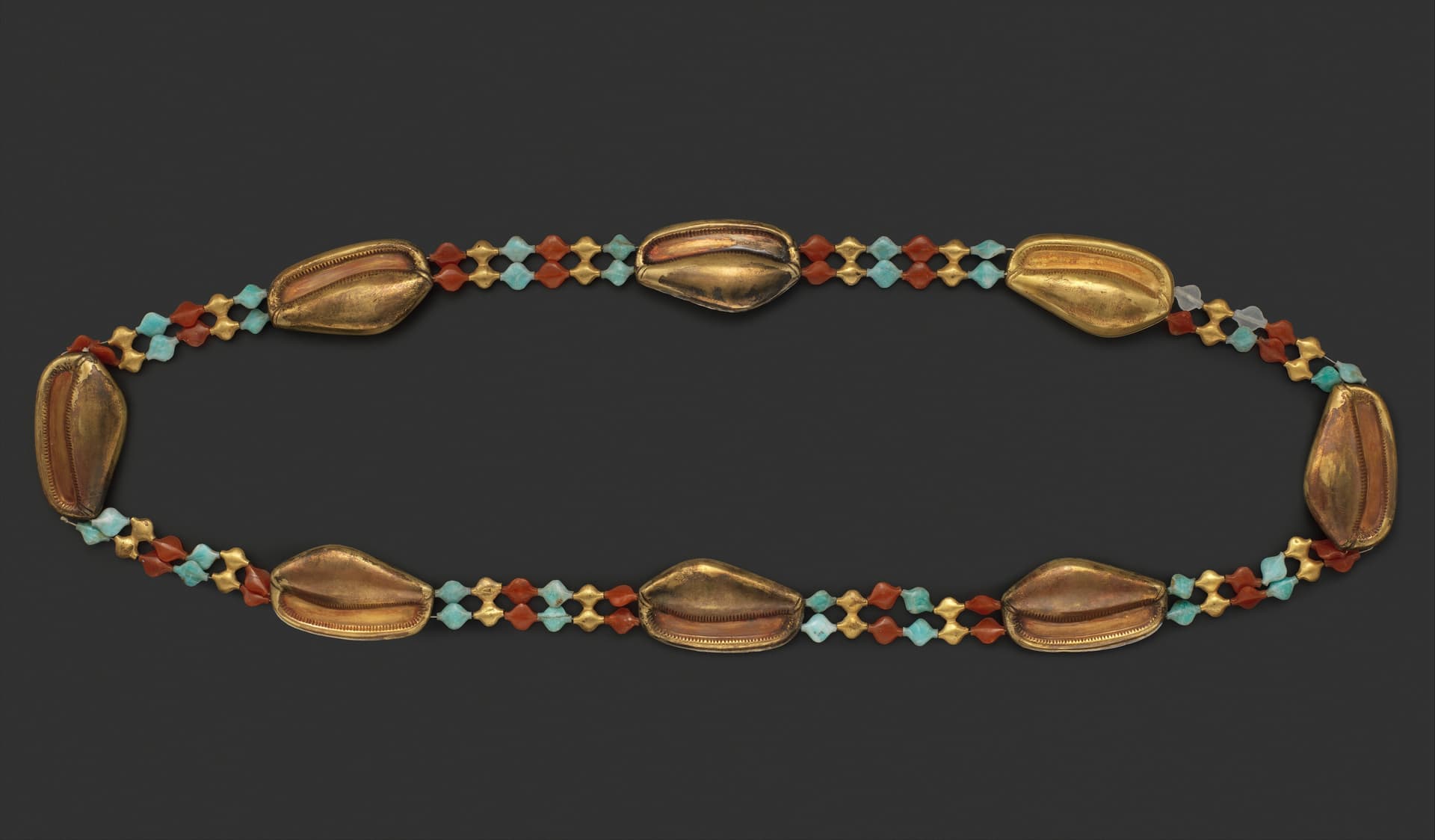
Layering in ancient Egypt was never just ornament. Broad collars, amulets, and menat necklaces worked as a visible system of rank, ritual, and protection, worn by everyone from farmers to pharaohs and carrying meaning in every bead, clasp, and strand. That is what makes Egyptian jewelry such a vivid starting point for today’s symbolic stacking: the look was always about intention.
Layering as a language of power
The American Research Center in Egypt describes jewelry as a shared part of ancient Egyptian life, with necklaces, collars, girdles, and amulets worn across genders and classes. Broad collars were popular from the Old Kingdom onward, and by the New Kingdom they had become among the most frequently worn pieces of jewelry among royalty and the elite. The same forms did not stop at life. Broad collars customarily adorned Egyptian mummies from the beginning of the Old Kingdom, which means layered adornment moved from the living body to the wrapped body without losing its force.
That continuity matters because it shows why Egyptian layering feels so modern. A collar could announce rank, a string of amulets could signal protection, and a necklace could do both at once. In other words, the stack was never accidental.
Amulets were worn like arguments against harm
The Metropolitan Museum of Art defines the Egyptian amulet as an object believed to transfer positive properties to its owner through shape, decoration, inscription, color, material, and ritual words or actions. That is a far more exacting idea than simple decoration. The object had to be made, marked, and sometimes spoken over correctly for its meaning to work.
Small amulets were often provided with loops so they could be strung and worn like necklaces, and they were believed to protect against sickness, infertility, death in childbirth, and dangers in the afterlife. Materials mattered too: the Smithsonian’s National Museum of Asian Art notes examples in faience, stone, ceramic, metal, and glass. Those choices were not neutral. Blue, green, black, white, yellow, and red each carried symbolic associations, with bead colors on funerary necklaces linked to water, sky, vegetation, youth, sun, light, fire, and blood.
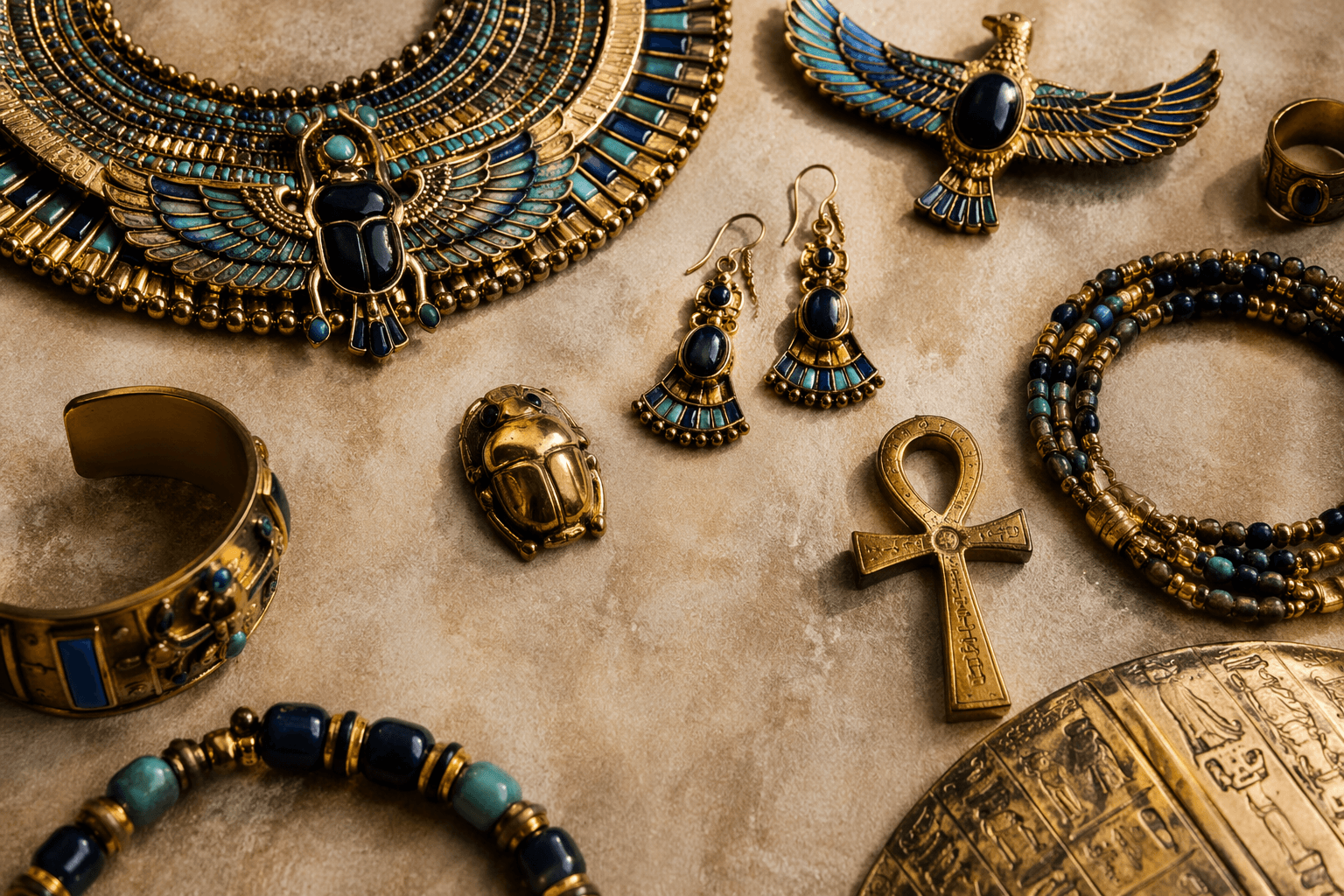
The menat shows how layered meaning could be built into a single object. A menat was a symbol of Hathor, and one surviving example served as the weighted counterpoise for a necklace made of several strands of tiny beads. The design itself made the point: multiple strands, one symbol, one deity, one system of protection and presence.
Objects that still read like modern stacks
One of the clearest examples is the Metropolitan Museum’s Broad Collar of Nefer Amulets. It dates to the New Kingdom and belonged to one of the wives of Thutmose III. The collar carries the nefer hieroglyph, which means good or beautiful, so the piece likely functioned as a wish for well-being as much as a sign of elite taste. It is a layered object, but it is also a message.
A second Metropolitan piece, Necklace with Amulets, deepens that story. It was found with a longer string and a well-preserved menat necklace, and its amulets depict Bes, Taweret, a standing goddess who may be Nut or Isis, and scarab beetles. That combination gives the necklace a protective cast, with named deities and familiar symbols repeating across the body in miniature. The object does what many modern layered necklaces try to do: it turns a cluster of elements into a single readable identity.
Another collar, the Broad Collar with Falcon-Head Terminals, decorated the chest of a woman’s mummy. The Metropolitan notes that broad collars consistently adorned Egyptian mummies, which is a reminder that these necklaces were not only for display in life but for passage beyond it. The Broad Collar of Wah pushes the point further. It was part of a funerary set with anklets and bracelets and was found in the linen wrappings closest to the body, a physical stack laid down in burial order.
The afterlife was layered too
The clearest proof that Egyptian jewelry functioned as a structured system comes from the Golden Boy mummy. Scans revealed 21 amulets arranged in a unique three-column pattern, not a random scatter but a deliberate layout. Among them were a golden tongue amulet meant to enable speech in the afterlife, an Isis knot tied to Isis’s protective power, and a right-angle amulet associated with balance and leveling.
That is the essence of Egyptian layering: one piece did not replace another. Each addition refined the meaning. A tongue amulet solved one problem, an Isis knot solved another, and a right-angle form addressed still another. The body was covered in symbols that worked together.
Recent finds keep that tradition alive. A 2025 discovery at Karnak Temple included gold-plated beads, eye-shaped amulets, and a necklace depicting a golden trio of deities. Even now, Egyptian layered adornment yields new objects that read less like treasure in the abstract and more like carefully constructed statements of belief.
What modern layering can borrow from Egypt
The modern appeal of layered jewelry is strongest when it follows the ancient logic of intention. Start with one symbolic anchor, then add a second piece that repeats or deepens the message. Keep color and material in the conversation, because in Egyptian jewelry a blue bead, a green bead, or a gold-plated charm was never just a visual choice.
That is why Egyptian jewelry still feels instructive. It shows that collars, amulets, and multi-strand necklaces were once worn as protection, status, and spirituality all at once. The smartest stacks today borrow that same discipline: they do not just decorate the body, they declare what the wearer wants the body to mean.
This article was produced by Prism’s automated news system from verified source data, official records, and press releases, then run through automated quality and moderation checks before publishing. The system is built and supervised by the people who set the standards it runs under. Read our full AI policy.
Did this article answer your question?