Cartier, Bvlgari and Boucheron Lead Fine Jewellery Layering Trends in 2026
Fine jewellery's biggest houses are redesigning desire itself — not around singular showpieces, but around pieces built to be worn together, every day.

There is a quiet but significant argument running through every major fine jewellery launch of 2026: that a piece's worth is no longer measured by how much it commands attention on its own, but by how naturally it settles into a life. Bees and serpents, butterflies and pearls, cables and honeycomb, interlocking gold — the motifs arriving from Cartier, Bvlgari, Boucheron, Van Cleef & Arpels and Fred this season are richly varied and, as one overview of the launches put it, "deliberately personal." What unites them is an ambition that feels almost philosophical: luxury today is less about the singular statement-making object and more about jewels that integrate into life, pieces that stack and layer, move with the body and shift effortlessly from day to evening.
That shift is not incidental. It reflects a deeper rethinking of what desirability means at the top of the market.
The Architecture of the Stack
To understand why layering has become the dominant design language of 2026, it helps to look at how the houses are actually engineering their new pieces. This is not styling advice retrofitted onto existing collections. The layerability is structural, built into the proportions, the mixed-metal strategies, and the modularity of each new range.
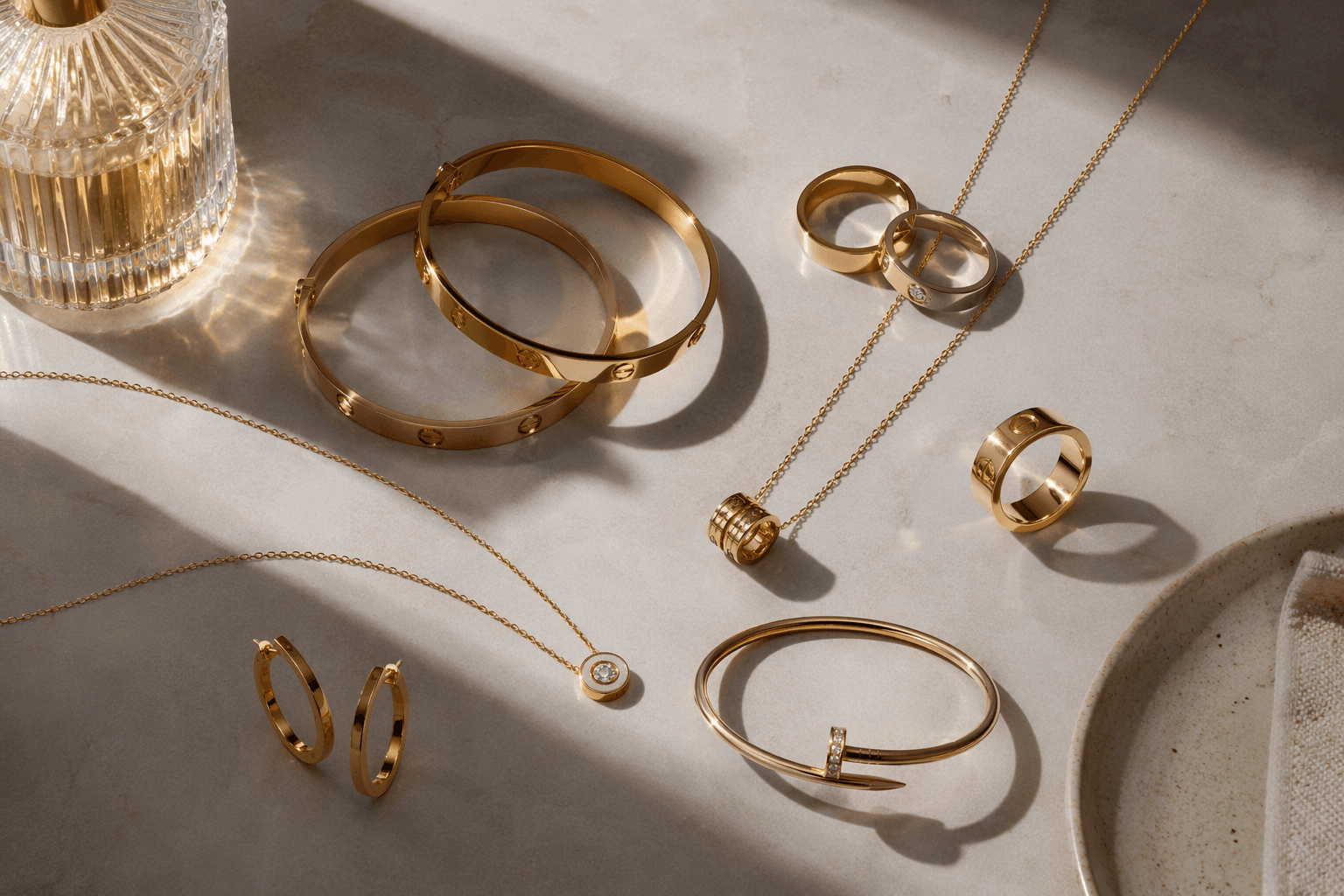
Cartier's contribution is anchored in anniversary momentum. The Force 10 collection turns 60 this year, and the French maison is marking the milestone with new yellow gold additions to its Force 10 Rise line, which was first introduced in 2025. The line reinterprets Force 10's signature cable-and-buckle motif through a more graphic lens, pairing the sinuous cable with a diamond-pavé buckle accented by a row of diamonds. The new yellow gold chapter comprises five pieces: a ring, an adjustable necklace, two pairs of earrings (half-moon hoops and classic hoops), and a versatile ear cuff. All are designed to be mixed, matched and stacked with the collection's existing pink and white gold versions, which is the point — the yellow gold additions do not replace what came before, they extend the conversation between metals on the wrist and at the ear.
Fred's Force 10 Rise line arrives at a similar intersection of cable engineering and diamond setting, with yellow gold earrings, a necklace and white-and-yellow gold ear cuffs, each set with diamonds. The ear cuff, in both houses' interpretations, is the piece worth noting: it functions simultaneously as a standalone sculptural object and as an anchor for a larger composition, which is precisely the kind of dual utility that defines 2026's layering logic.
Quatre XS and the Case for Delicacy
Where Cartier and Fred work in the language of cables and geometric buckles, the Quatre XS pieces take a different approach: restraint as strategy. The new Quatre XS range reinterprets its collection's signature elements in a slimmer form, available in the Black Edition and the Classique Edition. They are more delicate than the existing small version, yet lose none of the collection's visual impact — a difficult balance to achieve in jewellery, where reducing scale almost always means reducing presence. Here, the design intelligence lies in proportion rather than reduction. "Designed for layering, stacking and mixing, Quatre XS will appeal to those who want fine jewellery that is expressive, versatile and effortlessly modern."
The Black Edition and Classique Edition offer two distinct tonal registers within the same silhouette, which makes the collection a practical tool for building stacks that hold internal variation without visual chaos.
Heritage as a Design Engine
The layering trend does not exist in isolation from a broader creative strategy that is reshaping how the major houses conceive new work. Archives have become a powerful engine for creativity across the industry. Boucheron and Chaumet both drew explicitly from historic designs for their 2026 high jewellery collections, mining motifs from their own institutional pasts. Boucheron's Flèche collection, launched last year, reinterpreted the house's archival arrow motif; Bvlgari introduced Vimini this year, based on a past design. Cartier has long demonstrated the commercial power of this approach through collections such as Grain de Café.
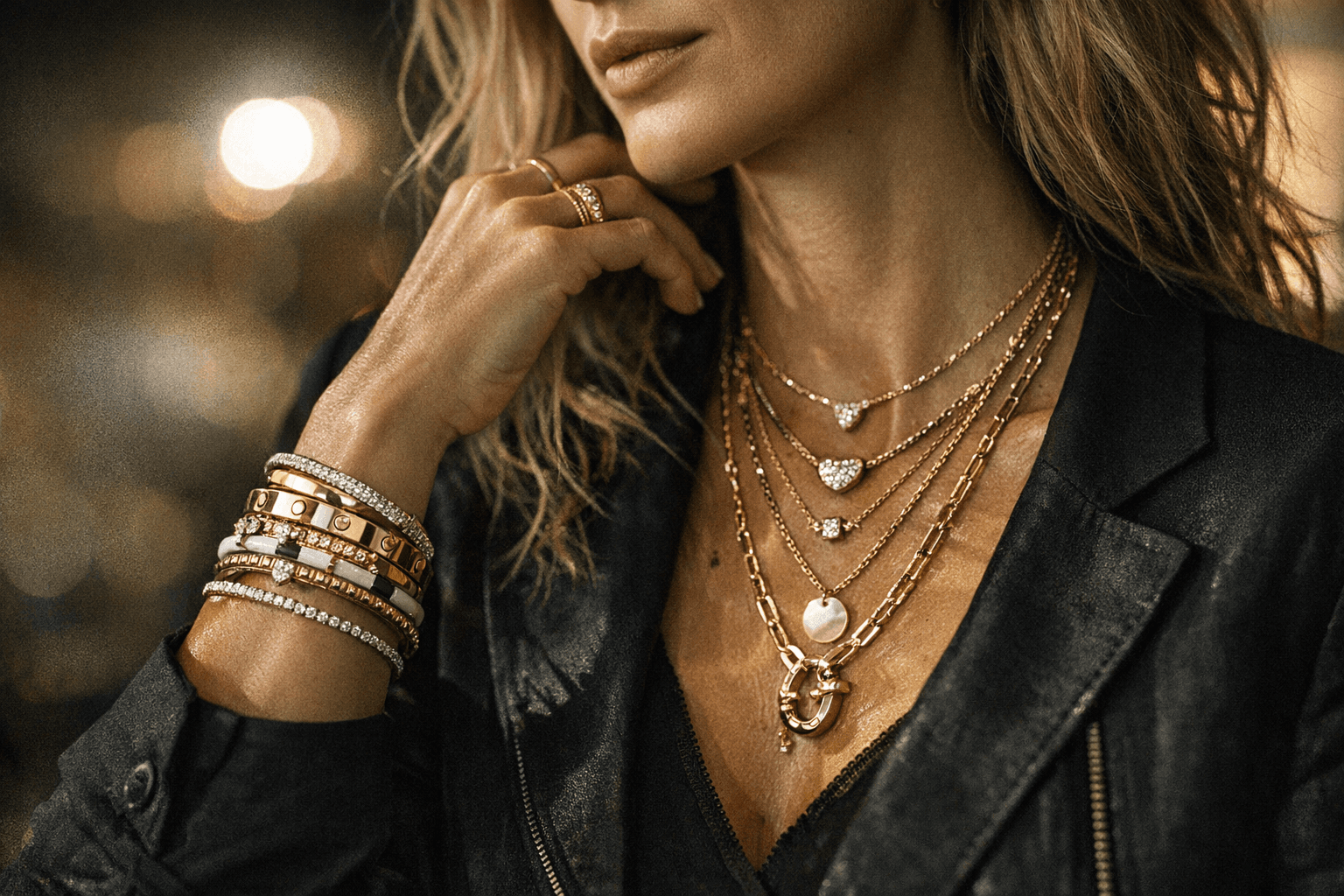
The reasoning is partly commercial and partly cultural. Icons such as Cartier's Trinity, Van Cleef & Arpels's Alhambra and Bvlgari's Serpenti function as what Vogue describes as "the holy grail for jewellery brands," because they allow houses to reach a wider and younger clientele without abandoning the codes that define them. The archive provides the legitimacy; the new execution provides the entry point. And when those archive-derived pieces are designed for stacking, the entry point multiplies: a collector might begin with one Alhambra pendant and, over years, build a layered composition that becomes an autobiography in gold and hard stones.
The Global Event Calendar and the Competition for Attention
The shift toward wearable, stackable jewellery is also a response to the way the fine jewellery market now operates commercially. Bvlgari pioneered the move away from a single, concentrated high jewellery season toward a year-round calendar of events. The brand now stages five to six major high jewellery events annually, rotating across key markets including Europe, the US, China, Japan and the Middle East. These global showcases are complemented by regional activations: in China alone, Bvlgari may visit five or six cities within a single month, hosting day-long presentations and evening dinners for around 60 clients per city.
Cartier, Boucheron and Chaumet operate in very similar ways, as do fashion houses that have expanded into jewellery, including Louis Vuitton and Dior. The competitive pressure is intensifying: Gucci and Armani have most recently entered the high jewellery space, making the calendar increasingly congested. In a market where every major house is staging events and new collections multiple times a year, the pieces that travel best, that can be photographed on real wrists in real cities and restyled across contexts, carry a distinct commercial advantage. Stackable, layerable jewellery is, among other things, extremely good content.
Stacking Across Houses
One of the more interesting phenomena accompanying the layering trend is the growing acceptance, even encouragement, of mixing pieces across houses. Cartier stacks have become a particular focal point for this conversation. Van Cleef & Arpels, with its delicate Alhambra motifs, adds a touch of whimsy to a Cartier stack; Bvlgari's bold, geometric designs introduce striking contrast; Tiffany & Co., known for its classic elegance, blends seamlessly with Cartier's signature pieces, lending itself to refined and balanced bracelet compositions.
The practical logic is straightforward: different houses excel at different scales and textures. A Cartier Love bracelet's smooth, screw-detail band sits cleanly against an Alhambra bracelet's more organic, floral geometry. The visual tension is the point.
The Gold Question
As global gold prices reach historic highs in 2026, some collectors are approaching their jewellery boxes with a dual lens: aesthetic pleasure and wealth security. The question of whether Cartier uses real gold has become, in this context, a practical one for new buyers entering the market. The answer is unambiguous: Cartier works in genuine gold alloys, as do all the houses covered here. What distinguishes fine jewellery at this level from fashion-adjacent alternatives is not just the gold content but the precision of the setting work, the integrity of the stones, and the considered relationship between metal and form that justifies both the price and the longevity.
That durability argument connects back to the layering philosophy. Pieces designed for daily wear, for moving with the body and shifting from day to evening, need to be built for exactly that. The cable-and-buckle engineering of the Force 10 line, the slim but structurally sound silhouette of the Quatre XS, the modular logic of a five-piece yellow gold chapter intended to stack with two other metal families: these are not styling suggestions. They are design commitments. In 2026, the most forward-thinking houses are betting that the most covetable thing a jewel can do is make itself at home.
This article was produced by Prism’s automated news system from verified source data, official records, and press releases, then run through automated quality and moderation checks before publishing. The system is built and supervised by the people who set the standards it runs under. Read our full AI policy.
Did this article answer your question?