Diamond Tassels Return, Bringing Motion and Drama to Layered Stacks
A $4.8 million Sotheby's auction traced the diamond tassel back 250 years. Now stylists are using the motif as a layering anchor, not a finale.
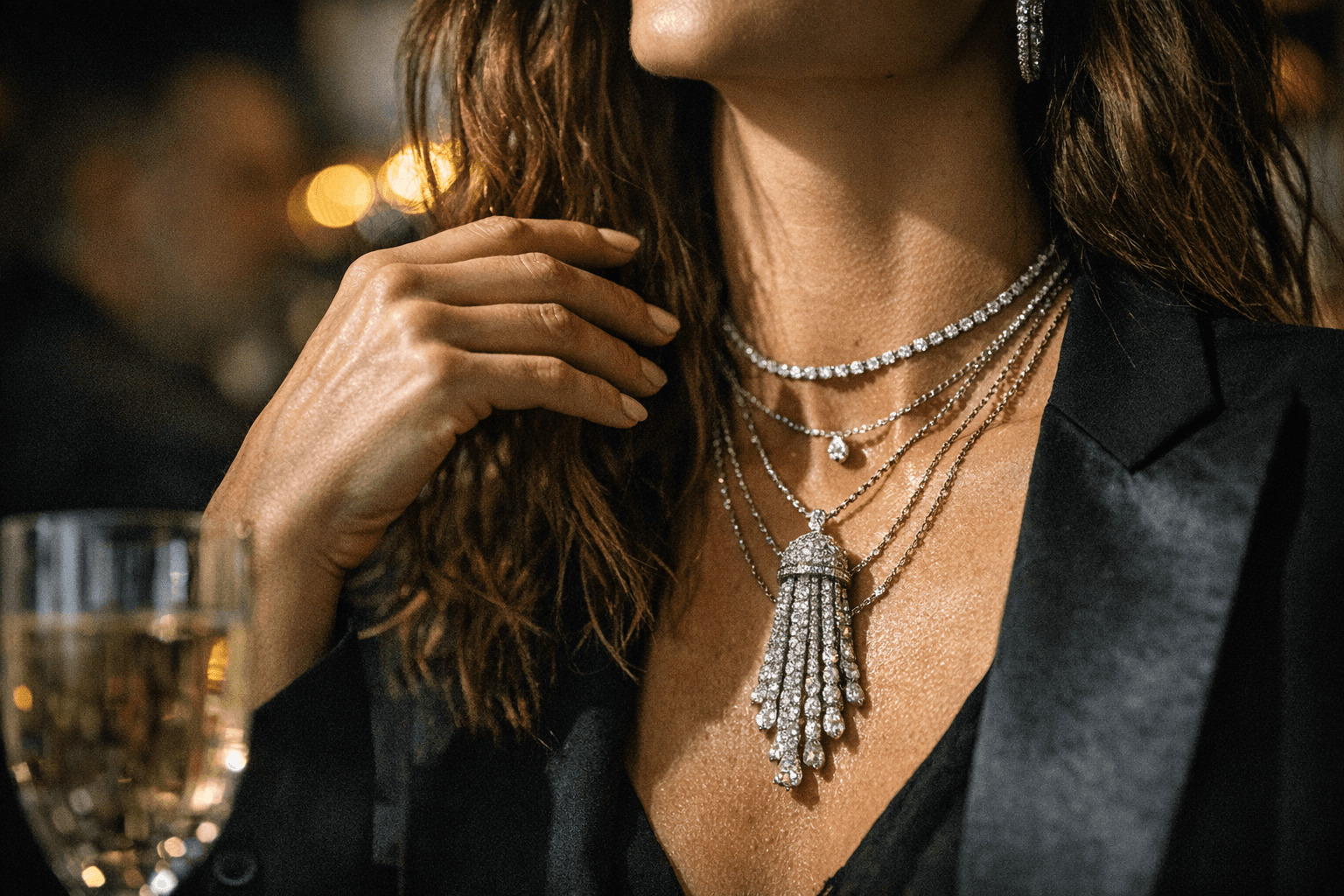
There is a particular quality of light that only comes from jewelry in motion. A diamond set in a prong or bezel is fixed, sending light back in predictable directions. A diamond tassel, with its loose strands shifting against fabric and skin, fractures light unpredictably. That unpredictability is not a flaw. It is the entire point.
The tassel is one of jewelry's oldest recurring motifs, and it is back with intention. What makes the current revival more interesting than a simple nostalgic turn is where the motif is landing: not as a statement finale on a single necklace, but as the organizing principle of a layered stack. Designers and stylists are placing tassels at the bottom of three- and four-necklace sequences, using the fringe's movement to animate the entire construction. Understanding why the tassel works so well in this role requires going back a long way.
A Motif Built on Motion
The diamond tassel's traceable history runs at least to the eighteenth century. In the courts of Versailles, tassel-ended necklaces and bodice ornaments appeared with frequency, the fringe functioning as a way to soften the rigidity of heavily set pieces. An extraordinary example from that era surfaced at Sotheby's in recent years: a three-strand diamond necklace finished with tassel ends, comprising roughly 500 diamonds and more than 300 carats, believed to have been created between 1780 and 1800 and linked to the circle of Marie Antoinette. It sold for $4.8 million, more than twice its estimate, after a seven-minute bidding battle between seven buyers. The piece was not merely decorative history; it was proof that the tassel's structural logic had been considered and refined over centuries.
By the early twentieth century, the tassel had been absorbed into the vocabulary of Art Deco, where it emerged as something more architectural: longer, more deliberate in its lines, often in platinum and calibré-cut stones. The 1970s brought a different interpretation entirely, softening the silhouette into something more fluid and swaying. Each revival reflected its era's understanding of glamour, but one constant held: the emphasis on movement, not as a visual trick but as a design intention. How the piece behaves when worn, and on whom, mattered as much as how it looked in a case.
How Fine Jewelry Houses Are Reinterpreting the Form
Contemporary craftspeople have the advantage of lighter construction techniques that allow longer, more intricate tassel strands without the rigidity or weight that older versions sometimes carried. Boucheron's "Flots" brooch, from its Carte Blanche High Jewelry collection, treats the tassel as a fluid waterfall form. Van Cleef and Arpels has moved through related territory, reinterpreting fringe and cascade structures within its high jewelry line. At the 2026 Schiaparelli Couture show, designer Daniel Roseberry sent Teyana Taylor onto the runway wearing a pearl-and-diamond crown paired with a chandelier-style bow brooch worn as a necklace, its ends finished with tassels. The Schiaparelli reference added an additional layer: the house drew consciously on the legacy of the French Crown Jewels, reinforcing the tassel's long association with institutional grandeur now being reframed through a contemporary lens.
New York jeweler Briony Raymond, who spent nearly a decade at Van Cleef and Arpels before founding her namesake atelier in 2015, has been one of the clearest voices on what makes the tassel endure as a fine jewelry form. "They introduce movement without complicating design," she has said. Her atelier's approach to tassels reflects the same precision she developed working with some of the world's most exacting high jewelry: the construction is the argument. As Raymond frames it, the focus belongs on proportion and how the piece sits, moves, and integrates, rather than on the tassel as a decorative addition.
The Red Carpet as Styling Laboratory
The most instructive recent tassel moments have come not from individual pieces worn in isolation, but from how stylists have positioned the motif within a total jewelry narrative. When Margot Robbie wore the Cartier Taj Mahal Diamond, originally owned by Elizabeth Taylor, to the Los Angeles premiere of Wuthering Heights, the headline was the pendant itself. But the piece's structural intelligence lay in what sat at the back: a tassel that balanced the necklace's front weight and introduced movement as Robbie turned or walked. The tassel was not the focal point. It completed the line.
Margaret Qualley made an even more pointed argument at the 2025 Oscars, wearing a diamond tassel necklace from Chanel's Motif Russe collection not at her collarbone but down her spine. Paired with an open-back black gown, the piece followed the line of her vertebrae. The effect was architectural rather than decorative, and it illustrated how a tassel's movement reads differently when positioned against the body's own structure.
Kate Hudson has returned to the tassel motif across different eras of her red carpet appearances, which makes her choices useful as a long-form study in how the form adapts. At the 2010 SAG Awards, she wore more than $1.75 million in Cartier jewels anchored by a white-and-gold diamond sautoir draped down her back, paired with drop earrings and diamond rings. The look built coherence from repetition of gesture, each piece echoing the others' sense of elongation. At the 2026 Actors Awards, the approach shifted but the logic held: a high jewelry suite by Emily P. Wheeler centered on an open torque necklace finished with diamond tassel fringes at the ends and a 10.15-carat cognac Desert Diamond. Her bubble fringe earrings carried 2.7 carats of Desert Diamonds, accented with white diamonds along each drop, so the fringe vocabulary traveled across the whole look.
Zendaya has brought the tassel into similarly layered necklace territory, using the motif as part of stacked sequences where the jewelry reads as part of the outfit's architecture rather than a finishing step applied after the clothes were chosen.
Scale, Mixed Metals, and the Stack
One of the tassel's practical virtues is the range of scales it can occupy. At the fine end, diamond fringe can be so delicate that individual strands are barely visible without close inspection, the movement more felt than seen. At the other end, costume-scale tassels bring full theatricality to a look, with strands long enough to graze a collarbone or sternum. Both ends of the scale function within layered stacks, and the choice of scale determines whether the tassel whispers or leads.
Mixed-metal stacks offer particular rewards when a tassel is involved. The fringe's movement draws the eye through the layers, so transitions between yellow gold, white gold, or oxidized silver read as deliberate rather than accidental. The tassel becomes the element that unifies contrasting metals by providing visual continuity through motion.
Building the Sequence
If you are constructing a three- or four-necklace sequence around a tassel, a few structural rules hold consistently:
- Position the tassel as the longest anchor piece. It defines the stack's base register and gives every shorter chain above it a clear relationship to resolve against.
- Keep the adjacent layers simpler. A tassel already carries significant visual information; flanking it with additional pendants or heavily textured chains creates competition rather than conversation.
- Space chains at least two inches apart. This is the practical rule that makes the aesthetic one possible: tassel strands need room to move without catching on neighboring links, and the spacing creates the layered hierarchy that makes each piece readable on its own terms.
The tassel is not a finishing touch in this context. It is a structural commitment, the piece that determines how everything else sits. Getting that right, understanding why the motif has endured from Marie Antoinette's court to a Schiaparelli runway to a contemporary necklace stack, is what separates a considered construction from a collection of chains that happen to be worn at the same time.
This article was produced by Prism’s automated news system from verified source data, official records, and press releases, then run through automated quality and moderation checks before publishing. The system is built and supervised by the people who set the standards it runs under. Read our full AI policy.
Did this article answer your question?