How to Build a Personal Bridal Ring Stack Over Time
The smartest bridal stack starts with one strong ring, then grows with nesting bands, mixed metals, and milestones that make the set feel earned.
Start with one ring that can carry the whole story
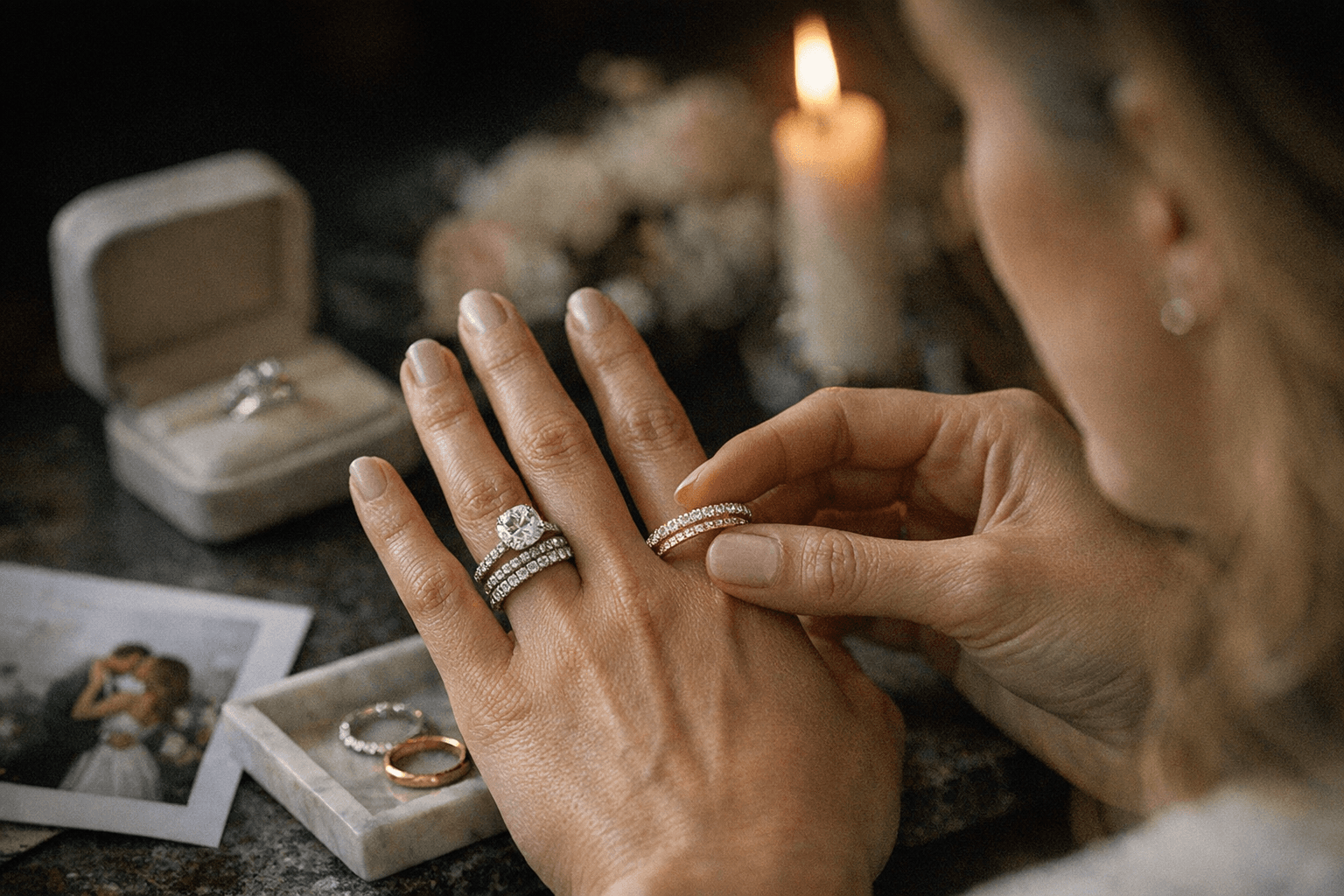
A bridal stack works best when the first ring is doing real visual labor. Choose a foundation piece with enough presence to anchor what comes next, whether that means a clean solitaire, a bezel-set stone, or a band with enough width to hold its own beside future additions. The point is not to lock yourself into a finished look on day one. It is to give yourself a center of gravity that can accept change without looking piecemeal.
That idea has deep roots in the market. JCK was writing about stackable bridal rings in 2012 and 2013, and by 2016 the publication was blunt about the category’s staying power, saying stacking rings “never really went anywhere.” The style has survived because it solves a real problem: many couples want a ring that feels personal now, but still leaves room for the relationship to evolve.
Build in layers, not all at once
The most satisfying stacks usually grow in stages. Begin with the engagement ring, then add nesting bands that sit flush or nearly flush against it, so the set feels integrated rather than appended. Over time, those bands can mark an anniversary, a move, a new chapter, or simply a change in taste. Some designers are now leaning into that logic explicitly, framing bridal rings as customizable systems meant to be added to over time.
A practical sequence for building the stack
1. Choose the foundation ring first, and let its profile guide everything else.
2. Add one nesting band that echoes the center ring’s scale and shape.
3. Introduce a second band only if it balances the first two visually.
4. Use one contrasting element, such as a different metal or texture, to keep the stack from becoming flat.
5. Reassess after each addition so the hand still reads as one composition.
The best stacks feel edited, not accumulated. They should look intentional when seen from across a room and still reward a closer look at the prongs, the edge of a band, or the way a polished surface catches light beside a matte one.
Mix metals, but keep the scale disciplined
Mixed metal stacks are having a moment because they allow personality without forcing every ring to match. JCK’s coverage of Pinterest search trends pointed to rising interest in ring stacks, unique wedding-ring stacks, and mixed-metal ring-stack wedding bands, which suggests brides are thinking less about uniformity and more about controlled contrast. The trick is to make the difference in color do the work, while the scale stays consistent.
Recent advice in wedding coverage lands on the same point: if you mix metals, keep the rings visually balanced in thickness and proportion so the stack feels deliberate. A slender yellow-gold band can sit beautifully next to a platinum center ring, but if one element is dramatically heavier than the others, the eye reads confusion instead of contrast. Balance is what makes mixed metals look curated rather than random.
Use texture as your quietest form of personality
Texture can carry a stack without adding visual clutter. A polished shank beside a milgrain edge, a satin finish beside high shine, or a band with tiny pavé stones beside a plain metal ring creates depth without overwhelming the center stone. This is especially useful if your foundation ring is already distinctive, such as a bezel setting or a vintage-inspired cut.
That direction aligns with broader bridal trends. National Jeweler’s 2025 engagement-ring coverage points to chunky bands, vintage diamond cuts, bezel settings, and bolder styling as major forces in the market. Those details matter for stacking because they change the visual weight of the ring. A bezel-set stone, for example, often reads modern and contained, so it pairs well with clean bands and strong geometry. A vintage diamond cut can tolerate more ornament, but it still benefits from one or two supporting pieces rather than a crowded frame.
Think in stack recipes, not random pairings
The easiest stacks to wear every day are the ones that solve for proportion first. A slim solitaire can take two narrow nesting bands and still look refined. A chunkier center ring may only need one slim companion to avoid feeling overbuilt. And if the main ring has strong vintage character, a plain band in a contrasting metal can calm the composition while adding dimension.
A few combinations work especially well for daily wear:
- A classic solitaire with two slender, nearly identical bands for symmetry.
- A bezel-set center stone with one polished band and one textured band for a cleaner, more architectural look.
- A bold vintage-cut ring with a single contrasting metal band to break up the silhouette without crowding it.
- A chunky band centered around a smaller stone, so the stack reads as one block of shape rather than several competing parts.
These pairings work because they respect the same principle. Each ring should know its role in the stack.
Let budget shape the timeline, not just the purchase
The bridal ring category is also changing because buyers are spending differently. The Knot’s 2024 Jewelry & Engagement Study put the average U.S. engagement-ring spend at $5,200, down from $6,000 in 2021, $5,800 in 2022, and $5,500 in 2023. That decline suggests many couples are becoming more selective, or more willing to spread purchases out over time instead of trying to buy the entire story at once.
De Beers’ bridal data points in the same direction. The company reported that 47% of brides acquired diamond jewelry for their wedding or engagement in 2022, and said that higher acquisition rate, along with a 10% increase in price per piece versus 2020, helped drive 6% bridal-market growth in 2022 versus 2020. In other words, the market is rewarding pieces that can be acquired incrementally. A stack makes that possible because it turns one purchase into a living framework for future additions.
A stack should feel like a biography, not a bundle
The most persuasive bridal stacks now read like records of milestones. One ring marks the proposal, another the first anniversary, another a major move or family chapter. That approach gives the jewelry emotional structure and avoids the trap of trying to compress every feeling into a single heroic ring. The result is less like a display case and more like a hand-written archive.
That is why stackable bridal jewelry keeps returning. It answers both style and meaning. The ring that starts the set can be beautiful on its own, but the real power lies in what it leaves room for: a band added later, a metal changed for contrast, a texture introduced for depth, and a stack that grows as the life behind it does.
This article was produced by Prism’s automated news system from verified source data, official records, and press releases, then run through automated quality and moderation checks before publishing. The system is built and supervised by the people who set the standards it runs under. Read our full AI policy.
Did this article answer your question?