Mejuri ride reflects jewelry’s shift to self-expression and self-gifting
Mejuri helped turn self-purchase into the jewelry habit of the moment, and the modern stack wardrobe is its clearest expression.

Mejuri did not invent jewelry layering, but it helped turn it into a daily habit. The brand’s rise mirrors a larger shift from gifts reserved for milestones to fine jewelry bought for self-expression, self-gifting, and repeat wear. That is why the modern stack reads less like a set and more like a wardrobe, built from pieces that can be worn together every day without losing their edge.
The new logic of the stack
McKinsey’s State of Fashion 2026 says jewelry demand is being driven by consumers seeking lasting investments and self-expression, with self-gifting rising among both men and women. The Business of Fashion says the category’s bright moment continues because more customers want lasting value and are willing to treat themselves. McKinsey’s 2021 jewelry-and-watches report had already mapped six seismic shifts shaping the sector through 2025, which makes today’s layering habit feel less like a trend cycle and more like the visible result of a longer change in buying behavior.
That change matters because layering only works when jewelry is designed to be repeatable. A necklace you wear once for an event does not build a wardrobe; a chain, a ring, or a bracelet that can return every morning does. The stack culture now taking hold is built on accumulation, not occasion, and on the idea that a piece gains character when it lives beside another.
Why Mejuri fit the moment
Mejuri was cofounded in January 2015 in Toronto by Noura Sakkijha and Majed Masad, and its mission page still says the brand has always been “fine jewelry for every day, for our damn selves.” Forbes previously described the company as a direct-to-consumer brand that “flipped the script” by eliminating traditional markup and recasting jewelry as everyday luxury. Long before self-purchase became a categorywide story, Mejuri was pushing the idea that fine jewelry could belong in ordinary life, not just in a velvet box for a special night.
That positioning was never only about price architecture. Mejuri’s own story ties the brand to transforming fine jewelry into “everyday moments” and to empowering women, which is part of why its language resonated beyond one customer base. Layering is a natural extension of that logic: if jewelry is meant to be lived in, then it should also be flexible enough to change with the wearer’s mood, schedule, and wardrobe.
The materials story reinforces the same point. Mejuri says it uses a combination of newly mined, lab grown, and recycled materials, and its sustainability materials argue that luxury and sustainability reinforce each other. That is a notable stance in fine jewelry, where the buyer is often weighing sentiment against substance. In this case, the brand is arguing that the two can sit together, and that a piece can feel responsible without losing its sense of occasion.
What the modern stack wardrobe includes
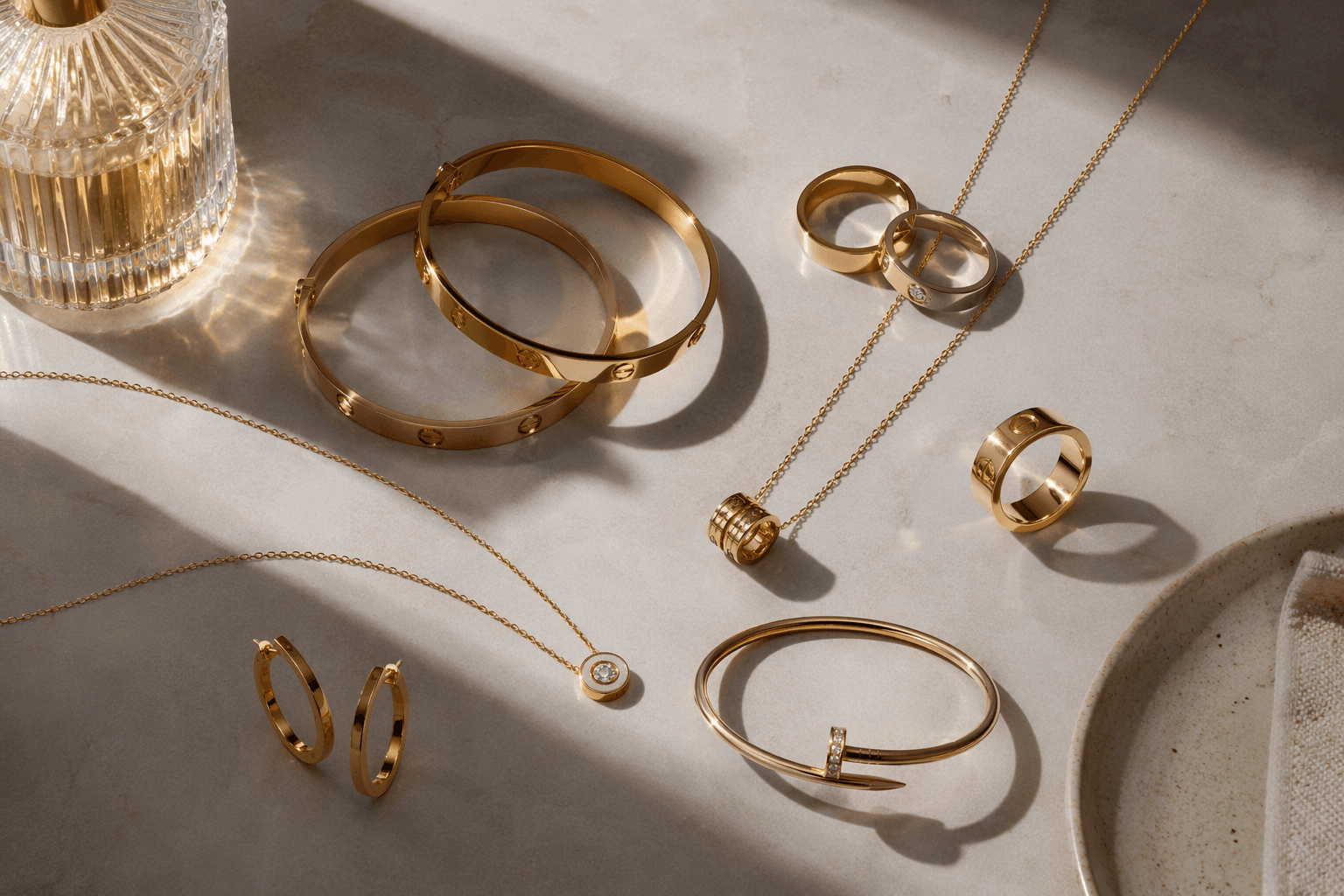
Mejuri’s current assortment now spans earrings, rings, bracelets, necklaces, charms, and tennis jewelry, and it also includes a dedicated men’s collection. That breadth tells you how far the category has moved. Jewelry layering is no longer just a necklace story, or even a women’s story. It is a full-body system of repeatable pieces, organized around how they sit on the ear, hand, wrist, and collarbone.
A strong starter stack tends to begin with a quiet base and then add contrast. In practice, that means one piece that reads cleanly on its own, another that adds texture or scale, and a third that introduces shine, movement, or sentiment. Mejuri’s spread across charms and tennis jewelry shows how the language of layering has widened, from minimal everyday basics to pieces that can add sparkle without abandoning the daily brief.
The most convincing stacks are rarely the most crowded. They usually depend on proportion, metal consistency, and a sense that each piece earns its place alone before it joins the rest. That is where the craft detail matters: a slender chain behaves differently from a heavier one, a ring with a low profile wears differently from a taller setting, and a bracelet with visual weight changes the balance of a wrist stack. Layering succeeds when those differences are intentional.
From growth metric to cultural signal
The scale of Mejuri’s growth shows how thoroughly the self-purchase mindset has spread. Forbes said in 2022 that the company had sold 3 million pieces since inception and was planning 22 brick-and-mortar stores by December of that year. By November 2025, Forbes said Mejuri had 56 retail locations, had marked its 10th anniversary, added new Middle East outposts, and expanded through Nordstrom shop-in-shop placements.
That retail footprint matters because jewelry is tactile. The difference between polished and brushed metal, between a fine chain and a more substantial one, or between a ring that stacks flush and one that does not is easier to understand in person than on a screen. In that sense, the store network is not just a sales channel. It is part of how the stack wardrobe gets built, one try-on at a time.
Mejuri’s significance now lies in how ordinary the behavior it helped normalize has become. Jewelry is increasingly bought to express taste, mark self-regard, and accumulate over time, piece by piece. That is the real story behind the modern stack: not a single statement purchase, but a way of dressing that treats fine jewelry as part of daily identity.
This article was produced by Prism’s automated news system from verified source data, official records, and press releases, then run through automated quality and moderation checks before publishing. The system is built and supervised by the people who set the standards it runs under. Read our full AI policy.
Did this article answer your question?