Tiffany’s Blue Book summer chapter layers platinum, gold and gemstones
Tiffany’s summer Blue Book points to the season’s next layering code: rope textures, two-tone metal, and saturated gemstone strands with real high-jewelry pedigree.
Tiffany’s Blue Book summer chapter reads less like a jewel box fantasy and more like a forecast. The clearest signals are the ones that will travel: rope-like texture, mixed yellow gold and platinum, and gemstone strands that feel fluid instead of rigid. In other words, the house is not just showing wealth, it is sketching the layered-necklace language that will shape the season.
Hidden Garden sets the pace
Blue Book 2026: Hidden Garden is Tiffany & Co.’s newest high-jewelry collection, designed by Nathalie Verdeille, the brand’s senior vice president and chief artistic officer, with the Tiffany Design Studio. The collection is built around nature, light, movement and transformation, and Tiffany frames it as a journey into nature’s secret world, an invitation into an enchanted landscape where blossoms open and wings take flight.
The rollout itself is part of the message. WWD reported that the collection is unfolding in three phases, spring, summer and fall, with a total of 122 pieces. The spring expression debuted on April 16, 2026, and the summer chapter was unveiled on Monday evening, June 1, in New York City, with a private gala at the Park Avenue Armory and additional events at The Landmark. That home-base staging matters: Tiffany is presenting high jewelry not as a distant museum object, but as a living seasonal statement from the center of its own universe.
Schlumberger’s vocabulary, rewritten for now
The collection’s deeper anchor is Jean Schlumberger, who joined Tiffany in 1956 and became one of the most influential jewelry designers of the 20th century. Tiffany says Hidden Garden reinterprets his iconic flora-and-fauna motifs, and that is where the collection starts to feel less like archival homage and more like a design brief for the present.
Schlumberger’s legacy was always about making the natural world uncanny, turning feathers, leaves, blossoms and creatures into jewelry with sculptural tension. Hidden Garden continues that instinct, but with a softer, more wearable emphasis on movement. Tiffany says the theme and color story came first, with stones selected to answer the narrative. That matters, because it signals a collection led by design intent rather than gem inventory, a subtler and more disciplined approach than the usual stone-first luxury playbook.
Anthony Ledru put the house’s position bluntly: “Exceptional stones are part of our legacy, more than perhaps any other jewelry brand in the world.” The line sounds like brand confidence, but it also explains why Tiffany can use rare materials as part of a larger visual argument instead of treating them as isolated trophies.
The motifs most likely to filter into everyday layering
The summer chapter adds new stories named Paradise Bird, Daisy, Raffia, Blossom and Petals. Not every one of those ideas will translate directly into mainstream layering, but several are already legible as retail cues. The strongest trend signal is not the exact form, but the way the pieces balance texture, color and motion.
Rope-like texture and raffia
Raffia is the most obviously transferable motif. Galerie Magazine noted that Verdeille described raffia-inspired elements as “supple, geometric, luminous structures,” and that phrase captures exactly why this works for layering: it brings visual structure without stiffness. Tiffany’s Raffia story uses the house’s legacy sugarloaf tanzanite with rubies and diamond accents, a combination that gives the look weight, color and a tactile finish.
Expect that language to surface in flatter, more wearable ways first: twisted chains, woven links, and necklaces that read almost like textile translated into metal. In a market full of delicate strands, anything that suggests braid, coil or rope will feel current because it adds dimension without requiring a large pendant.
Mixed yellow gold and platinum
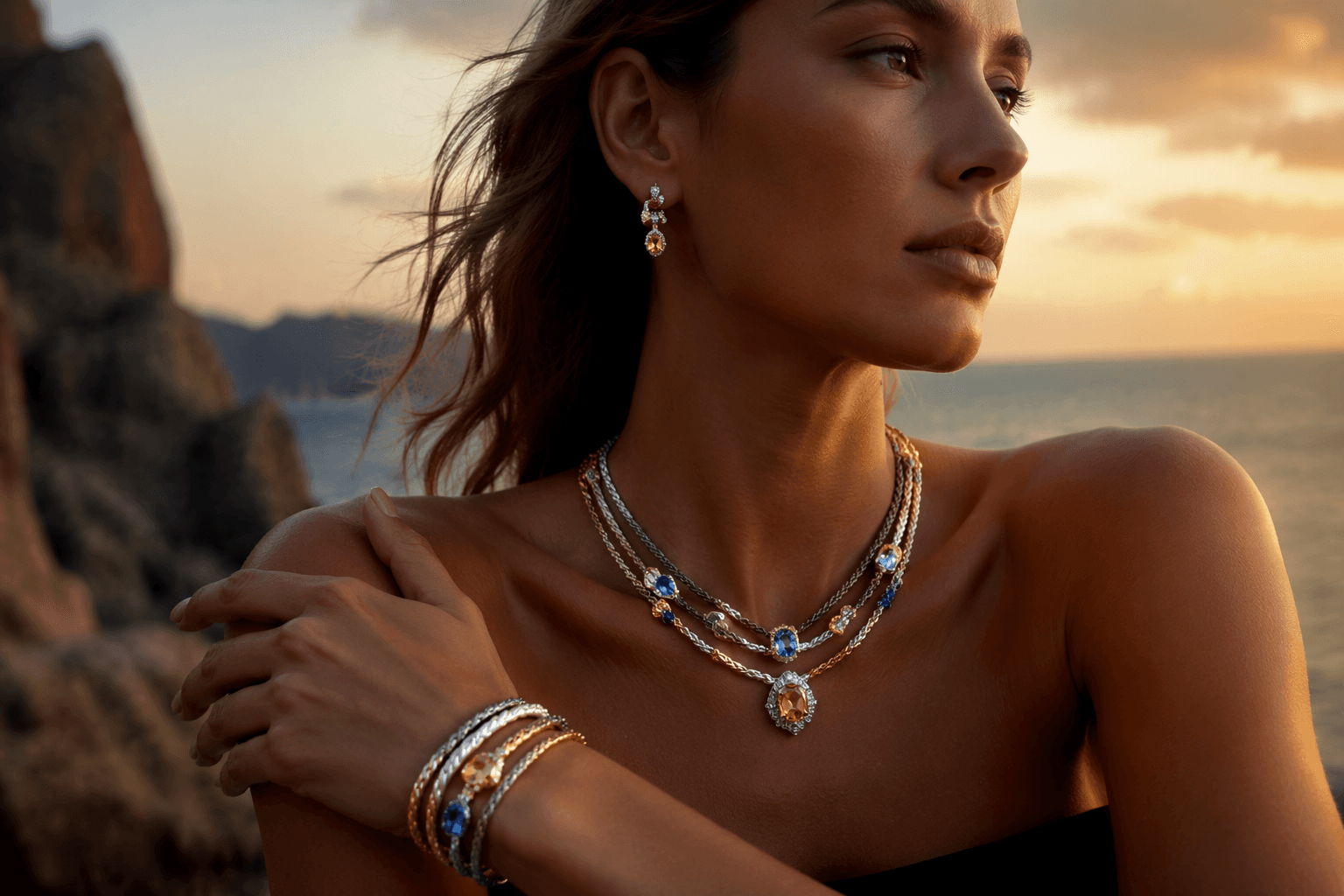
The summer chapter also leans into contrast. Galerie Magazine reported that Verdeille described birds made of yellow gold, diamonds and platinum, and that mix is one of the clearest styling cues in the collection. Yellow gold brings warmth and visibility; platinum cools the line down and sharpens the silhouette. Together, they make layering feel deliberate rather than matchy.
That is precisely the direction mainstream necklaces are moving in now. A single-metal stack can look tidy, but mixed metals create friction, and friction reads as fashion. The high-jewelry version will be grand and sculptural, but the retail translation is easy to see: two-tone chains, a platinum pendant sitting against a yellow-gold collar, and layers that are meant to clash a little.
Saturated gemstone strands
If metal is the structure, color is the pulse. Paradise Bird includes American chrysocolla, Namibian purple calcedony and Nigerian spessartine, a palette that gives the summer chapter depth far beyond traditional diamond-led layering. The stones are named with geographical specificity, which is part of their appeal: the fantasy feels grounded in actual places and actual materials.
That is also where the next wave of layered necklaces is headed. Instead of one precious center stone surrounded by filler chains, expect more color-first pieces, especially cabochon strands, bead-like links and pendants that read as gemstones first and jewelry second. For collectors, this is the most interesting shift because it restores color to a role that diamond minimalism has dominated for years.
Birds and blossoms, reduced to silhouette
The bird, blossom and butterfly motifs are less likely to appear literally in everyday layers, but they will shape the outline of what feels desirable. Tiffany says Hidden Garden captures an imagined garden where blossoms unfurl and wings take flight, and that language points to jewelry that looks animated even when it is still. The appeal is not novelty for its own sake; it is the sense that a necklace can hold motion in its construction.
In the market, that often becomes a subtler language: a curved clasp, a feathered terminal, a pendant with soft asymmetry, or a station necklace that breaks rhythm just enough to feel alive. The high-jewelry versions may be museum-scale, but the styling idea is portable.
What makes the story matter beyond the runway
The real strength of Hidden Garden is that it ties Tiffany’s heritage to a very current appetite for layered jewelry that looks intentional, tactile and slightly untamed. The collection is not about piling on more; it is about building depth through texture, using stones with character, and letting mixed metals and sculptural forms do the work.
For readers watching where the season goes next, the takeaway is clear: the most influential layered necklaces will not simply repeat Tiffany’s high-jewelry motifs. They will absorb their logic, favoring rope-like construction, two-tone metal, and gemstone color stories that feel drawn from a garden rather than a formula. That is where luxury tends to become a trend, and where the most persuasive jewelry stories begin.
This article was produced by Prism’s automated news system from verified source data, official records, and press releases, then run through automated quality and moderation checks before publishing. The system is built and supervised by the people who set the standards it runs under. Read our full AI policy.
Know something we missed? Have a correction or additional information?
Submit a Tip