Tomfoolery London showcases alternative engagement rings for personalized bridal style
Tomfoolery’s Love Ring turns bridal jewelry into layers of color, texture, and meaning, with buyers spending around £5,000 on pieces that feel personal.
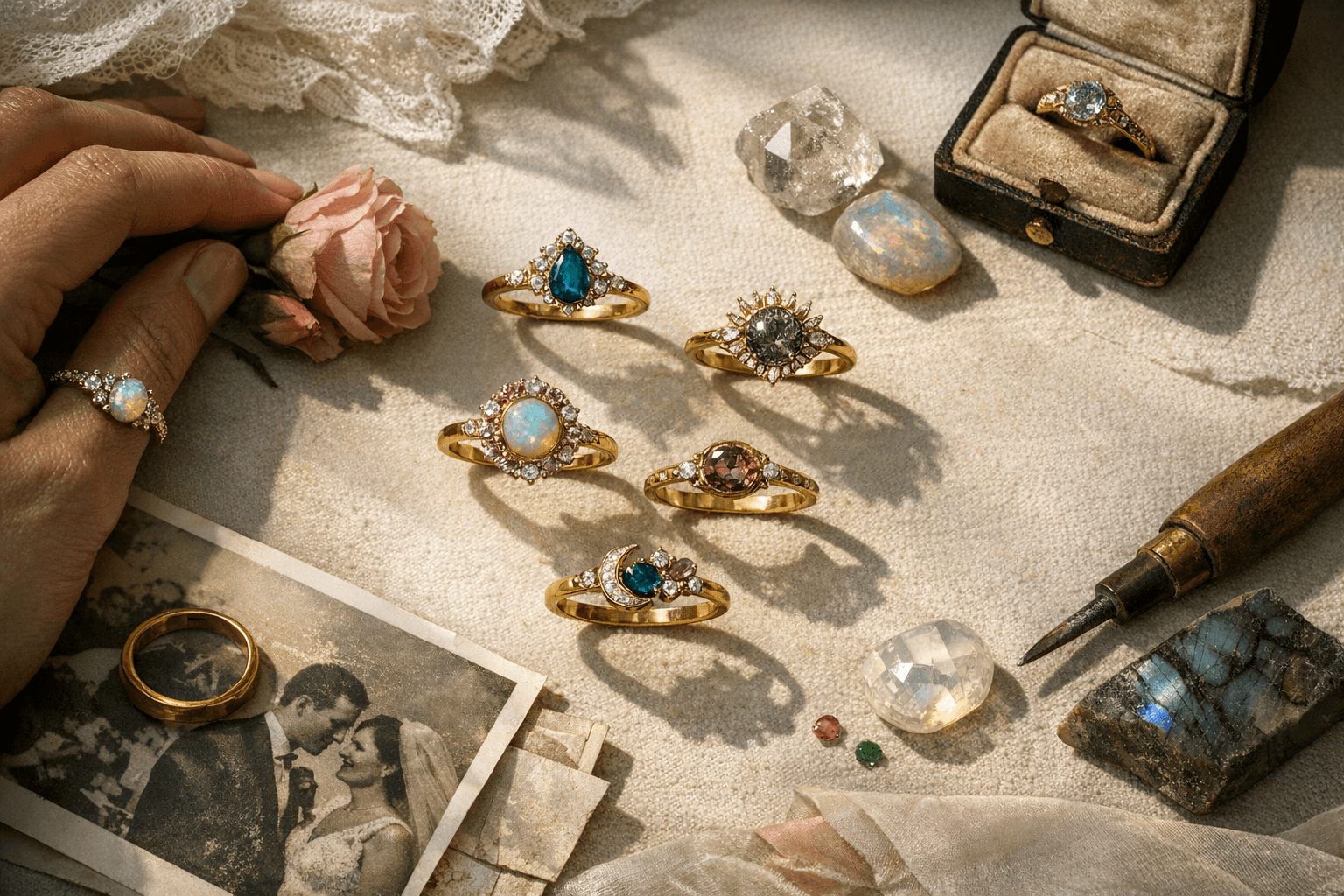
An engagement ring no longer has to carry the whole bridal story alone. At Tomfoolery London’s Love Ring, the strongest proposal for 2026 is a layered one: a sculptural center ring, a curved band that sits close beside it, and, if the wearer wants, a second or third ring that adds texture, color, or a family memory. Laura Kay says the market has become “a distinctly sentimental moment for consumers,” and that sentiment is visible in the spend, with customers comfortable investing around the £5,000 mark on average and going higher when a piece feels significant.
The new bridal brief is personal, not standardized
Love Ring runs from April 18 to July 4 at Tomfoolery’s Muswell Hill gallery, and the edit is built around a clear shift in taste: pieces are being chosen less for tradition than for what they represent. Tomfoolery frames the showcase as a collection of alternative engagement and wedding jewellery that moves beyond expectation, emphasizing originality, thoughtful craftsmanship, and the idea of a modern heirloom. That makes the category feel less like a single purchase and more like the beginning of a hand-built composition.
The range is deliberately broad, stretching from engagement rings to wedding bands and even men’s wedding rings, which matters because the bridal look is no longer being designed from one fixed template. Instead, the annual showcase gathers independent designers whose work spans organic forms, coloured gemstones, delicate details, and rustic textured bands alongside more classic silhouettes. The result is a collection that treats commitment as a design language, not a uniform.
What Love Ring 2026 is showing
The visual grammar of the 2026 edit is easy to read. Tomfoolery groups the selection into categories such as organic forms, coloured gemstones, delicate details, and wedding bands, and those themes show up in the individual pieces: the Eyes Wide Open ring comes in 9k yellow gold with a 2.37 ct sapphire, a 1.91 ct purple sapphire, an 0.8 ct orange sapphire and an 0.08 ct green sapphire, while Alice Clarke’s Catkin Crescent Cascade ring uses 18k yellow gold and 0.46 ct total weight diamonds. Alison Macleod’s Blodyn y Mor ring pairs 14k yellow gold with a 1.05 ct green sapphire and 0.65 ct total weight old-cut diamonds, and Annie Fensterstock’s Sunburst ring sets a 0.39 ct rose-cut yellow-orange sapphire in 9k yellow gold with diamond accents.
That material mix is the story in miniature. There are lab-grown and natural stones, old-cut diamonds and black-and-white diamond combinations, high-shine yellow gold and rose gold, and ring shapes that read as architectural rather than purely traditional. Leto Lama’s marquise wrap ring, set east-west in 9k yellow gold with a 1.44 ct lab-grown diamond, and Diamonds by TF’s Turned Out tiara ring in 14k yellow gold with 0.6 ct total weight black and white diamonds, both show how bridal jewelry can carry presence without relying on a single classic solitaire.
The price spread is just as telling. The edit begins at £1,575 for Annie Fensterstock’s Sunburst ring and rises to £8,865 for the Eyes Wide Open ring, with plenty of ground in between, including Momocreatura’s Hearts bubble band at £3,250, Karen Karch’s Treasures ring at £4,600, and Alice Clarke’s Catkin Crescent Cascade at £6,390. That range supports Tomfoolery’s point that flexibility across price points is now essential, because bridal buyers are not all shopping for the same emotional or aesthetic outcome.
How to build a layered bridal look that still feels refined
The cleanest way to translate this showcase into a real wardrobe is to start with one ring that can anchor the hand, then build around its silhouette. An east-west marquise, a crescent, or a tiara-like profile already gives the eye a direction, so the second ring should support that shape rather than flatten it. Tomfoolery’s own wedding band selection includes curved bands, rustic textured designs, and timeless romantic classics, which suggests a useful formula: let the band follow the engagement ring, then let the third element add contrast rather than competition.
Color is the easiest way to make the stack feel personal. The showcase runs from rainbow-hued and pastel gemstones to green sapphires, yellow-orange sapphires, fancy yellow diamonds, old-cut diamonds, and black-and-white diamond pairings, so a wearer can echo one tone across multiple rings instead of matching every surface exactly. That is where a family heirloom or a pre-existing everyday band can enter the picture: repeat the metal, repeat the stone color, or repeat the texture, and the stack begins to read as intentional rather than assembled.
The most convincing bridal layers also respect scale. A highly detailed ring, such as the Sunburst or a textured organic form, needs breathing room next to the hand, while a slim curved band can tuck in and preserve the architecture of the centerpiece. The broader point of Love Ring is that the modern bride, or any wearer marking commitment, is no longer expected to choose between symbolism and style. The pieces on view show that the two are strongest when they are allowed to coexist in layers, each one carrying part of the story.
This article was produced by Prism’s automated news system from verified source data, official records, and press releases, then run through automated quality and moderation checks before publishing. The system is built and supervised by the people who set the standards it runs under. Read our full AI policy.
Did this article answer your question?