Trapeze-cut diamonds take center stage in sculptural new jewelry
Trapeze-cut diamonds are moving from side-stone status to the center of layered jewelry, where their angular geometry sharpens necklaces, rings, and earrings.

Trapeze-cut diamonds are having a moment because they do something rounds and ovals cannot: they break the line. In Kavant & Sharart’s Mingle Trapeze collection, the shape is not a trim detail but the point of the piece, turning necklaces, rings, and earrings into sculptural interruptions that make a stack look more deliberate.
Why the trapeze cut reads so directional
The word trapeze is a nickname for diamonds shaped like trapezoids, four-sided forms with at least one pair of parallel sides. GIA makes a useful distinction here: cut refers to how a diamond’s facets interact with light, while shape refers to the stone’s outline. That distinction matters because a trapeze stone can read as architectural in outline while still being executed with different facet styles, from traditional step cuts to more modern brilliant cuts.
For years, trapezoid and trapeze stones were most often tucked into the role of side stones. That history is part of what makes their current appearance so fresh. When a shape that usually supports a center stone steps into the spotlight, it changes the visual rhythm of the whole jewel, especially in layered looks where one angular form can reset a run of soft curves.
Kavant & Sharart puts the shape in the lead
The Mingle Trapeze line comes from Kavant & Sharart, the Bangkok- and Singapore-based Thai fine jewelry house founded by Nuttapon Yongkiettakul and Shar-Linn Liew. The brand describes itself as an award-winning Thai fine jewelry brand and says its work blends engineering and design with a focus on high-quality diamonds and colored gemstones. That background explains why the trapeze cut feels like a natural fit rather than a novelty gimmick.
The designers have said the shape feels “architectural yet fluid,” and that they wanted trapeze diamonds to become the “hero” of the design. That idea runs through the collection’s earrings, necklaces, rings, and stud styles, where the geometry is clean enough to feel modern but animated enough to move with the body. The Mingle collection was built to layer, complement, and evolve rather than sit in isolation, so a trapeze stone used as a centerpiece fits the brand’s core language rather than fighting it.
The reveal also landed at Las Vegas Jewelry Week, which ran from May 29 to June 1, 2026 at The Venetian Expo in Las Vegas. That timing matters because the trade show has become a stage for unconventional diamond shapes, and this season’s energy favored designs that elevated once-secondary stones into statement elements.
The materials and price points behind the polish
The Mingle Trapeze collection uses 18k gold and natural diamonds, a combination that keeps the work firmly in fine-jewelry territory. One standout is the Mingle Trapeze Duo 7 Diamond necklace in 18k yellow gold with 2.01 carats total weight of diamonds, priced at $24,800. Another is the Mingle Trapeze Arch Diamond Hanging earrings in 18k yellow gold with 1.51 carats total weight of diamonds, priced at $16,000.
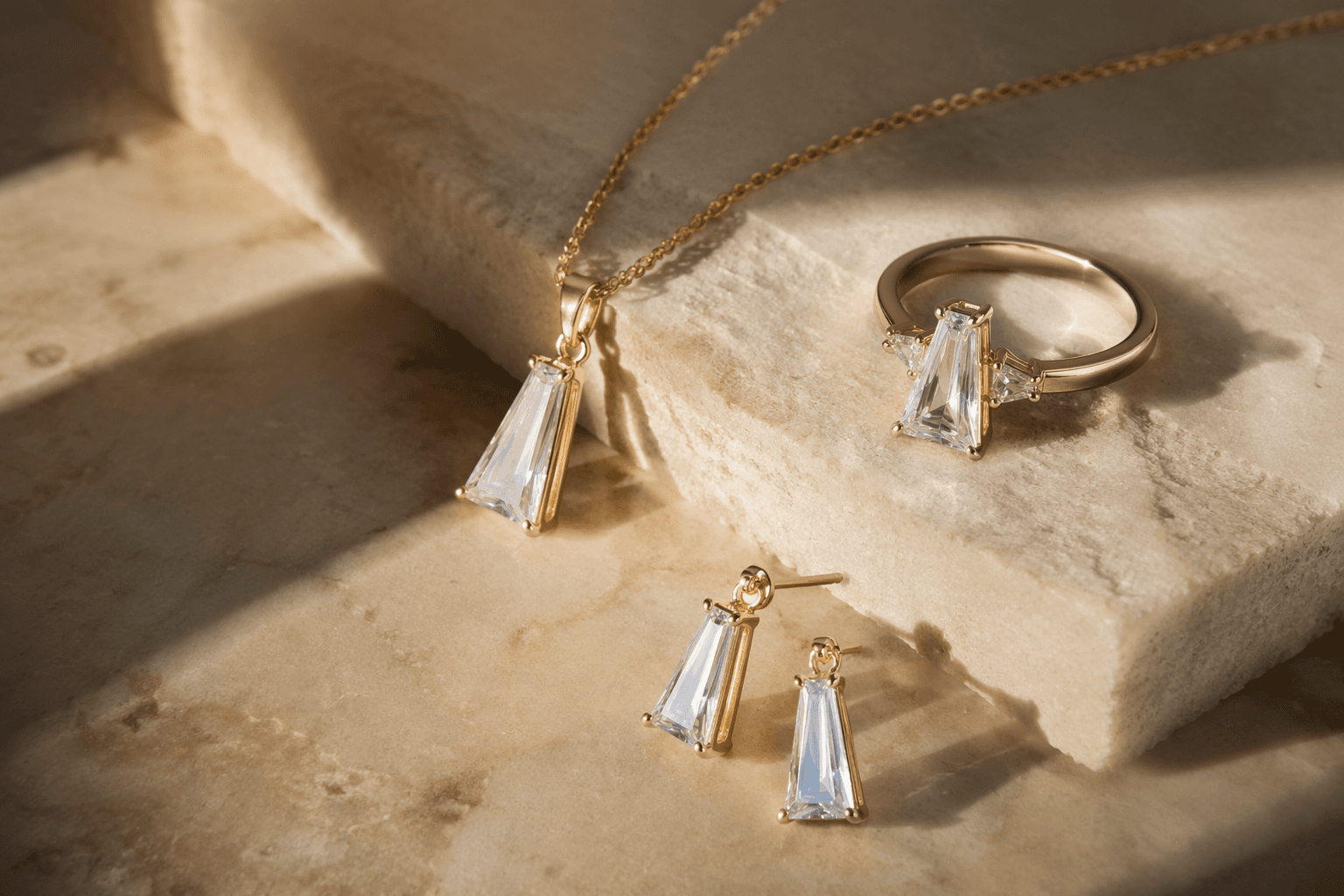
The brand’s own listings widen the picture. The Mingle Trapeze Edge Diamond Bracelet is priced at $9,900, the Mingle Trapeze Edge Diamond Necklace at $15,900, the Mingle Trapeze 7 Diamond Earrings at $15,260, and the Mingle Trapeze 15 Diamond Necklace at $19,000. Those figures place the line in the upper tier of contemporary fine jewelry, where price is driven not only by carat weight but by gold content, design complexity, and the decision to use a rare shape as the visual engine.
How to layer a trapeze cut without making it feel precious or fussy
The easiest way to wear trapeze-cut diamonds is to let them interrupt something softer. In a necklace stack, that means placing the angular piece amid round, oval, or gently curved forms so the eye has a hard edge to land on. In a ring stack, the trapeze stone works best when it sits against slim bands or more restrained silhouettes, so the shape can stay readable instead of getting lost in a crowded hand.
A few styling rules make the cut feel modern rather than niche:
- Choose 18k yellow gold when you want the geometry to feel warm and wearable, not icy or severe.
- Keep companion stones simple so the trapeze remains the visual pause, not one more busy element in the stack.
- Use one trapeze piece per composition when possible, especially in ear stacks, so the angle reads as intentional.
- Let round and oval stones flank the trapeze cut rather than compete with it, which makes the contrast feel graphic and clean.
This is where the collection’s sculptural language becomes useful. Earrings like the Arch Diamond Hanging style bring movement to the jawline, while necklace pieces such as the Duo 7 Diamond design create a directional line at the collarbone. The result is less about matching and more about choreography: one angular stone can make the rest of the stack look sharpened and considered.
Why the shape feels contemporary now
Part of the appeal is that the trapeze cut has the right amount of rarity. It is uncommon enough to feel inside-the-know, yet familiar enough to be legible the moment it appears beside more common silhouettes such as pears, cushions, emeralds, and ovals. That balance is exactly what layered jewelry needs right now, because the strongest stacks usually rely on one piece that changes the pace without overpowering the rest.
JCK’s broader Las Vegas Jewelry Week coverage showed that unconventional diamond shapes were one of the season’s clearest signals, especially when designers treated side-stone profiles as the main event. Kavant & Sharart’s trapeze pieces make that shift concrete: a shape once meant to support another stone is now carrying the composition, and that change gives necklaces, rings, and earrings a sharper, more directional finish.
This article was produced by Prism’s automated news system from verified source data, official records, and press releases, then run through automated quality and moderation checks before publishing. The system is built and supervised by the people who set the standards it runs under. Read our full AI policy.
Did this article answer your question?