Van Cleef & Arpels channels Egypt in Fascinating Egypt high jewelry
Van Cleef & Arpels turns Egyptomania into a layering cue, where black-and-gold contrasts and sacred motifs invite more story-driven stacks.
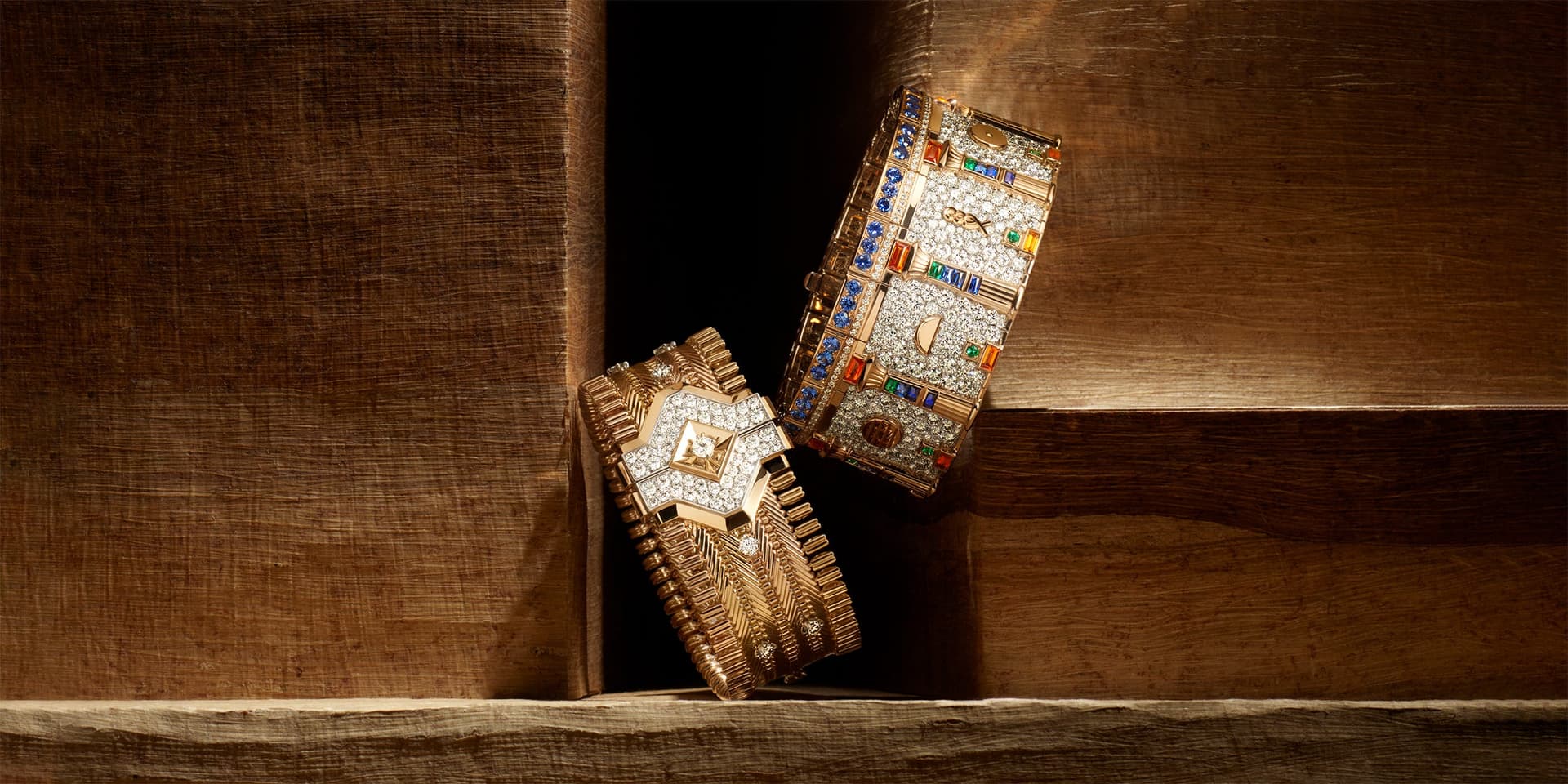
Van Cleef & Arpels is making a persuasive case that the next chapter of jewelry layering may belong to symbols, not slogans. With Fascinating Egypt, the maison returns to the visual language of pharaohs, papyrus, and Nile-side ritual, translating it into high jewelry that feels surprisingly relevant to a market tired of generic chains and interchangeable charms. The result is not museum-piece theater so much as a reminder that layered jewelry can carry narrative, contrast, and conviction.
Egyptomania returns as a styling language
Egypt-inspired jewelry has never been a static category. It tends to surge when culture is looking backward for visual authority, and the pattern is long established: the early 19th-century Egyptian Revival followed Napoleon’s Egypt campaign and the publication of Description de l’Égypte, another wave followed Verdi’s Aida in 1871, and a spectacular Art Deco revival took hold after Tutankhamun’s tomb was discovered in November 1922. Each moment transformed ancient forms into contemporary adornment, from pyramids and sphinxes to pharaohs, rendered in materials such as diamond, onyx, turquoise, and carnelian.
That history matters now because layering itself has changed. The most compelling stacks are no longer simply accumulations of gold links or dainty pendants, but compositions with point of view. Egyptian revival motifs, with their stark geometry and strong silhouettes, are tailor-made for that shift: they bring shape, symbolism, and a sense of hierarchy to a wrist, neck, or hand that might otherwise feel decorative but anonymous.
What Van Cleef & Arpels is really doing with Fascinating Egypt
The maison’s own relationship with Egypt goes back to 1923 to 1925, when it created Egyptian-inspired pieces in response to the worldwide fascination sparked by Howard Carter’s 1922 discovery of Tutankhamun’s tomb. Those earlier jewels used contemporary Art Deco codes, including geometric lines, repeated patterns, and stark contrasts, which is exactly why they still read as modern rather than merely historical. Van Cleef & Arpels understood early that Egypt could be filtered through structure as much as symbolism.
Fascinating Egypt extends that idea across nearly 180 creations, including profile figures, sacred animals, papyrus flowers, lotus blooms, and scenes from daily life along the Nile. A standout is the Paysage Merveilleux bracelet, a one-of-a-kind piece in yellow and white gold, sapphires, and black spinels. The house’s official term for these storytelling bracelets is Paysage, a useful clue to how the collection should be read: not as isolated ornaments, but as miniature landscapes built in precious materials.
Why black and gold feels especially current
Among the collection’s strongest visual ideas is the tension between black and gold. Yellow gold has been moving back to the forefront of serious jewelry, and here it gains even more force when set against black spinels and the cooler flash of white gold. That contrast sharpens the motifs rather than softening them, giving the pieces the crisp graphic edge that makes them legible in a stack.
This is where the collection becomes interesting beyond the high-jewelry set. Black-and-gold combinations can anchor a layered look the way a strong blazer grounds an outfit: they create a visual center. In practice, that means motif-heavy jewelry no longer has to compete with everything around it. A scarab-inspired pendant, a lotus-shaped ring, or a geometric cuff can coexist when the palette is disciplined and the contrast is deliberate.

Archival references are the new luxury shorthand
One of the collection’s necklace designs is inspired by a 1929 Van Cleef & Arpels masterpiece once owned by Princess Faiza of Egypt, and that reference tells you a great deal about the maison’s strategy. Archival jewelry is no longer simply about reproduction or nostalgia. It is about provenance, royal association, and the authority that comes from proving a design has already lived more than one life.
That logic is increasingly visible in how collectors think about layering too. Pieces with a story tend to layer better than pieces without one, because they create internal conversation: one jewel can echo another, or answer it, or deliberately interrupt it. A princess-owned archive reference beside a sacred animal motif beside a Nile scene offers the kind of layered narration that makes a stack feel curated rather than assembled.
From the museum to the jewelry box
Van Cleef & Arpels is also marking broader heritage milestones in 2026, including exhibitions tied to its Art Deco centennial. The house won a grand prize at the 1925 International Exhibition of Modern Decorative and Industrial Arts in Paris, and that history still radiates through its work with symmetrical forms, bold contrasts, and polished surfaces. A Tokyo exhibition featuring 250 pieces ran through January 18, 2026, underscoring how seriously the maison continues to stage its own legacy.
That institutional backdrop helps explain why Fascinating Egypt feels larger than a seasonal collection. It arrives alongside the opening of Cairo’s Grand Egyptian Museum, where the contents of Tutankhamun’s tomb can be seen in full for the first time, and it lands in a market where Egyptian Revival jewelry can command record prices at auction. In other words, this is not a niche historical flourish. It is part of a broader cycle in which ancient symbolism returns whenever luxury wants more depth than decoration.
What the revival means for layering now
The lesson for jewelry layering is clear: the strongest stacks will be built around motif, contrast, and narrative, not just volume. Egyptian-inspired pieces bring exactly that, whether through pharaoh-era references, sacred animals, or the clean geometry that Art Deco made so persuasive a century ago. A black-and-gold bracelet, a symbolic pendant, and a sculptural ring can work together when each one contributes a different chapter to the same visual story.
That is why Fascinating Egypt matters beyond the bounds of a single high-jewelry debut. It suggests that the most compelling layers ahead will not be the quietest or the most minimal, but the most intentional, the ones that let history, iconography, and craftsmanship speak at once. In that sense, Van Cleef & Arpels is not just revisiting Egypt; it is helping make the case for a richer, more narrative form of stacking.
This article was produced by Prism’s automated news system from verified source data, official records, and press releases, then run through automated quality and moderation checks before publishing. The system is built and supervised by the people who set the standards it runs under. Read our full AI policy.
Did this article answer your question?