Art Jewelry Forum Curates Studio Pieces Rich in Cultural and Conceptual Meaning
AJF's "On Offer" showcases studio pieces from Peter Bauhuis, Carina Shoshtary, and Melanie Isverding that treat material itself as cultural argument.
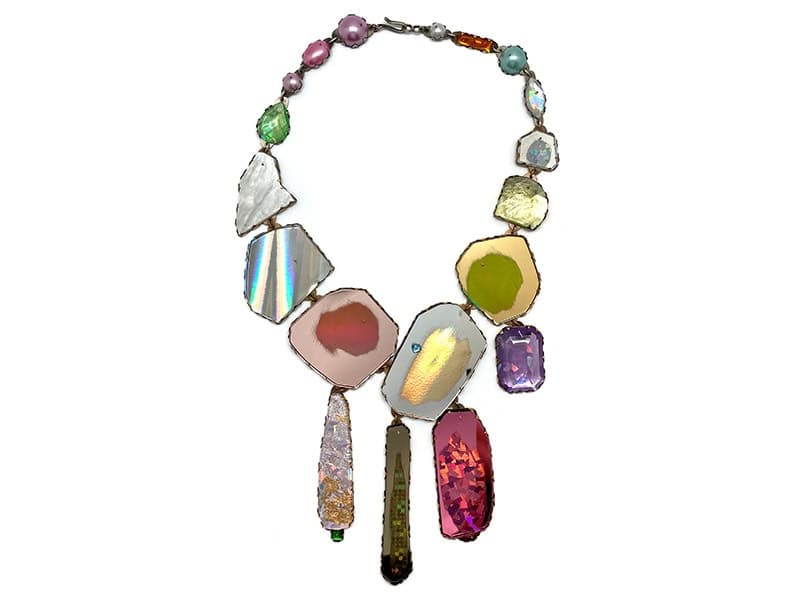
The pieces that carry the most weight are rarely the ones with the highest carat count. In studio art jewelry, the conversation has long moved past gemstone economics toward something harder to appraise: the cultural freight a piece carries, the material choices that encode a philosophy, the specific hand responsible for every millimeter of form.
Art Jewelry Forum's bi-monthly "On Offer" series sits squarely at the center of that conversation. The April 2026 installment, curated from member galleries across the world, includes a tumbaga ring that references pre-Columbian mythology, a pair of bio-plastic earrings built by hand without a single 3D printer, and a brooch whose crushed hematite interior challenges the entire premise of gemstone-driven value. Taken together, these works surface three unmistakable motifs running through contemporary studio practice: mythological form-making, material ethics rooted in ecological sourcing, and a deliberate reassignment of what makes a stone worth wearing.
Peter Bauhuis works in tumbaga, an ancient alloy of gold and copper used by pre-Columbian cultures across South America long before Europe imposed its own precious-metal hierarchies. His ring "Pareidolia," featured in the April installment, belongs to a series named for the psychological phenomenon of perceiving faces or recognizable forms in inanimate matter. The surface of the ring holds the viewer in that threshold between recognition and abstraction, which is precisely where Bauhuis intends it to sit. The material choice is inseparable from the concept: tumbaga predates the European gold market by centuries and was historically valued for ceremonial significance rather than assay purity. Bauhuis, whose work is held in the permanent collections of the Victoria and Albert Museum in London and the Schmuckmuseum in Pforzheim, received the Bavarian State Award in 2011 and the grand prize at the 17th Silver Triennial in Hanau in 2013. "Pareidolia" arrives on the market carrying all of that institutional credibility and none of the conventional precious-metal logic.
The sustainability thread in the April curation runs through Carina Shoshtary's "For When We Flourish (Red)," a pair of 2026 earrings shown through Heidi Lowe Gallery in the United States. Shoshtary constructs her pieces from PLA (polylactic acid), a biopolymer derived from renewable sources including corn and rice starch, combined here with vintage elements and recycled silver. The pieces are entirely handmade with a 3D pen, not printed, a distinction that matters both technically and philosophically: the human hand remains at every stage of construction, giving the work a specificity that additive manufacturing cannot replicate. Shoshtary studied under Otto Künzli at the Academy of Fine Arts in Munich and received the Bavarian State Prize for Emerging Designers in 2012. Her work is held in the permanent collections of the Röhsska Museum in Gothenburg and the Design Museum in Munich. PLA also comes with conditions: pieces require storage away from heat and should not be kept in direct sunlight, a first reminder that studio art jewelry operates by different rules than conventional fine jewelry.
The third thread is the most philosophically pointed. Melanie Isverding's "Cavea (46)," a brooch made in 2016 from silver, enamel, crushed hematite, pearls and lacquer, challenges the premise of gemstone-driven value at its foundation. Isverding, who won the Danner Award in Munich in 2017, the European Prize for Applied Arts in 2018, the Bavarian State Prize in 2019, and the Herbert Hofmann Prize in 2020, built the Cavea series around a single reframing: what happens when you treat a stone not as a commodity but as a cultural witness? "Cavea comes from the Latin word for cage, but it can also refer to a theater stage," she told Art Jewelry Forum. "The cages, or the inside rooms, are filled with crushed stones, minerals, and pearls. I wanted to bring the materials back to their roots: They were connected to stones, they came from the mountains and from deep down in the earth." Crushed hematite carries no resale market; it cannot be certified or appraised. It records geology and intention, which, in Isverding's framework, is the only relevant measure. Her work is in the collections of the Cooper-Hewitt Smithsonian Design Museum in New York, Die Neue Sammlung in Munich, and the CODA Museum in Apeldoorn.
Buying one-of-a-kind studio jewelry through a gallery's online listing requires more active due diligence than a conventional retail purchase, and "On Offer" is no exception. Scale photographs are the first thing to request if they are not already included. Art jewelry frequently photographs larger than it actually is; a brooch that fills a frame can measure four centimeters across in person, and the difference changes how and whether you will wear it. Ask the gallery for a photograph of the piece worn on a body before purchasing.
Materials disclosure is the second checkpoint. For pieces involving non-traditional materials, PLA bio-plastic chief among them, full care instructions should accompany any sale. Ask specifically about storage conditions, heat tolerance, and what happens if a component fails. Galleries representing studio artists of Shoshtary's caliber expect these questions and can generally connect buyers directly with the artist.
On returns and commissions: most galleries participating in "On Offer" operate on a gallery-commission basis, representing the artist and managing logistics, insurance, and condition. Return policies vary considerably. Some accept returns within a defined window if the piece arrives as described; others, particularly for one-of-a-kind works, treat sales as final. Clarify the return policy before purchasing, especially for pieces shipped internationally, where customs declarations and import duties complicate any reversal.
The single most useful question to ask before committing: "Has the artist confirmed this piece is currently in stock and has not been shown or worn in an exhibition context since the photographs were taken?" Art jewelry loaned to exhibitions sometimes returns with minor wear, surface shifts, or handling marks not visible in original photographs. A direct answer tells you both the condition of the piece and the gallery's attentiveness to its inventory.
Art Jewelry Forum's "On Offer" publishes twice monthly, listing each piece with retail price and direct gallery contact. The April 2026 installment reflects a moment when studio jewelers are drawing more deliberately on material history, ecological sourcing, and conceptual frameworks borrowed from sculpture and philosophy. Isverding's crushed hematite, Shoshtary's corn-derived biopolymer, Bauhuis's pre-Columbian alloy: these are not aesthetic accident. They are arguments about what jewelry is for, made one piece at a time.
This article was produced by Prism’s automated news system from verified source data, official records, and press releases, then run through automated quality and moderation checks before publishing. The system is built and supervised by the people who set the standards it runs under. Read our full AI policy.
Did this article answer your question?