Jacob Arabov on Why the Jewelry Industry Needed a New Diamond Cut
The Angel cut's 37 facets, one for each year of Jacob Arabov's marriage, solve the light-extinction problem that has long plagued rectangular diamonds.
The problem with rectangular diamonds has always been a quiet one. An emerald-cut stone can look immaculate in a jeweler's loupe under controlled lighting, but move it to a candlelit table and dark patches bloom across the table. Brilliant cuts reduce extinction by scattering light from every angle, but apply that geometry to a rectangular outline and the stone reads busy rather than refined. Buyers have been choosing between these two imperfect options for decades.
Jacob Arabov, founder and chairman of Jacob & Co., decided that tension was worth two years of work to resolve. The result is the Angel cut: a patented 37-facet geometry with a lozenge-shaped table set within a stepped rectangular outline with cut corners, developed entirely in-house and introduced this spring as part of the house's 40th-anniversary collection.
The geometry is the argument. A round brilliant carries 57 or 58 facets precisely angled to maximize fire and scintillation across a circular outline, where every facet works in concert toward a single optical goal. A cushion cut applies brilliant-style facets to a softer rectangular form, trading some of that concentrated fire for visual warmth. An emerald cut takes the opposite philosophy: step facets preserve rough yield and create clean planes of reflection, but the architecture that makes these stones look commanding in bright conditions is exactly what makes them go dark under directional or low light. The Angel cut's 37 facets, deliberately fewer than any of those options, are calibrated to direct light upward and distribute it evenly across the stone's face, producing what Jacob & Co. describes as a continuous, composed luminosity rather than concentrated sparkle or dark extinction zones. Fewer facets, precisely positioned, outperform more facets accumulating without geometric discipline.
That efficiency also addresses a second structural problem: yield. Brilliant cuts applied to rectangular rough sacrifice meaningful carat weight to achieve their light performance. Step cuts preserve yield but surrender brightness. The Angel cut works with the natural geometry of rectangular rough, maintaining material efficiency while improving substantively on the emerald cut's optical weaknesses. As Arabov puts it: "We were not interested in creating another variation on an existing theme. It had to be a true invention, something more versatile, more radiant and more refined. The fact that the cut has 37 facets, coinciding with 37 years of marriage with my wife Angela, gave it an even deeper meaning for me personally."
That 37 is not incidental. It is the specific count arrived at after two years of in-house geometric refinement, where facet placement carries more weight than facet quantity. The coincidence with the Arabovs' marriage is the kind of alignment between craft and biography that turns a technical story into a personal one, and in the jewelry market, that crossover is what converts a purchase into a possession.

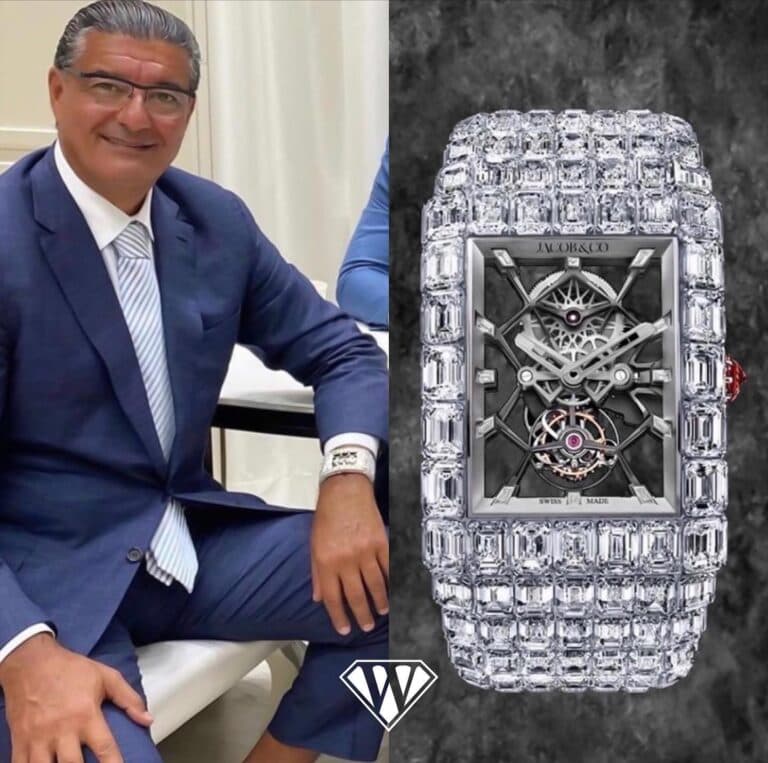
The cut debuted not in a ring or necklace but on a $3.4 million watch: the Billionaire Double Tourbillon Angel Cut, limited to 18 pieces. The 54 x 41mm white gold case carries 98 Angel-cut diamonds totaling 51.13 carats; the dial adds 88 Angel cuts weighing approximately 11 carats alongside 80 baguette-cut diamonds framing twin flying tourbillons at 12 and 6 o'clock. The clasp contributes a further 30 Angel cuts at 15.72 carats. Every stone is invisibly set against a gold lattice with no visible prongs, a technique that reads as one continuous field of light only when each stone performs consistently regardless of its precise angle to the light source. Benjamin Arabov, chief executive officer of Jacob & Co., called the debut on the Billionaire a "deliberate decision" - this was the watch model that "has always been our most uncompromising expression of watchmaking and gem-setting" since the original Billionaire launched in 2015 carrying emerald-cut diamonds. Choosing that platform to introduce a new diamond cut is a calculated form of credentialing: a geometry proven at the extreme establishes its optical claims before it enters the broader jewelry market.
For buyers considering rectangular stones, the Angel cut's stepped outline and cut corners make it compatible with channel, bezel, and invisible settings where stones are exposed to shifting light conditions throughout the day, precisely the context where emerald cuts have historically disappointed. At larger sizes, above roughly half a carat, the lozenge-shaped table becomes the defining visual signature, differentiating it clearly from both the Asscher's square geometry and the long, narrow hall-of-mirrors of a traditional emerald cut.
"For me, legacy is about creating something that did not exist before and that will continue beyond you," Arabov said. "Instead of reinterpreting existing cuts, I wanted to introduce something original that could become part of the industry's future."
Twelve years separate the house's 288-facet Jacob cut from the 37-facet Angel. The deliberate move toward geometric precision over facet accumulation as the primary tool for optical performance is a shift in philosophy, and it reframes the question buyers should ask when evaluating a rectangular stone: not how many facets, but how well each one works.
This article was produced by Prism’s automated news system from verified source data, official records, and press releases, then run through automated quality and moderation checks before publishing. The system is built and supervised by the people who set the standards it runs under. Read our full AI policy.
Did this article answer your question?