Permanent Welded Jewelry Explained: Process, Care, and Lifestyle Considerations
A clasp-free bracelet sounds simple until you need an MRI, change jobs, or develop a nickel rash. Here's how to decide whether permanent jewelry belongs on your wrist.
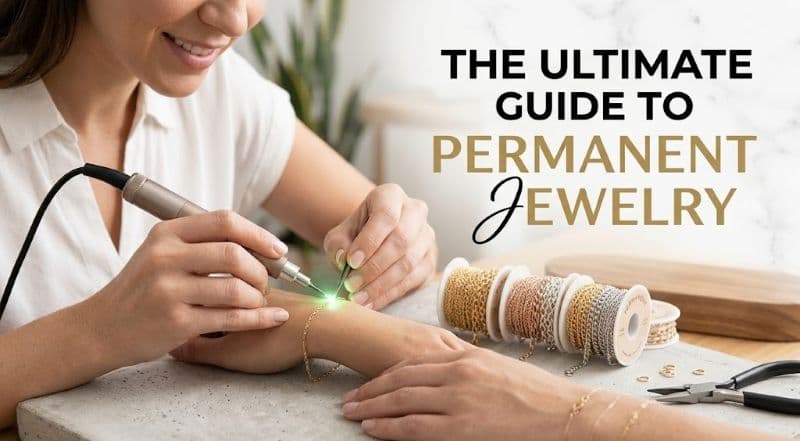
The jewelry that matters most tends to stay. A gold chain that hasn't left someone's neck in a decade. A ring worn so continuously it leaves a faint impression. Permanent welded jewelry makes that quality of constancy its entire premise: a bracelet, anklet, or necklace with no clasp, fused directly onto your body by a micro-welder, designed to live there until you decide otherwise.
The format has traveled quickly from boutique studios to pop-up appointments at birthday parties and bridal showers, driven in large part by social media visibility and celebrities spotted wearing welded bracelets as symbols of friendship and personal milestones. The emotional logic, though, is older than TikTok: the desire to mark something that matters with something you cannot easily remove. Couples have even begun choosing permanent rings as an alternative to traditional promise or engagement rings, treating the welding appointment itself as a small ceremony.
The Welding Process
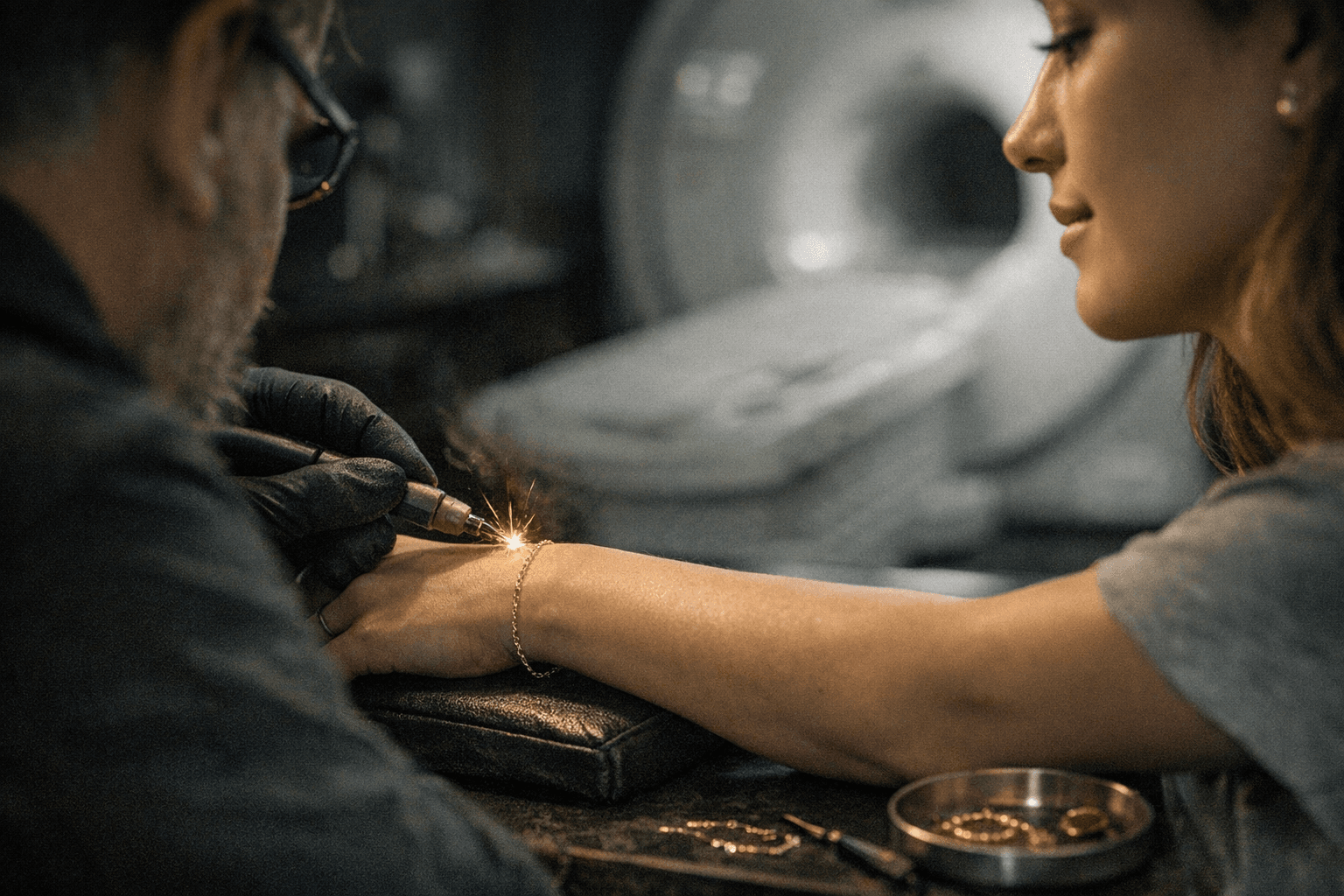
The mechanics are simpler than the name suggests. You choose a chain - available in most studios as 14k solid gold, 14k gold-filled, or sterling silver - and a style. The jeweler measures the chain to fit your wrist, ankle, or neck without tension, then positions an open jump ring to close the circuit. A micro-welder delivers a precise arc to fuse the ring shut. A protective barrier sits between the chain and your skin throughout; the spark never contacts you directly. The process takes a matter of minutes. Most people describe it as entirely painless, with a slight warmth at most. The result is a piece with no clasp, no opening mechanism, and no realistic way to accidentally lose it to a drain or a gym bag.
Metal and Chain-Width: A Durability Matrix
Material choice determines everything downstream: how the piece holds up, whether it irritates your skin, and how well it maintains its finish over years of continuous wear. Chain widths typically run from 1mm to 3mm, fine enough to sit flush against skin but sturdy enough for daily life.
- 14k solid gold, 2mm to 3mm chain: The most durable combination for an active lifestyle. Gold is non-ferrous, non-magnetic, and resistant to tarnish. At many studios, solid gold bracelets start around $195, with anklets priced higher. This is the right choice for swimmers, frequent gym-goers, or anyone who wants to genuinely forget the piece exists for years.
- 14k gold-filled, 1.5mm to 2mm chain: A lower-cost alternative with genuine longevity. Gold-filled construction bonds a thick layer of 14k gold over a base metal, making it substantially more durable than gold-plated pieces. Sterling silver and gold-filled bracelets typically start around $65. Well-suited for most everyday lifestyles.
- Sterling silver (.925), 1mm to 1.5mm chain: The most affordable entry point, but silver requires more care. It will tarnish with exposure to chlorine, sweat, and air, and benefits from regular cleaning. For someone who wants a genuinely low-maintenance piece, gold-filled is a more practical starting point.
One important caveat: white gold often contains nickel as a hardening agent. If you have any history of metal sensitivity, confirm the exact alloy composition before committing to the weld.
Who This Is Perfect For
Permanent jewelry rewards people whose lives don't frequently require its removal. If you work in a non-industrial office or from home, rarely undergo medical imaging, and want a low-maintenance piece that functions as a kind of wearable memoir, this format is exceptionally well suited to that intention. The minimalist aesthetic is central to the appeal: a single delicate chain that disappears into daily life while retaining its meaning. No fishing through a jewelry box, no fumbling with a clasp. The piece simply exists.
It is particularly well matched to anyone commemorating a milestone (a birthday, a sobriety anniversary, a major life transition), marking a friendship with another person who will be welded at the same appointment, or simply wanting the security of knowing a piece they love will not be lost or forgotten somewhere.
Who Should Think Carefully
The word "permanent" is conditional on your circumstances, and for some people, those circumstances argue against it.
*Frequent medical imaging or upcoming surgery*: MRI machines use powerful magnetic fields, and even non-magnetic metals like gold can form a conductive loop that heats during a scan, posing a real burn risk. Most imaging centers require removal of all metal before an MRI. Surgeons routinely make the same request for sterility. If you anticipate imaging or procedures in the near future, whether for a known condition or a planned surgery, factor the removal and re-welding cycle into your decision. It is manageable, but it is not zero effort.
*Job restrictions*: Healthcare workers, food handlers, and anyone in industrial or laboratory environments often face employer or regulatory rules prohibiting wrist and hand jewelry. Confirm your workplace policy before committing.
*Sensory sensitivity*: A piece that never comes off is a piece you feel constantly. For people with tactile sensitivity or certain sensory processing differences, that continuous awareness can shift from pleasurable to distracting. Consider wearing a comparable bracelet for a full week before agreeing to the weld.
*Nickel allergy*: More than 18 percent of people in North America are allergic to nickel, according to the American Academy of Dermatology. Symptoms, which include itching, redness, and in more severe cases blistering, typically appear 12 to 48 hours after contact. If you react to inexpensive earrings, clothing fasteners, or belt buckles, confirm the exact alloy of both the chain and the jump ring. Solid 14k yellow gold, platinum, and .925 sterling silver are generally safer choices; some white gold and stainless steel alloys may contain enough nickel to cause a reaction.
Airport Security and Fitness
TSA does not require the removal of fine jewelry for airport security screening. Gold and sterling silver are non-ferrous and non-magnetic, which means they typically won't trigger standard metal detectors or full-body scanners. Stainless steel, which contains ferrous components, is more likely to prompt a secondary check, though this is easily resolved with a brief visual explanation. The piece will appear on X-ray scans, which does not interfere with the imaging. International travel to very high-security airports may involve more sensitive screening equipment and additional scrutiny; carrying a brief written description from your jeweler can smooth the process.
At the gym, permanent jewelry holds up well to most training. The practical concern is prolonged chlorine exposure in swimming pools, which accelerates tarnish in silver pieces and degrades gold-filled finishes over time. For heavy lifting or contact sports, a thicker chain in solid gold (2mm or above) is meaningfully more resistant to breakage than a fine 1mm delicate style.
Emergency Removal
The pieces are designed to release under significant force to prevent injury, and intentional removal is straightforward. The simplest method: a pair of nail clippers applied directly to the jump ring. Scissors work as well, though nail clippers offer more control on something this small. Save the chain afterward. A reputable jeweler can re-weld it later, often for as little as $10, or add a clasp to convert it into a traditional bracelet if you prefer not to re-weld. If you have a procedure scheduled, call the imaging or surgical facility at least 48 hours in advance to confirm their protocol, cut at the jump ring, store the chain in a labeled bag, and schedule the re-weld once you are medically cleared.
Questions to Ask Before You Sit Down
The welding takes minutes, but the studio matters considerably. There are currently no mandatory licensing requirements for permanent jewelry artists in most markets, which means training levels vary. Before your appointment, ask:
- What training have you completed, and how long have you been welding? Look for someone who has completed a recognized certification course rather than purely self-taught practice.
- What is your sanitation protocol between clients? The welder, measuring tools, and anything that contacts skin should be cleaned between appointments.
- What is your policy if the weld fails? A well-calibrated weld should not fail under normal wear, but equipment and technique both matter. Confirm whether a failed weld is corrected at no charge.
- What does re-welding cost after medical removal? Some studios re-weld at no cost following a documented procedure; others charge a nominal fee.
- What is the exact alloy composition of the chain and jump ring? This is non-negotiable if you have any known metal sensitivity.
The Permanence in Perspective
Calling this jewelry "permanent" is, ultimately, a statement of intent rather than a physical absolute. It comes off cleanly when it must. What it offers, beneath the studio aesthetic and the social media moment of the weld, is something quieter: a small act of deliberate commitment to a person, a memory, or a version of yourself you want to carry forward. The right piece, in the right metal, on the right wrist, can hold that weight with extraordinary lightness. The work is in knowing, before you sit down under the welder's lamp, exactly which story you're asking it to tell.
This article was produced by Prism’s automated news system from verified source data, official records, and press releases, then run through automated quality and moderation checks before publishing. The system is built and supervised by the people who set the standards it runs under. Read our full AI policy.
Did this article answer your question?