Passover and Easter Symbols Unite in Meaningful Spring Jewelry Collections
Lamb, egg, and green herbs appear on both the seder plate and the Easter table. Here's how designers are turning those shared symbols into jewelry worth giving.
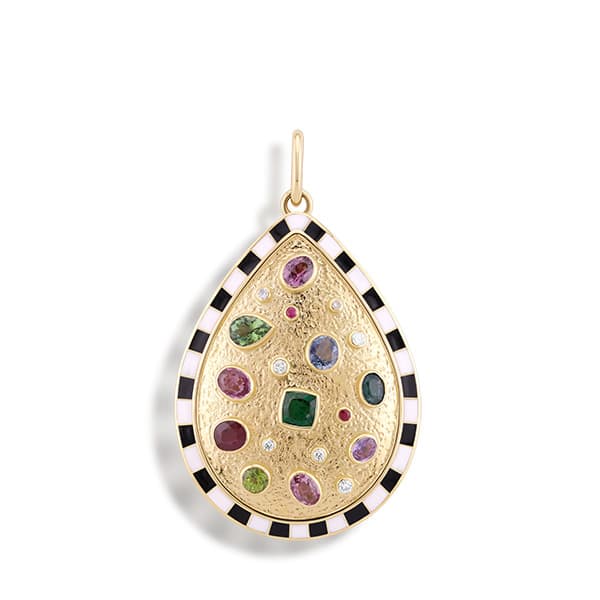
There is a moment, somewhere between the seder plate and the Easter basket, when two of the world's great spring holidays speak the same visual language. The lamb. The egg. Bread and bitter herbs. Green shoots reaching through cold soil. These are not borrowed symbols; they are the same symbols, carried through parallel traditions across millennia, and right now, jewelry designers are paying close attention.
Passover began at sundown this past Wednesday, and Easter follows on Sunday. The overlap is intentional in the liturgical calendar and, increasingly, it is intentional in fine jewelry as well. JCK's spring edit draws a direct line between the two, framing shared motifs not as a coincidence but as an invitation: to find pieces that honor both traditions with equal care, and to gift them without misstep.
Where the Two Holidays Meet
The connection runs deeper than calendar proximity. The symbols placed on the Passover seder plate, including the lamb shankbone, the roasted egg, the bitter herbs, and the flat bread, are the same elements present at the Last Supper, which Jesus shared with his disciples. That meal was itself a Passover seder. Themes of light, liberation, and hope for renewal are not borrowed across traditions; they are genuinely shared. As JCK noted in its April feature, these symbols "are representational of events during these holidays" and the underlying themes of light for the world and hope for freedom bond both observances.
Understanding this shared root matters for anyone choosing a gift piece. It means that a well-chosen symbol can feel meaningful to a Jewish host and a Christian family member at the same gathering, without requiring either to compromise.
The Spring Palette: Greens, Malachite, and Turquoise
If there is one color that unifies Passover and Easter jewelry this season, it is green. Karpas, the green vegetable dipped in salt water at the seder, represents spring's first growth. Easter's iconography is dense with new leaves, lily stems, and the reawakening earth. Designers are translating that shared palette directly into stone.
Capucine De Wulf, the Charleston, South Carolina-based designer, has made green the organizing principle of her spring 2026 Easter Edit. "We love to explore the symbolism and energy of color, and green feels especially meaningful this time of year," De Wulf says. "It represents renewal, growth, prosperity, and the fresh promise of the season." Her collection moves across a spectrum of greens anchored by two stones: malachite and turquoise.
Malachite brings the darker, more grounded end of that range. With its striking natural banding, the stone has long been associated with protection and transformation, making it genuinely apt for a season organized around those very ideas. Turquoise, used in reconstituted form in De Wulf's pieces, provides a brighter, more celebratory counterpoint. It is worth noting what "reconstituted" means here: the material is typically crushed natural turquoise or turquoise powder bound with resin, chosen for consistent color and durability at accessible price points. It is a legitimate and widely used choice, but one any informed buyer should understand before assuming they are receiving a solid natural stone. De Wulf is transparent about this: turquoise is used in reconstituted form "for its color and durability," which is an honest framing. "Across all of these designs, color is central. We like layering tones of green and turquoise to create pieces that feel vibrant, celebratory, and deeply connected to nature," she says.
Symbol-to-Piece: A Gifting Guide
The table below maps the shared seasonal symbols to jewelry forms, with notes on appropriate contexts and what to avoid when giving across traditions.
| Symbol | Meaning in Context | Jewelry Form | Cultural Consideration |
|---|---|---|---|
| Lamb | Passover sacrifice; Easter's Agnus Dei | Pendant charm, engraved locket | Appropriate for both traditions; avoid pairing with explicitly sectarian motifs as a "universal" gift |
| Egg | Spring renewal; Passover resilience; Easter rebirth | Oval cabochon ring, egg-shaped locket | Broadly secular in form; gemstone egg shapes read as spring rather than overtly religious |
| Bread / Matzo | Passover's unleavened bread; Eucharistic bread | Engraved charm (matzo texture), braided gold bangle | Matzo charms read specifically Jewish; avoid gifting to non-Jewish recipients without clear intent |
| Green Herbs | Karpas (seder plate); Easter's new growth | Malachite pendant, clover charm, green enamel ring | One of the safest cross-tradition choices; botanical motifs carry no denominational weight |
| Clover | Spring luck and renewal (not exclusively religious) | Charm necklace, stud earrings | Culturally neutral; ideal for a host gift across traditions |
| Cross / Crucifix | Easter's central Christian symbol | Cross pendant, crucifix charm | Deeply personal to Christian recipients; never appropriate as a general interfaith gift |
| Star of David | Jewish identity and faith | Pendant, ring | Specific to Jewish tradition; an expression of identity, not a generic "Passover" gift |
| Hamsa | Protection and blessing (shared Jewish and broader Middle Eastern heritage) | Bracelet charm, necklace | Widely appreciated in Jewish households; non-Jewish givers should understand its meaning before presenting it |
Designer Pieces Worth Knowing
Capucine De Wulf's Double Sided Clover Charm necklace ($125) sits at the most accessible end of the spring gifting range. Set in 18k gold-plated brass with mother-of-pearl, the clover charm earns its place on both a Passover table and an Easter brunch. The plated construction means it is a fashion piece rather than a fine jewelry investment, and buyers should be aware that gold-plated brass requires more care to maintain than solid gold, but at this price point it is a thoughtful and genuinely beautiful gesture.
At the other end of the scale, Anita Ko's Lucky Rabbit talisman in 18k solid gold with diamond accents ($6,200) is designed for longevity. The rabbit is one of those rare symbols that crosses Easter iconography (where it represents fertility and spring) and the Chinese zodiac (2023's Year of the Rabbit still resonates with many collectors), making this a layered piece rather than a single-note holiday gift. The use of solid 18k gold and natural diamonds means the provenance question is worth asking: Anita Ko's pieces are generally sourced through established fine jewelry supply chains, but as with any diamond purchase, requesting documentation under the Kimberley Process certification remains good practice.
What to Avoid: A Few Clear Lines
The most common gifting misstep is conflation: choosing a piece that mixes Christian and Jewish symbols on a single object as a gesture of unity. A pendant combining a cross and a Star of David may be well-intentioned, but it often reads as a flattening of two distinct traditions rather than a celebration of either. Each faith's symbols carry specific theological weight, and that weight deserves respect rather than decoration.
A second misstep is assuming that secular Easter symbols (the bunny, the egg, the spring palette) translate neutrally into Jewish gift contexts. They are largely fine as spring imagery; the problem arises when a buyer presents them as "Passover-appropriate" without understanding what actually belongs to Passover's symbolism. A green enamel botanical necklace is a lovely seder host gift precisely because it echoes karpas without pretending to be more.
Finally, watch the metal choices against the occasion. Heavily religious communities in both traditions observe distinct norms around jewelry during holidays, from the Orthodox Jewish approach to Shabbat-adjacent restrictions to Catholic and Eastern Orthodox traditions around simplicity in Holy Week observance. For a gift that will be worn at the table rather than to services, this matters less; for something intended as a devotional piece, ask.
The Ethical Thread
Spring's shared themes of liberation and renewal carry their own ethical charge for anyone who takes jewelry's supply chain seriously. Malachite is primarily sourced from the Democratic Republic of Congo, a mining region with well-documented labor and environmental concerns. A designer using malachite in a "renewal" collection without addressing its provenance is making a claim the stone itself cannot easily support. Responsible buyers should ask whether malachite pieces come with any chain-of-custody documentation, or choose designers who work with small, traceable parcels.
Green stones sourced responsibly do exist. Colombian-origin malachite and Arizona turquoise both carry traceability possibilities that DRC material rarely offers. The most honest jewelry gifting this spring asks not only what a piece means symbolically, but where the meaning began, in the mine, the workshop, and the hands that shaped it.
The spring holidays that gave us the seder plate and the Easter table were always about asking those questions. The jewelry that honors them should do the same.
This article was produced by Prism’s automated news system from verified source data, official records, and press releases, then run through automated quality and moderation checks before publishing. The system is built and supervised by the people who set the standards it runs under. Read our full AI policy.
Did this article answer your question?