Noor Fares’ Inayat Explores Meaning and Form
Named for the Arabic word for compassion, Noor Fares' 30-piece Inayat collection turns architecture, calligraphy, and celestial geometry into wearable amulets built for intention.
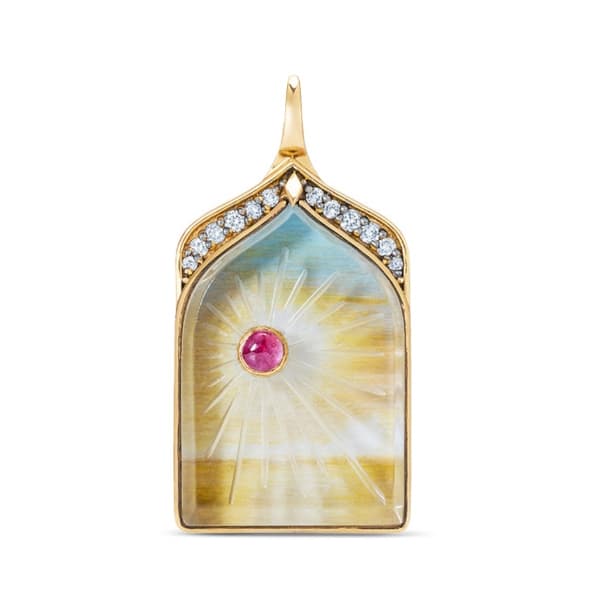
There is something ancient in the impulse to wear protection. Long before jewelry became fashion, it was talismanic: a symbol pressed against the skin, a stone chosen for its particular quality of light, a shape carried as a quiet reminder of what you believe. Noor Fares has built her entire practice around that instinct, and her spring 2026 collection, Inayat, is its most fully realized expression yet.
The Meaning Behind the Name
Released in March 2026, Inayat takes its name from an Arabic word meaning care or compassion, and its 30 pieces draw on architectural forms, calligraphy, and celestial geometry. The collection does not simply reference these traditions as ornamental shorthand. Each motif has been chosen because it carries specific, layered meaning, the kind a wearer can return to and find something new in. Fares' work is rooted in her Lebanese heritage as well as her travels to India, where sunsets and the light over landscapes and architecture can incite spirituality and introspection. That dual inheritance, Middle Eastern symbolism and the visual vocabulary of South Asian sacred geometry, gives Inayat a richness that no single cultural tradition alone could produce.
Fares herself is Paris-raised and London-based, a Central Saint Martins graduate with a GIA certification and a brand she launched in 2009. Whether it be the mystical symbolism of Hindu mandalas in India or the intricate geometric patterns found in Middle Eastern architecture, she is inspired by unexpected beauty wherever she goes. That restlessness is the engine of her practice, and Inayat channels it with unusual precision.
Decoding the Motifs: Architecture, Calligraphy, Geometry
Each of Inayat's three visual languages carries its own intention, and understanding them is the first step toward choosing pieces that resonate beyond aesthetics.
*Architectural forms* in the collection evoke thresholds and sheltered spaces: arches, carved façades, the proportions of buildings designed to make the human body feel both protected and transcendent. In jewelry terms, these translate to grounding. Pieces built on architectural shapes are the ones to reach for when you want a reminder of stability, of being held.
*Arabic calligraphy* is the collection's most distinctive element, and also its most technically ambitious. Integral to the collection is its use of Arabic lettering, developed in collaboration with calligrapher Farah Behbehani. Rather than sitting on the surface, the script is integrated into each design, shaping proportions, guiding layout, and becoming part of the piece's overall structure. This distinction matters enormously. Script as surface decoration is one thing; script as the underlying armature of a jewel is another entirely. These are pieces built for clarity of intention: words as architecture, letters as load-bearing elements. If you are drawn to language, to naming what you want to call into your life, a calligraphy-forward piece from Inayat is the appropriate entry point.
*Celestial geometry*, the collection's third motif language, operates on the scale of the cosmos. Star-derived shapes, sacred proportions, and forms that echo the movement of light across celestial bodies speak to love and connection, the forces that link us to something larger than daily life. In the fine jewelry context, geometric pieces read as the most versatile of the three: they translate across occasions, from a private ritual to a formal table.
Materials as Design Language
The same level of consideration carries through to the materials: hand-engraved gold, painted mother-of-pearl, polki, rose-cut, and salt-and-pepper diamonds, and gemstones including tourmaline, moonstone, and spinel. They're used not just for contrast but for how they interact with light and form. In some cases, even the natural inclusions within a stone become part of the design rather than incidental to it; perfection is as nature intended.
That philosophy represents a quiet but meaningful departure from conventional fine jewelry. Where most of the market still treats inclusions as defects to be minimized or disclosed apologetically, Fares treats them as texture, as character, as proof that the stone came from somewhere real. It is an approach shared by a small group of designers working in polki and salt-and-pepper diamonds, but few integrate it as completely into a collection's conceptual core.
The pieces are set in both 18k yellow gold and 18k gray gold, a pairing that expands the tonal range of the collection considerably. Specific highlights include earrings in 18k yellow gold with 23.5 carats total weight of green amethyst, 1.6 carats of rock crystal, 0.5 carat of abalone, and 0.04 carat of diamonds, priced at £3,100 ($5,000), and a painting pendant in 18k gray gold with mother-of-pearl, 17.5 carats of rock crystal, 0.45 carat of moonstone, and 0.65 carat of diamonds at £7,995 ($10,580). The entry point is the Inayat painting pendant in 18k yellow gold with mother-of-pearl, 6.5 carats of rock crystal, 0.5 carat ruby, and 0.09 carat of diamonds at £2,625 ($3,480). Across all three price points, the logic of the making is consistent: every material choice is in service of the overall meaning, never incidental to it.
Building a Talisman Stack
The most considered way to engage with Inayat is to think about what you actually want a piece to do. Fares designs with that in mind, and the collection is structured so that pieces work individually as core amulets or in combination as a curated stack. Here is a practical framework:
- Core amulet (the anchor piece): Choose based on your primary intention. An architectural pendant for grounding and protection; a calligraphy-integrated piece for clarity or a life transition you want to name and hold; a celestially geometric ring or earring for love and connection.
- Supportive shapes: Layer in a second piece that shares a material but shifts the motif. A moon quartz earring paired with a mother-of-pearl painting pendant, for instance, keeps the palette cohesive while doubling the symbolic weight. The gray gold pieces, with their labradorite and gray diamond combinations, read as a quieter frequency alongside the bolder yellow gold architectural forms.
- Stone intention: Moonstone for intuition; spinel, a stone long associated with vitality and renewal, for energy; rock crystal for amplification; ruby for the heart. Polki diamonds, uncut and close to the earth, carry a grounding quality distinct from the brilliance of a faceted stone. Salt-and-pepper diamonds are the collection's most personal choice: visibly imperfect, entirely individual, and impossible to replicate.
A well-built talisman stack from Inayat need not be large. Two or three pieces with clear intentional alignment will carry more meaning, and read more beautifully, than seven assembled at random.
A Note on Wearing Calligraphy-Inspired Jewelry Respectfully
As fine jewelry increasingly draws on the visual traditions of Arabic script, it is worth pausing to consider how to engage with these pieces thoughtfully.
- Ask about the translation. Every piece in Inayat that incorporates Arabic lettering has a specific meaning. Know what you are wearing. The name of the collection alone, care and compassion, is a meaningful place to begin.
- Acknowledge the artist. Farah Behbehani is a named collaborator on this collection. When a designer has made the effort to work with a practicing calligrapher rather than appropriate a script from reference images, that credit matters and is worth repeating when you share or discuss the piece.
- Ask about material sourcing. Sustainability has been a cornerstone of Fares' practice since the brand's early years. She is known for using ethical metals and traceable stones. When investing in a culturally significant piece, it is reasonable to ask whether the gold and gemstones meet the same standard.
- Wear it with context. Calligraphy-informed jewelry at its best is a form of cross-cultural dialogue. Carry that lightly but carry it consciously.
Why Inayat Matters Now
The intention and detail that go into crafting Inayat's jewelry suit the current consumer interest in meaningful designs. Offering both symbolism and visual impact, this is a collection retailers can stock with confidence. But that framing, useful as it is commercially, understates what is most interesting about what Fares has built here. Inayat is not meaningful jewelry in the marketing sense of the phrase. It is meaningful in the older, more demanding sense: pieces whose every formal decision, from the integration of script into structure to the embrace of natural inclusions, has been made in service of a coherent idea about what it is to wear something with intention. As Fares herself has put it, "I try to create pieces that are innovative yet at the same timeless." Inayat proves the ambition is justified.
This article was produced by Prism’s automated news system from verified source data, official records, and press releases, then run through automated quality and moderation checks before publishing. The system is built and supervised by the people who set the standards it runs under. Read our full AI policy.
Did this article answer your question?