Buddha Mama's Diamond Moon Locket Reimagines the Classic Heirloom Keepsake
Buddha Mama's Moon locket packs 10.34 carats of diamonds and room for three photographs into a one-of-a-kind 20k gold piece headed to Dallas April 9–11.
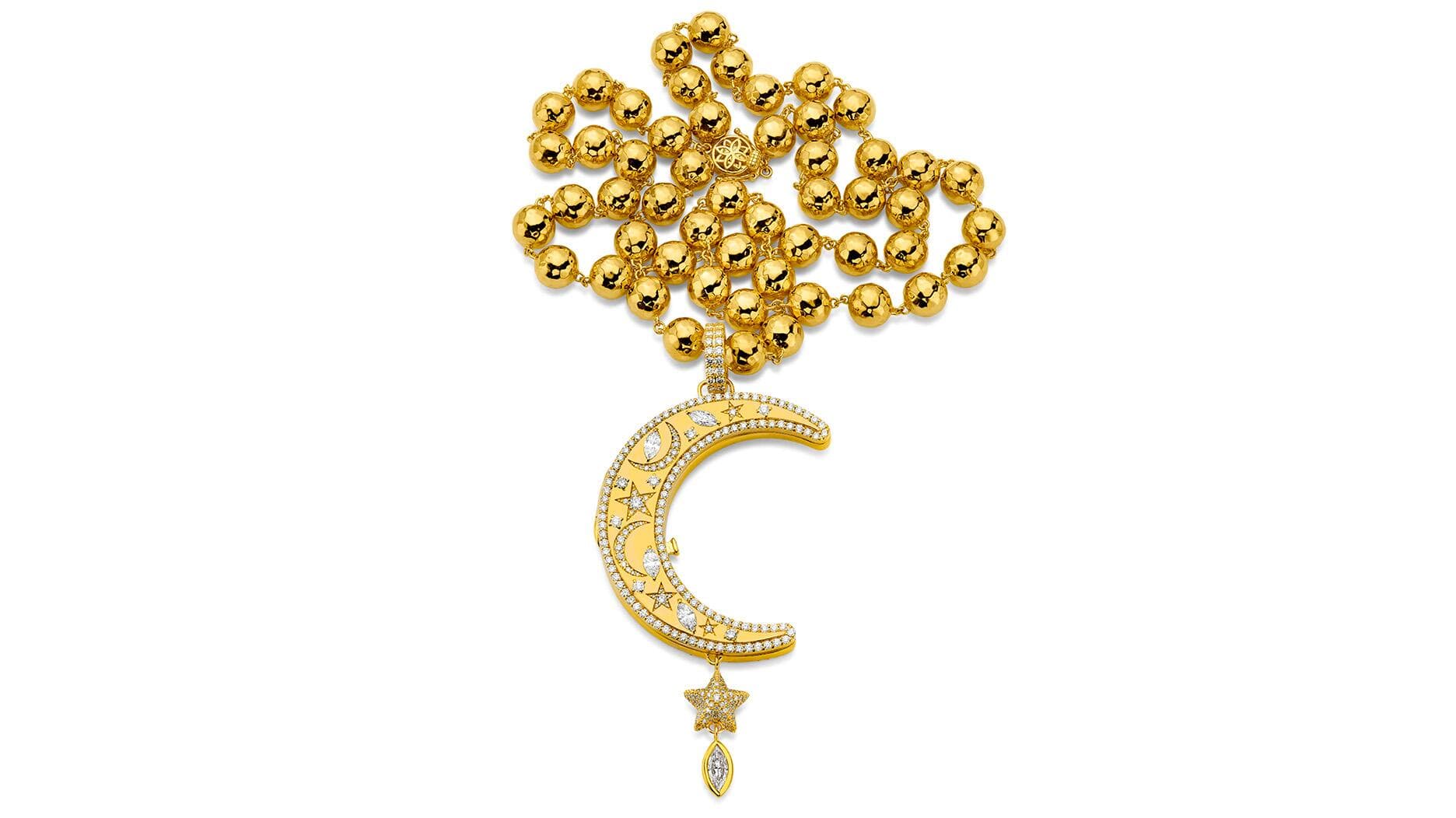
The pieces that earn the word "heirloom" tend to be built around someone specific, not a general occasion. Buddha Mama's "Moon" locket, a one-of-a-kind piece in 20-karat yellow gold carrying 10.34 carats of diamonds, began with a grandmother's devotion to the night sky and became one of the most architecturally serious lockets in contemporary fine jewelry.
The Moon belongs to the brand's Celestial Love collection, which designer Nancy Badia and her daughter Dakota conceived as an homage to Nancy's mother and Dakota's grandmother, a woman who shared her love of nature and the stars with the Badias. That origin is visible in every detail of the piece: moon and star motifs built from marquise- and round-cut diamonds, framed by fields of pavé, with a diamond-encrusted star pendant suspended from the body of the locket and a single marquise diamond drop hanging at the very end. Styled on a ball chain, it reads as architectural jewelry, not sentiment in a case. "We are very drawn to lockets," said Nancy and Dakota Badia, "and so when this piece was being conceived by us, we thought we could take it to the next level and make it into a locket."
What makes the Moon instructive beyond its own considerable beauty is how precisely it illustrates what separates a locket worth owning from one worth ignoring.
Start with the gold. Buddha Mama builds its entire line in 20-karat yellow gold, a deliberate departure from the 18-karat standard that dominates American fine jewelry. The difference is meaningful to the eye before it is meaningful on paper. Twenty-karat gold is 83.3 percent pure versus 75 percent for 18-karat; the higher gold content produces a visibly deeper, more saturated yellow with roots in Eastern jewelry-making tradition, more warm than brassy, more antique than modern. The tradeoff is marginal softness, which is precisely why setting integrity matters on a piece like the Moon, where pavé diamonds must hold across a surface that flexes open and closed through years of wear. When examining any high-diamond locket, inspect the pavé rows nearest the hinge first: uneven prong height, stones that shift under light pressure, or scratched metal between settings are signs of a piece that will not age gracefully.
The interior of the Moon holds three images, an upgrade on the single-photograph standard of most commercial lockets that also functions as a construction test. A three-image interior requires more precise hinge engineering, because any spring tension that favors one side will cause the piece to sit unevenly against the body. Ask to open and close the locket yourself before committing; the mechanism should engage cleanly and hold shut without give. Look at the interior finish while it's open: a well-made locket is finished inside as carefully as outside, with no rough casting marks or unpolished edges.
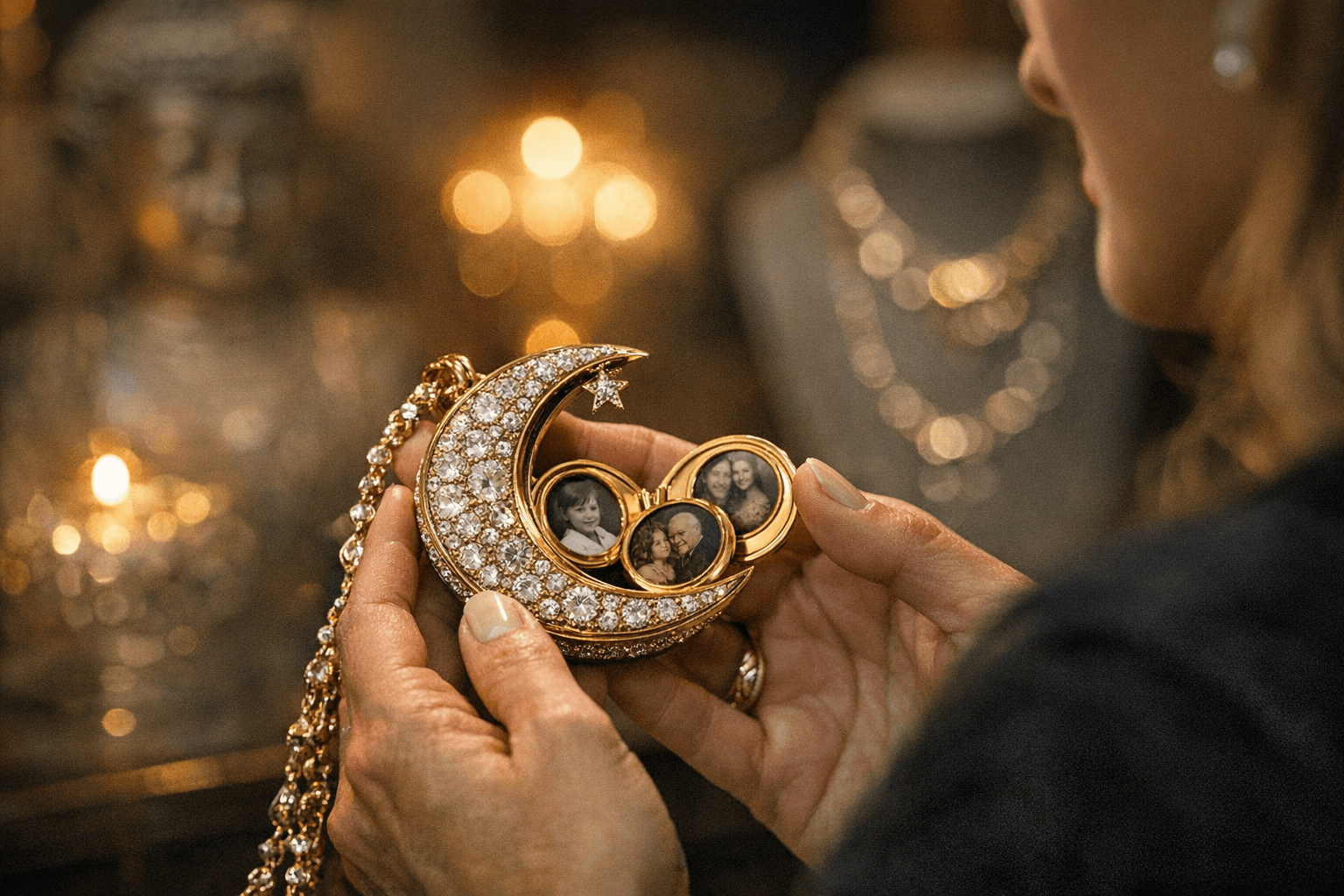
Then there is the diamond weight question. At 10.34 carats distributed across marquise cuts, round brilliants, and pavé, the Moon is a piece designed to be worn with intention. A marquise cut maximizes visual surface area while keeping overall depth low, which is why this locket carries its carats with more elegance than the number alone might suggest. Before purchasing any high-carat locket, hold it against a simple neckline in natural light. Weight distribution matters as much as total carat count; a ball chain, as used here, distributes load more evenly than a fine cable or box chain, which tends to concentrate stress at the clasp and pull the pendant off-center.
The Moon is priced upon request. For insurance purposes, ask for a written appraisal documenting total diamond weight, gold karat, and setting details. A rider on a homeowner's or renter's policy is the standard vehicle for covering fine jewelry; for a one-of-a-kind piece, irreplaceable should be reflected honestly in the coverage limit, not estimated conservatively. When traveling with a piece of this value, keep it in carry-on luggage in a rigid-sided case, and photograph it against a neutral background before leaving home.
Nancy and Dakota Badia will bring the Moon and additional one-of-a-kind pieces to Dallas for a pop-up with artist Ashley Longshore from April 9 through 11. Longshore's bold, color-saturated work and the Badias' jewels share an instinct for maximalism with intention, which is what makes the pairing more than logistical. "We are excited that you get to experience it in such a magical environment with Ashley Longshore," the Badias said. The event runs by appointment; to schedule time directly with the Badias and Longshore, message Buddha Mama on Instagram or email Elizabeth@thegemsproject.com. One-on-one time allows for exactly the kind of hands-on assessment a locket at this level warrants.
Before the appointment: research the Celestial Love collection and come with specific questions about stone origins and appraisal documentation. At the appointment: open every piece yourself, check hinge tension, examine pavé under direct light, and ask whether settings can be serviced over time. After the appointment: if a piece resonates, move on insurance immediately rather than waiting. A one-of-a-kind locket with a family story already embedded in its design is not a category of object that waits.
This article was produced by Prism’s automated news system from verified source data, official records, and press releases, then run through automated quality and moderation checks before publishing. The system is built and supervised by the people who set the standards it runs under. Read our full AI policy.
Did this article answer your question?