Cartier King of Hearts cufflinks at Hancocks spotlight Georges Lenfant provenance
A 1960s Cartier King of Hearts cufflink pair at Hancocks turns a playing-card motif into a lesson in signed provenance, with Georges Lenfant craftsmanship at the center.
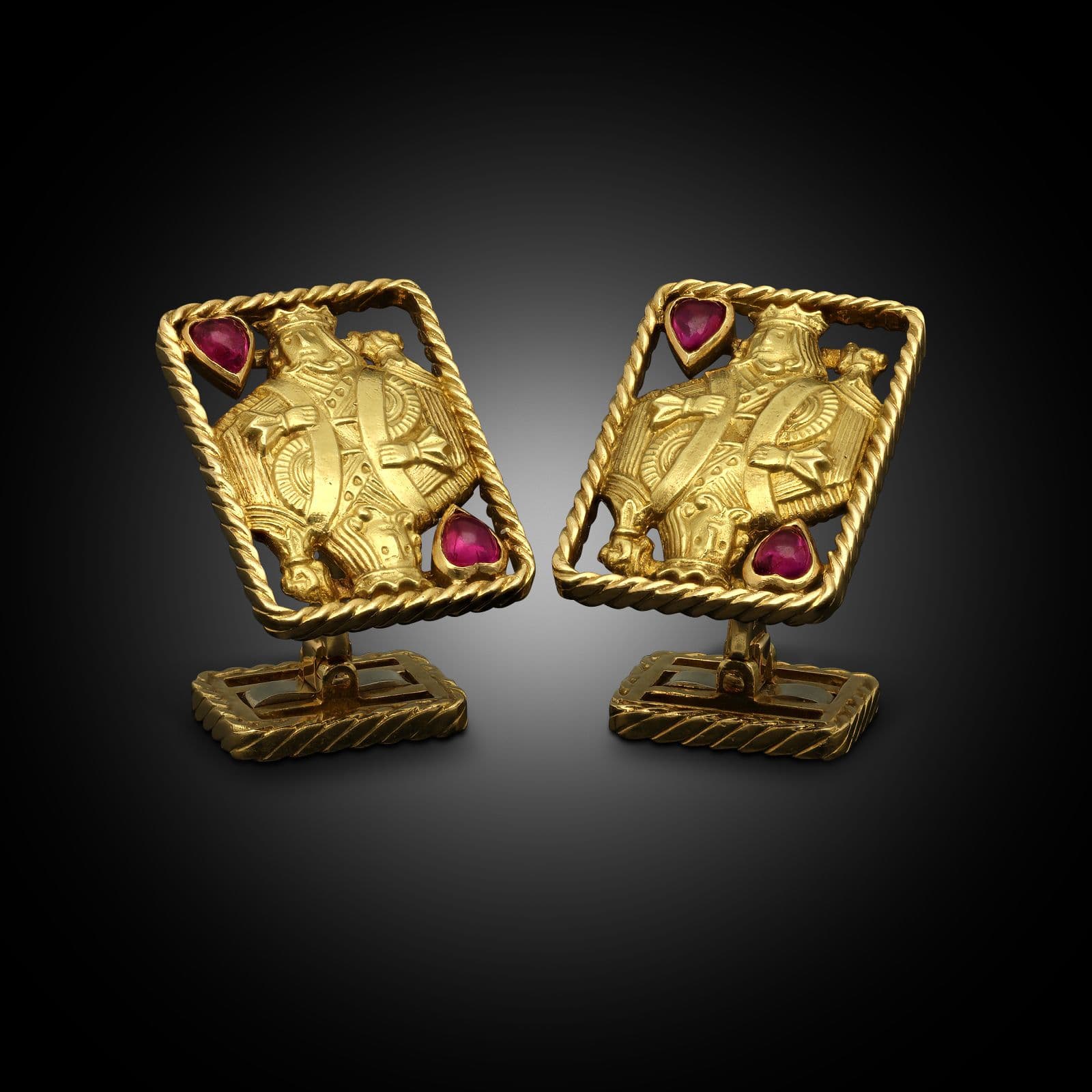
The strongest thing about this pair of Cartier cufflinks is not simply that they are old, signed, or rare. It is the way the King of Hearts motif, the Cartier France stamp, and the Georges Lenfant maker’s mark line up to turn a dress accessory into a tiny, legible object lesson in Parisian luxury. Hancocks London has placed the circa-1960s pair among its signed jewels, and the effect is less like browsing estate stock than opening a case on a miniature royal relic with modern collector appeal.
The motif does the storytelling
Each cufflink is shaped like a traditional playing card, but the design is not decorative noise. The King of Hearts motif gives the piece its immediate visual charge: a familiar card symbol translated into 18ct yellow gold, with the hearts set as cabochon rubies and framed by ropetwist borders. That combination of smooth gemstone domes, textured gold relief, and tight border work gives the cufflinks a strong graphic identity even before the Cartier name enters the picture.
The playing-card format matters because it makes the object readable at a glance. Instead of relying on scale or excess, the design uses a clear emblem, one that feels witty, aristocratic, and slightly secretive all at once. In men’s jewelry, where meaning often has to be compressed into small surfaces, that kind of symbolism is exactly what turns a useful fastening into a conversation piece.
Cartier and Lenfant give the pair its pedigree
The cufflinks are signed Cartier France, but the maker’s mark points to the Georges Lenfant workshop, which is where the provenance becomes especially interesting. Hancocks identifies Georges Lenfant as a Cartier workmaster and places the founding of his business around 1900, a reminder that much of Cartier’s most appealing mid-century work depended on specialist Paris workshops with deep technical knowledge.
Reference material on Lenfant places the workshop at 47 rue des Petits-Champs in Paris and notes that the maker’s mark was registered by 1909. That detail is more than archival trivia. For collectors, a registered mark helps connect the object to a specific manufacturing lineage, giving the cufflinks a traceable identity beyond the retail signature. When Cartier’s name and Lenfant’s workshop mark appear together, the piece reads as a collaboration between maison and master craftsman, not as a generic signed accessory.
The Lenfant story continues beyond the 1960s. After World War II, Jacques Lenfant took over the firm and continued the family business before production ended in 2003 after the Bouder buyout. That long arc matters because it shows how workshop names can outlive generations, and how a maker’s mark can carry the memory of a production culture long after the original founder is gone.
Why provenance changes the way you value cufflinks
A pair of cufflinks like this one can be understood on two levels at once. On the surface, they are handsome formalwear objects: 18ct yellow gold, cabochon rubies, ropetwist edging, and a court-card silhouette. Underneath, they are documented objects with multiple identifiers, which is where the real collector appeal begins. Cartier France establishes the maison, while Georges Lenfant establishes the hand behind the making.
That dual signature is especially powerful in vintage jewelry because it reduces the distance between aesthetic pleasure and material history. The cufflinks are not merely styled in the manner of Cartier; they are tied to a specific workshop known for making jewels for top Paris houses. Hancocks’ listing places them at £35,000, a price that reflects not only gold and rubies, but also the strength of the names attached to the piece and the clarity of the story they tell together.
Hancocks frames the piece as part of a longer jewelry tradition
Hancocks London is well suited to this kind of object because the business has been dedicated to antique, vintage, and contemporary jewelry since 1849. That history gives the pair a home in a broader tradition of signed and sourced jewels rather than in a generic luxury display. In that setting, the cufflinks are not isolated curiosities; they sit within a curatorial practice that prizes authorship, condition, and named origin.
The store’s emphasis on curated antique-and-vintage pieces also sharpens the meaning of the Cartier and Lenfant attributions. A cufflink pair like this depends on more than age. It needs workmanship that still looks exacting under close inspection, and it needs documentation sturdy enough to survive collector scrutiny. Here, the visible details do the heavy lifting: the card shape, the gold relief, the ruby-set hearts, and the ropetwist borders all reinforce the sense that the piece was designed to be recognized rather than hidden.
What makes this pair endure
Meaningful jewelry often works best when its symbolism is easy to read and its provenance is hard to dismiss. These cufflinks do both. The King of Hearts motif gives them immediate personality, while the Cartier France signature and Georges Lenfant workshop mark give them the kind of traceable pedigree that collectors value most.
That is why the pair feels so compelling now: it is not nostalgia dressed up as rarity, but rarity made intelligible through design. The result is a compact, highly specific lesson in how signed jewelry keeps its authority, one finely worked card at a time.
This article was produced by Prism’s automated news system from verified source data, official records, and press releases, then run through automated quality and moderation checks before publishing. The system is built and supervised by the people who set the standards it runs under. Read our full AI policy.
Did this article answer your question?