Cindy Chao’s Feather Brooch blends sculpture, architecture, and nature
A 4-carat fancy brown-yellow marquise diamond anchors a brooch shaped by family memory, architecture, and hand-sculpted craft.
A family line, cast in precious metal
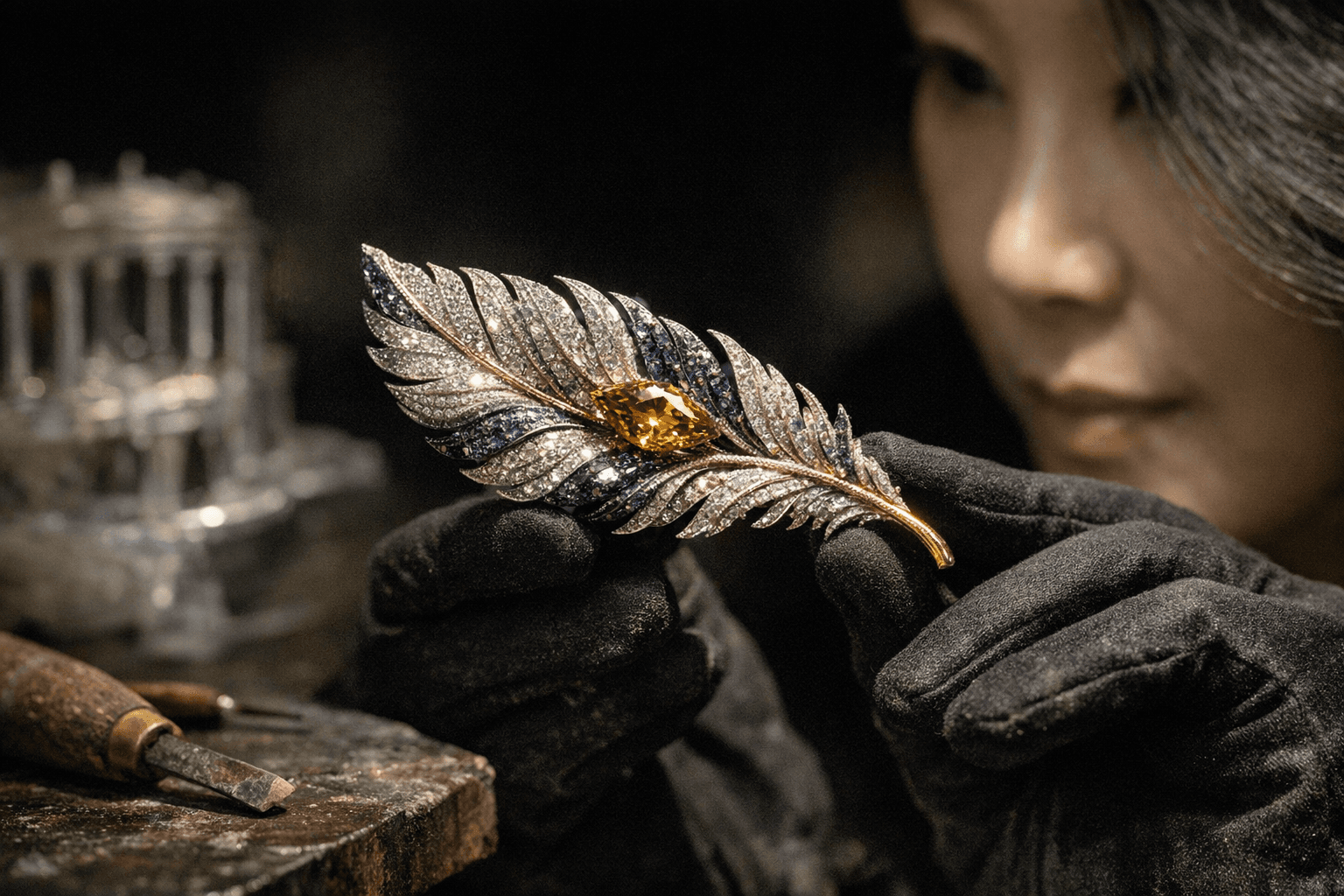
Cindy Chao’s Feather Brooch is memorable because it behaves less like an accessory than a small, disciplined act of sculpture. The eye lands first on the 4-carat fancy brown-yellow marquise diamond, but the real seduction is in the way the stone is made to feel airborne, as if weight itself had been edited out of the object.
That illusion matters. A brooch is usually a matter of placement, a pinning point on fabric; Chao turns it into a self-contained work of art. Here, titanium and ox horn frame the jewel with the kind of technical daring that makes the piece feel simultaneously exacting and organic, a feather rendered in materials that are anything but delicate.
Why the feather form feels so personal
The brooch reads as a family portrait in disguise. Chao’s father was a sculptor, and her grandfather was an architect who designed temples across East Asia, so the piece carries both hands-on modeling and structural thinking in its DNA. You can feel that inheritance in the way the form is built, not merely decorated, with volume, balance, and contour doing as much expressive work as the gems themselves.
That lineage helps explain why the piece feels emotionally specific rather than merely spectacular. Chao is not using a feather motif as a pretty symbol; she is using it to explore lightness, movement, and fragility through the discipline of a maker who understands mass. The result is a jewel that suggests memory as much as nature.
The diamond is the star, but it is not the whole story
The four-carat fancy brown-yellow marquise diamond gives the brooch its pulse. Its elongated shape creates forward motion, while the color adds warmth and complexity, avoiding the blank brilliance of a more conventional white center stone. A single white diamond sharpens the composition, and 2,383 white, yellow, and brown diamonds build the surrounding shimmer with astonishing precision.
Robb Report lists the finished brooch at 11.3 cm by 4 cm by 3.2 cm, with 73.91 carats of stones in total. Those numbers are important because they make clear that this is not a petite ornament hiding under the dress lapel. It is a significant object, scaled with the ambition of miniature architecture, yet still meant to live on the body.
The use of titanium and ox horn heightens that tension between heft and air. Titanium gives the piece engineering strength without visual bulk, while ox horn contributes a natural, sculptural softness. In Chao’s hands, the material palette reinforces the illusion that the brooch could have grown rather than been assembled.
How craft becomes the point of view
Chao’s process begins with lost-wax sculpting, or cire perdue, a technique rooted in 18th-century Europe. That choice is revealing. It places the work in dialogue with centuries of metalworking history, but it also leaves room for her hand to remain visible in the final object, even when the finish is exquisitely polished.
This is where her background in sculpture and architecture becomes more than biography. Lost-wax sculpting demands a maker who can think in three dimensions before the final metal exists, and that spatial confidence is what gives the Feather Brooch its authority. The piece does not rely on surface decoration to persuade you of its value; it persuades you through construction.
Chao’s house also identifies titanium work as part of its signature material approach, which helps explain why her jewels feel so distinct within high jewelry. Where many maisons use precious metal to spotlight stone, Chao often uses structure to intensify meaning. The stone is still the attention grabber, but the craft is what makes the attention linger.
From Taipei to the museum case
Chao launched her brand in Taipei in 2004, and that origin still matters. The work has always carried the tension between private luxury and public art, between jewels meant to be worn and jewels that seem built for a vitrine. Her international debut came in 2007 at Christie’s New York with the Winter Branch Necklace and Bangle, a moment that introduced her to a broader audience as more than a designer of expensive adornment.
The recognition that followed was institutionally unusual for a jeweler working at this scale. In 2009, the Black Label Masterpiece No. I Royal Butterfly was inducted into the Smithsonian National Museum of Natural History’s National Gem Collection in Washington, D.C. Her work has also been exhibited at the Musée des Arts Décoratifs in Paris and the Victoria and Albert Museum in London, which places her squarely in the realm of collectible art rather than seasonal luxury.
That museum trajectory helps clarify what the Feather Brooch is really saying. It belongs to a house that divides its output between museum-calibre Black Label Masterpieces and the White Label Collection, but the Feather Brooch stands as a concentrated example of why Chao’s best work travels so well across contexts. It can be worn, studied, collected, and displayed without losing its force.
Why this brooch stays with you
What makes the Feather Brooch unforgettable is not simply the rarity of its stones or the technical difficulty of its build, though both are formidable. It is the way Chao turns a brooch into a vessel for inherited vision, pairing a sculptor’s sensitivity with an architect’s sense of structure and a jeweler’s command of materials. The result is a jewel that does what the most serious high jewelry should do: it transforms status into story, and story into form.
The 4-carat fancy brown-yellow marquise diamond may draw the gaze first, but the broader achievement is subtler. Chao has made a feather that feels weightless without pretending to be effortless, and in that contradiction lies its beauty. It is wearable sculpture with a memory inside it, which is why it reads not as decoration, but as lasting art.
This article was produced by Prism’s automated news system from verified source data, official records, and press releases, then run through automated quality and moderation checks before publishing. The system is built and supervised by the people who set the standards it runs under. Read our full AI policy.
Did this article answer your question?