Designers turn soaring gold prices into intentional, lighter jewelry
Soaring gold prices are changing more than costs. They are thinning silhouettes, shifting metal mixes, and revealing which jewelry is truly designed, not merely trimmed.
Gold’s new luxury signal is restraint
The strongest fine jewelry this season feels lighter in the hand and sharper in intention. As gold prices climb, designers are not just raising tags, they are redrawing proportions, thinning solid-gold structures, and leaning on platinum, silver, ceramic, resin, and titanium to keep collections viable without flattening their design language.
That shift matters to shoppers because it changes the actual object, not just the invoice. A piece that once might have been a dense yellow-gold statement now arrives as a more measured composition, where the clasp, setting, or hidden mechanism carries more of the value than sheer metal weight. In the best cases, that makes the work feel more considered. In the worst, it is simply cost-cutting with a polished surface.
Why gold’s surge is reshaping what you see and feel
The macro picture is hard to ignore. Total gold demand in 2025, including OTC, topped 5,000 tonnes for the first time. The LBMA (PM) gold price set 53 new all-time highs that year, and the annual average reached US$3,431 an ounce, up 44% year over year. Jewelry demand volume softened in that high-price environment, even as the value of jewelry demand rose 18% to a record US$172 billion.
That split tells you everything about the market right now. People are buying less by weight, but the category is still commanding more money overall, which means the pieces that survive this squeeze have to justify themselves through design, craft, and narrative. Earlier in 2025, gold had already climbed from around US$2,000 an ounce in January 2024 to about US$3,100 an ounce by early April, forcing brands to rethink inventory and the templates behind their collections.
For the shopper, the visible result is a new kind of jewelry logic: less mass, more intelligence. A ring may be slimmer at the shank, a pendant may rely on a smaller gold element attached to a different material body, and a bracelet may use construction tricks that preserve presence while reducing metal content.
How independent designers are adapting
Independent jewelers are feeling the pressure most acutely. Larger houses can hedge gold and buy in bulk, but smaller studios have to maneuver carefully, balancing creative ambition against volatile raw-material costs. That reality has pushed many designers to reduce the weight of solid gold pieces, turn more often to platinum and silver, and change production methods to control usage.
Sarah Müllertz, founder of Copenhagen-based Kinraden, has described that landscape as especially difficult for independents. Her point is not simply financial. It is about whether a designer can keep the line’s identity intact when the material itself becomes a constraint. The answer, increasingly, is to treat scarcity as part of the story rather than a compromise to hide.
Stephen Webster has taken a similarly pragmatic path, shifting clients from white gold to platinum. He said platinum is around one-third the price of gold, a reminder that luxury metal choice is now as much a matter of economics as aesthetics. That move also changes the visual effect: platinum reads cooler, denser in appearance, and often more architectural, especially in settings where white gold once provided the default.
When lighter becomes smarter
There is a meaningful difference between design innovation and disguised shrinkage. True innovation usually shows up in the architecture of a piece: how it balances, how it opens, how a stone is secured, how the clasp contributes to the whole. Cost-cutting, by contrast, often shows up as a vague reduction in heft without a corresponding increase in ingenuity.
That is why the most interesting jewelry now often mixes materials rather than relying on one precious metal to carry everything. Ceramic can supply color and surface discipline. Resin can add warmth or opacity. Titanium can keep a piece structurally crisp while dramatically lowering weight. Gold then becomes an accent, a touchpoint, or the final closure, not necessarily the entire body of the jewel.
For buyers, that broader mix is not a downgrade if the materials are deployed with confidence. It can be a sign that the designer understands modern luxury as a composition of textures and technologies, not just a tally of grams.
Anna Maccieri Rossi’s Carpe Diem shows what intentionality looks like
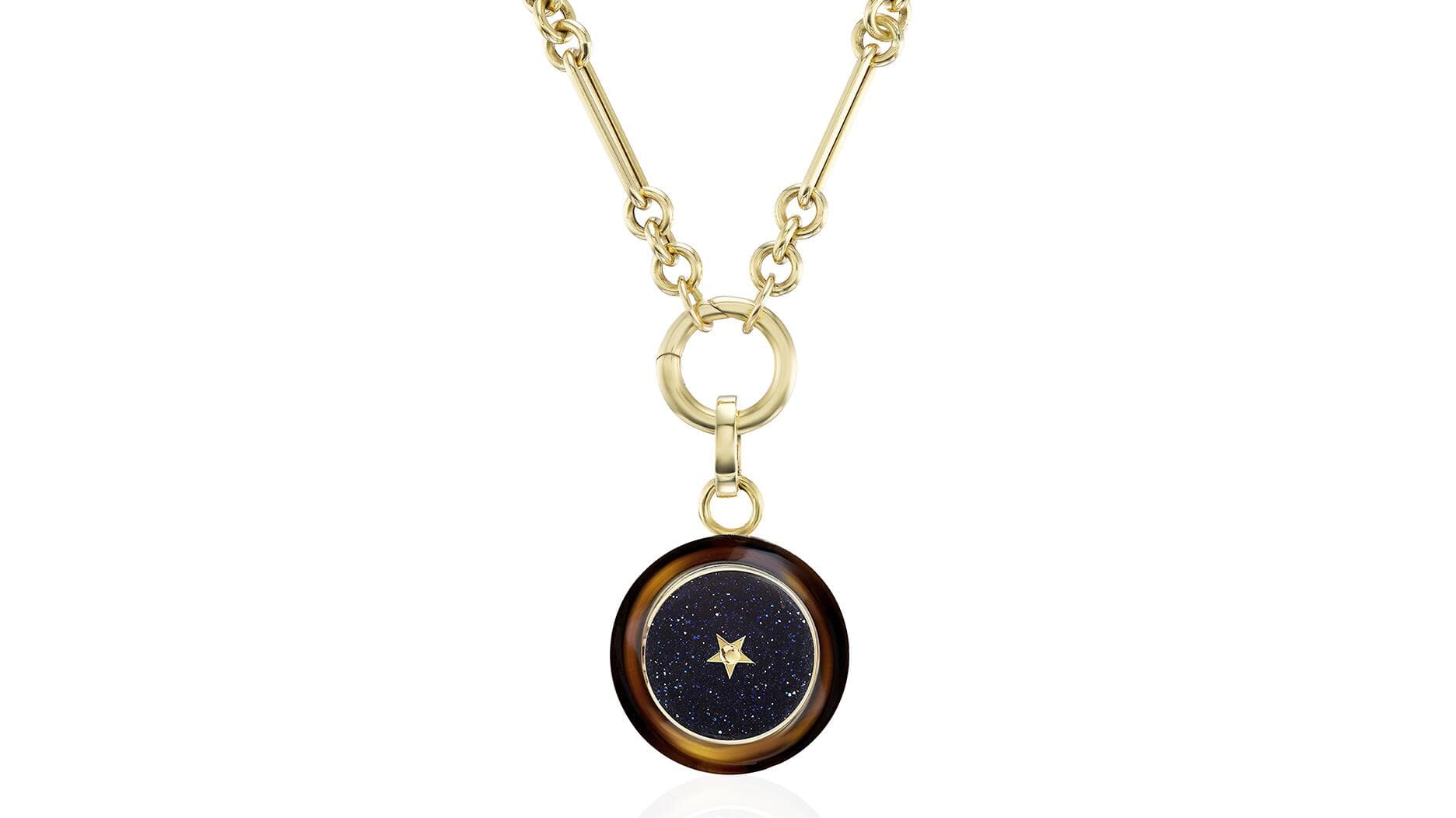
Anna Maccieri Rossi’s Carpe Diem pendant is a strong case study in this new jewelry language. After years working in watchmaking for luxury brands, she launched her fine jewelry line in 2018 with time as her central theme, describing it as “our most precious treasure.” That background matters, because the piece is not trying to imitate conventional high jewelry so much as translate horology into wearables.
The concept merges dial art and movement, and Rapaport noted that the little star at the center moves every second, a subtle kinetic detail meant to remind the wearer that every moment counts. That is not merely poetic branding. It is engineering used as narrative, with motion itself becoming part of the emotional value.
The construction reinforces that point. 1stDibs describes Carpe Diem as a pendant made with white ceramic or brown resin and titanium, paired with an 18-karat gold clasp or openable clasp and a clock movement inside. In other words, gold is present, but strategically, not excessively. The piece still carries the prestige signal of gold, yet its identity comes just as much from the contrast between precious and technical materials, and from the fact that it houses a functioning movement.
That is what makes the pendant feel like a response to the current market rather than a workaround. It does not apologize for using less gold. It makes the reduction part of the meaning.
What is still worth buying now
The best pieces in this market are the ones that understand weight as a choice, not a guarantee. If a jewel feels lighter, the question is whether that lightness serves a clearer silhouette, a more original construction, or a smarter material mix. If gold is used sparingly, it should still be used decisively, in a clasp, a frame, a bezel, or a mechanical detail that matters.
That is where the real distinction lies for buyers navigating high metal prices. A thinner piece can be more valuable than a heavier one if the design is disciplined, the engineering is thoughtful, and the materials are chosen with purpose. The market’s message is no longer that more gold automatically means more jewelry. It is that the most persuasive pieces can now carry their value in proportion, precision, and the intelligence of what they leave out.
This article was produced by Prism’s automated news system from verified source data, official records, and press releases, then run through automated quality and moderation checks before publishing. The system is built and supervised by the people who set the standards it runs under. Read our full AI policy.
Did this article answer your question?