Expensive gold is changing how people buy engagement rings
Gold up 70% in a year pushed average ring prices 47% higher at some bridal shops, even as diamond prices fell. Here's how to navigate the math before your first appointment.
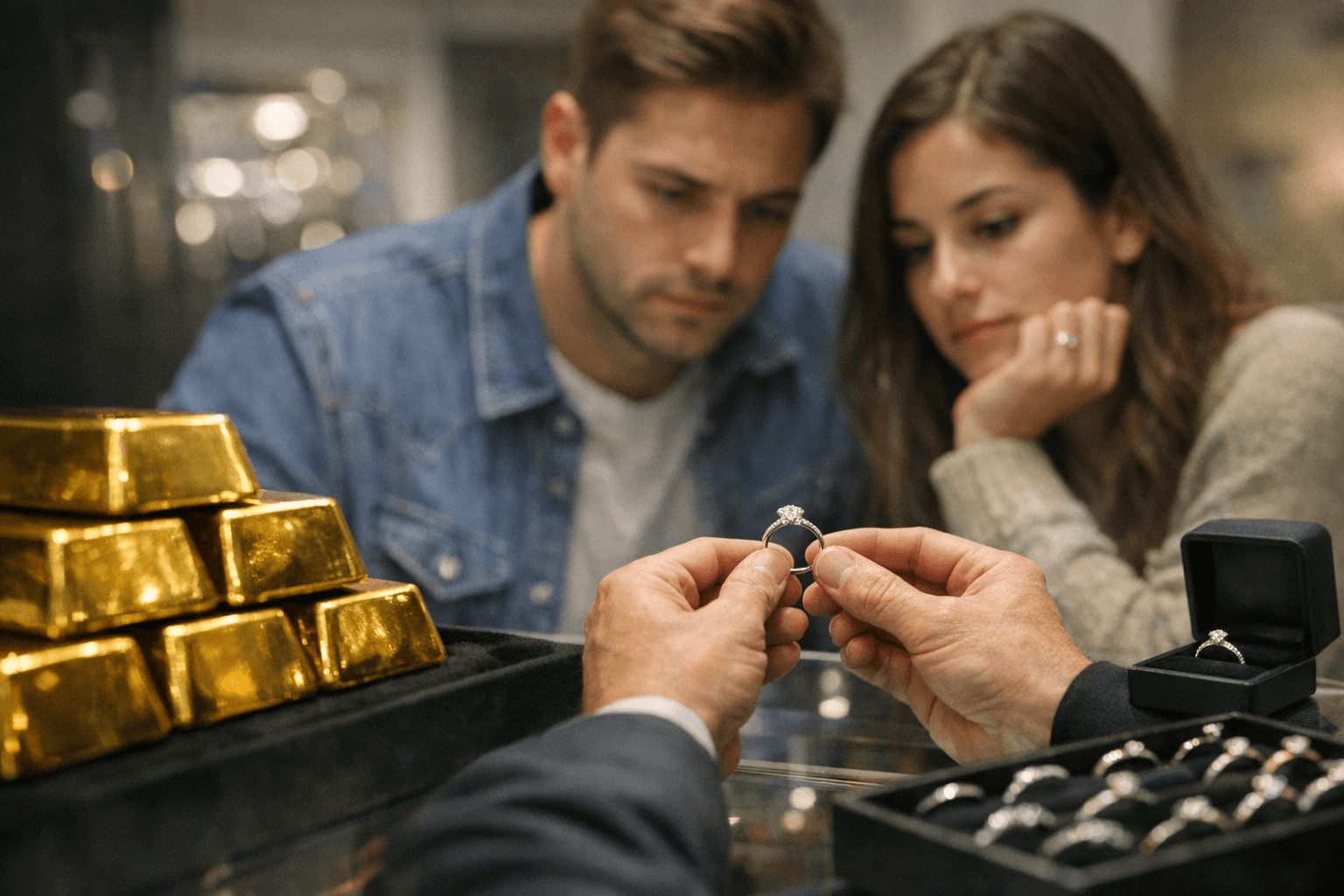
Walk into a bridal jewelry counter today carrying a mental budget from two years ago and prepare for a full recalibration. The metal beneath the stone has quietly become the most disruptive variable in engagement ring pricing, and no amount of savvy diamond shopping fully cancels it out.
Gold prices hit a record high above $5,500 per troy ounce in late January 2026. Spot gold prices are currently around $4,650, over 70% higher than at the start of 2025. For couples who tracked the market even loosely, those numbers are jarring. For couples who didn't, the quote they receive at the counter can feel like a different currency entirely.
The number that explains the sticker shock
At Ben Garelick, a New York-based bridal jeweler, the average engagement ring price jumped 47% from 2024 to 2025, reaching $2,408. That jump came even as loose diamond prices at the store fell nearly 40% from 2023 to 2025, largely because lab-grown diamonds, now the majority of its sales, became cheaper. Gold absorbed the savings, and then some. Men's wedding band prices rose from $1,050 in 2023 to $1,575 in 2025. Women's bands moved more modestly, from $1,700 to $1,800, partly because lab-grown diamonds and 10K gold options helped contain the climb.
The impact is especially pronounced in the mid-range affordable luxury segment, where consumers are more price sensitive. When gold behaves like a speculative asset, a bridal purchase starts to feel uncomfortably like one too, and that friction changes behavior at the counter.
What buyers are actually doing
The consumer response has taken several distinct shapes. Some couples are delaying proposals outright, waiting for a gold price stabilization that may not arrive on any predictable timeline. Others are turning to financing and layaway arrangements, spreading costs across months rather than accepting a single point-of-sale number. And a meaningful share are having a frank conversation with their jeweler about karat.
That conversation matters more than most buyers realize. Gold purity is measured in karats, with 24K representing pure gold. The metal in fine jewelry is alloyed for durability: 18K contains 75% gold, 14K contains 58.3%, and 10K contains 41.7%. With spot gold above $4,600 per ounce, that difference in gold content translates directly and immediately into price. A ring built in 10K gold can cost meaningfully less than the same design in 14K, and significantly less than 18K, though the visual difference between 14K and 18K yellow gold is subtle enough that most wearers would never notice it on the hand.
14K, 18K, or platinum: the metal decision before you walk in
Before your first appointment, it helps to know where you stand on each option.
- 18K gold is the prestige standard for fine bridal jewelry: 75% pure gold, a rich warm color, and a softness that makes it ideal for intricate pave and filigree settings. It carries the highest gold-content premium in the current market, full stop.
- 14K gold is what most independent jewelers recommend for daily wear. Its higher alloy content makes it more durable, holds prongs more securely, and resists surface scratching better than 18K. At current gold prices, the cost difference between 14K and 18K on a simple solitaire band can run several hundred dollars.
- 10K gold is the legal minimum karat sold as gold in the United States. It offers maximum durability and the lowest gold-content cost, though its slightly paler yellow tone is perceptible on warmer-hued pieces.
- Platinum deserves serious consideration in 2026. Historically priced well above gold, platinum now trades at a significant per-ounce discount to gold, making it a more competitive option for white-metal settings than it has been in years. Its density and durability make it especially well-suited to prong settings holding a center stone. Even Pandora has read the market: the brand is introducing platinum-plated versions of its best-selling pieces in 2026, with leadership citing a need to "reduce our reliance on silver to protect margins."
Lab-grown diamonds: the cost lever that changes the equation
If gold is the problem, the stone is, counterintuitively, part of the solution. Lab-grown diamonds have driven wholesale diamond prices down sharply, and that pricing pressure has now reached retail counters in full force. A one-carat lab-grown diamond that retailed for close to $3,000 in 2022 can now be found for under $1,000 at many jewelers, representing a windfall that can be redirected toward a higher-karat setting, a more complex design, or a larger center stone.
The tradeoff deserves candor: lab-grown diamonds do not hold resale value the way natural diamonds do, and that gap is widening as supply increases. For a couple who plans to keep the ring indefinitely and places no weight on resale, a lab-grown stone is a genuinely pragmatic choice. For one who views the piece as a long-term asset, the calculus is different.
Heirloom rescue: the sentimental alternative gaining real traction
Not every couple is trading down on materials. "If anything, we're seeing the opposite," said the founder of Florida-based fine jewelry brand Henri Noël, who noted that her clients are still choosing 18K or 14K gold for their engagement rings as they are seen as future heirlooms. "These are deeply emotional, milestone purchases, so couples are not typically looking to downgrade materials."
That heirloom logic is reshaping another segment of the market entirely. Jewelers are reporting a meaningful uptick in heirloom rescue and redesign: the practice of bringing in an existing piece, whether a grandmother's solitaire, an inherited band, or a vintage stone sitting in a safety deposit box, and resetting it into a contemporary design. The stone, which often represents the single largest cost in an engagement ring, is already paid for. Labor, a new setting, and perhaps a few accent stones represent a fraction of starting from scratch. As one jeweler in the space put it: "Clients are realizing that the jewelry sitting in a drawer is often one of the most meaningful and valuable assets they already own."
A budget-first decision tree before your first appointment
1. Break out the metal cost from the stone cost. Ask your jeweler to quote both line items separately. The split will tell you where your budget pressure actually lives.
2. Decide your karat floor before you arrive. If 14K meets your aesthetic and durability standards, you do not need 18K. The saved gold content is cash, a larger stone, or a more intricate setting.
3. Get platinum and white gold quotes side by side. At current pricing, the gap between the two may be smaller than you expect, and platinum's durability advantage is real.
4. Treat lab-grown as a deliberate tradeoff, not a compromise. A 1.5-carat lab-grown diamond in a handcrafted 14K setting is visually identical to a natural stone at twice the retail price. If the savings serve other life priorities, that is a coherent choice.
5. Ask about heirloom inventory before you shop retail. A skilled setter can work with stones from vintage rings, brooches, and earrings. One conversation can redirect significant money.
6. Lock in a price if you're ready. If gold's direction worries you, a deposit or layaway arrangement protects you from further increases before your delivery date.
Gold's volatility is unlikely to resolve on a timeline that aligns with proposal season. The forces driving it, sustained institutional demand, economic uncertainty, and constrained global supply, don't move to the rhythms of a jewelry calendar. The shifts underscore how jewelers are rethinking materials and pricing as precious-metal markets grow increasingly volatile after historic gains. For couples willing to engage with those options deliberately, the sticker shock at the counter is the beginning of the conversation, not the end of it.
This article was produced by Prism’s automated news system from verified source data, official records, and press releases, then run through automated quality and moderation checks before publishing. The system is built and supervised by the people who set the standards it runs under. Read our full AI policy.
Did this article answer your question?