High Jewelry Houses Bet on Storytelling, Provenance, and Experience to Stay Relevant
Ninety-two percent of necklace buyers still choose natural stones over cheaper alternatives. The story behind the stone is now the product.

When you clasp a necklace with a natural stone at its center, you are participating in something the industry now recognizes as a full-scale structural shift. Nine out of ten fashion necklaces sold today feature natural stones rather than lab-grown alternatives, even as lab-grown options grow dramatically more affordable. That 92% figure, drawn from CaratX's 2025 analysis, is not a fluke of consumer conservatism. It is evidence that buyers are paying a premium for perceived provenance: the idea that the stone in their hands has a history worth telling.
This is what high jewelry houses are betting on. Meaning, they have decided, is a competitive moat that no price adjustment can replicate.
A Market With Serious Stakes
The scale of the opportunity clarifies the urgency. The global jewelry market was valued at USD 242.79 billion in 2025, projected to reach USD 254.13 billion in 2026 and USD 387.36 billion by 2034, growing at a compound annual rate of 5.41% according to Fortune Business Insights. Within that broader market, the luxury jewelry segment grew from USD 30.66 billion in 2024 to USD 32.78 billion in 2025 and is forecast to reach USD 51.75 billion by 2032, per Research and Markets. Some projections from Business Research Insights and SkyQuest place luxury jewelry at USD 59.06 billion as early as 2026, driven by a faster CAGR of 8.83%.
Asia Pacific is the world's dominant regional jewelry market, holding 39.23% of global market share in 2025, a fact that shapes every expansion strategy from Paris to New York. The productivity benchmarks within luxury jewelry retail make the stakes even plainer: Graff, according to the Deloitte Luxury Report 2025, achieves an estimated USD 15,000 in revenue per square foot, placing high jewelry among the most concentrated and high-stakes retail categories anywhere in the world.
Provenance as Design Brief
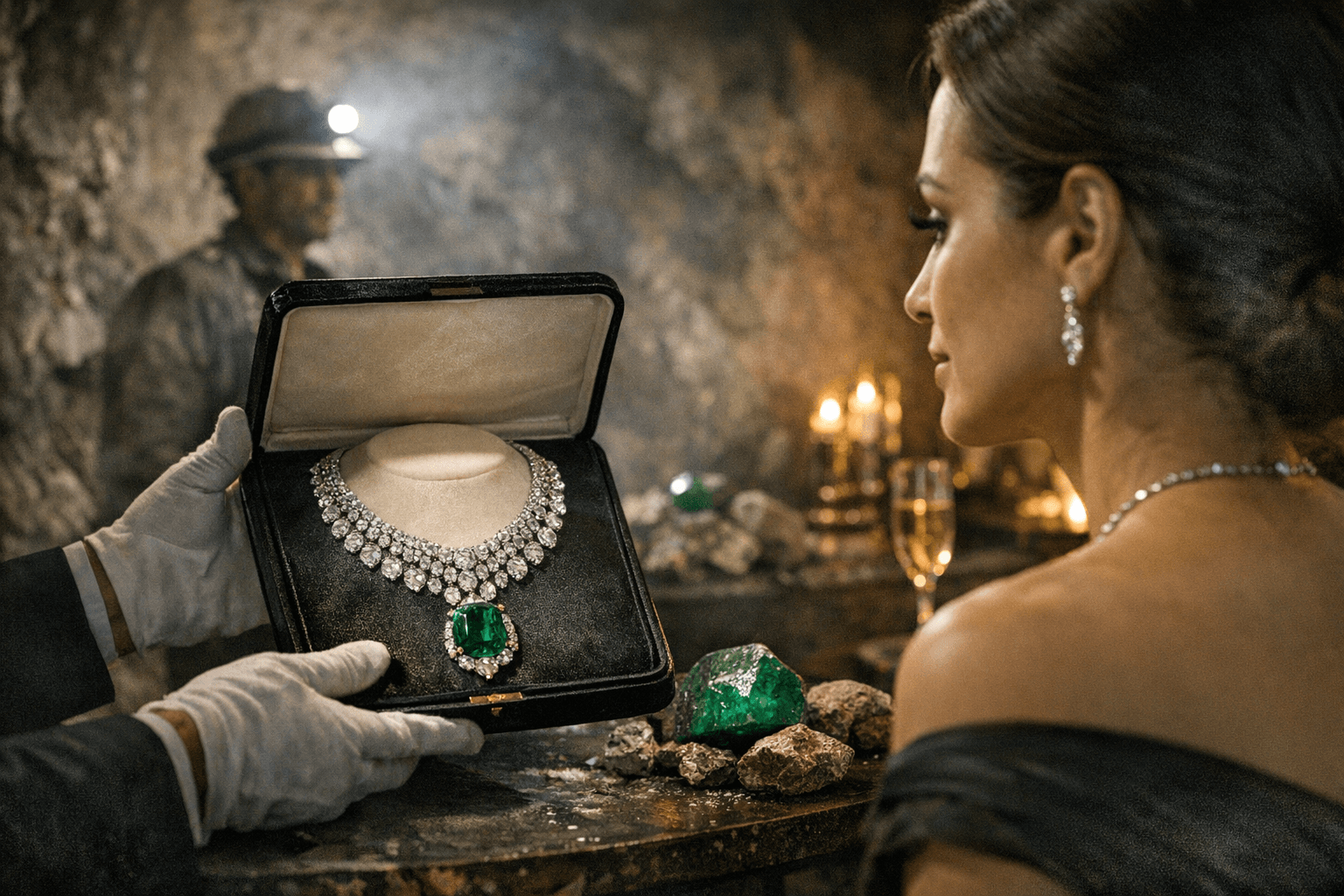
The most significant strategic shift across high jewelry houses is the reframing of provenance. Not as compliance language buried in a sustainability report, but as a creative asset woven through the entire client experience. Artisan narratives, atelier processes, source community stories, and certificates of origin have moved from footnote to foreground; they are now part of the creative brief itself.
This is harder to execute than it sounds. Approximately 80% of the world's colored gemstones come from small-scale artisanal mines, making traceability an endemic structural challenge for any house working with rubies, sapphires, emeralds, or the full chromatic spectrum of colored stones. Tiffany & Co. has confronted this directly, applying strict sourcing protocols across 60 varieties of colored gemstones used in its jewelry. The brand is broadly described as doubling down on sustainability, launching a series of ambitious initiatives designed to elevate responsible sourcing across the luxury sector.
On the diamond side, the traceability conversation has moved into technology. De Beers launched Tracr, its blockchain-based diamond traceability platform, in 2018 in partnership with Accenture. As of 2025, every diamond over one carat registered on the platform can be traced to a single country of origin, a significant leap in what the category could previously verify. De Beers now registers over two-thirds of its global production by value on Tracr, which has tracked 2.8 million diamonds to date. The platform is expanding its verification capabilities through a partnership with Sarine, a leader in diamond scanning and evaluation technology, reinforcing traceability as a technologically verifiable competitive asset rather than a claim taken on faith.
The Psychology Behind the Purchase
Industry research validates what the provenance push is responding to. Planderful's 2026/2027 industry forecast puts the shift plainly: "Consumers are no longer purchasing jewelry purely as decorative luxury goods. Instead, they are seeking pieces that represent personal narratives, ethical values, emotional milestones, and cultural identity."
Tuple Strategy's 2025 jewelry consumer trends research documents the same structural change: modern luxury consumers are prioritizing experiences and narratives over pure product acquisition, with measurably increased demand specifically for jewelry with documented stories or historical significance. The house that can tell you who cut the stone, which valley the ruby came from, and which atelier hand-finished the setting has a story that no discount can undercut. Context, in other words, has become both the creative brief and the commercial differentiator.
Experiential Retail, Flagship Expansion, and New Categories
Flagship expansion is one of the most visible expressions of this strategy. When Bulgari opened a second New York City boutique at Hudson Yards, it joined Tiffany & Co., Cartier, Van Cleef & Arpels, and Messika in what has become one of the world's most concentrated luxury jewelry retail corridors. Hervé Perrot, CEO of Bulgari North America, described the brand's "longstanding connection with New York City since it opened the doors of its first boutique over 50 years ago," a heritage the house actively weaves into its retail programming and client storytelling.
That kind of archival depth is not decorative. Van Cleef & Arpels, which has been headquartered at Place Vendôme in Paris since 1906, is a case study in how houses deploy institutional history as both narrative resource and competitive positioning. The maisons investing most heavily in experiential retail are doing more than opening beautiful rooms. They are building commissioning programs that place a client's own story at the center of the creative process, staging boutique events that introduce artisans and atelier techniques, and investing in recycled metals and responsibly sourced materials as visible proof points, not quiet footnotes.
Archival motifs and artist collaborations provide another layer of narrative texture, lending collections a lineage that a newly launched brand cannot manufacture. Digital experiences that foreground maker narratives extend these stories to audiences who may never walk through a flagship door, meeting a generation of buyers who research provenance online before they ever step inside.
Beyond jewelry itself, the category extension strategy broadens the storytelling surface further. Houses are moving into wearables and home objets, finding new formats through which provenance-driven narratives can reach clients across different contexts of daily life. A decorative objet with documented materials and an atelier origin story carries the same emotional logic as a sapphire ring. The container changes; the architecture of meaning does not.
A Supply Chain Under Scrutiny
The pressure reshaping the industry is not only coming from ambitious houses seeking growth. The Association of Intelligent Diamond International describes the luxury jewelry sector as undergoing a significant transformation as brands scrutinize their supply chains at a level of granularity that would have been unusual a decade ago. Consumer awareness has extended the accountability conversation beyond environmental concerns to encompass human rights, labor practices, and community development in source regions.
The brands succeeding in this environment are those treating ethical sourcing not as a liability to be managed quietly but as a narrative to be told transparently: the workers in the source community, the conditions governing extraction, the audit trail that a buyer can follow from mine to setting. This is accountability as design language, not PR.
What Credibility Actually Costs
The confluence of market scale, technological traceability, consumer psychology, and experiential retail creates a specific kind of pressure on every house in the fine jewelry space. The question is no longer whether to invest in provenance programs or storytelling infrastructure. It is whether the investment is deep enough to hold up to scrutiny.
For a category where Graff generates USD 15,000 per square foot and a single diamond's journey from mine to finger can now be verified on a blockchain tracking 2.8 million stones, the bar for what constitutes a compelling story has risen considerably. The houses that are winning treat every provenance certificate, every atelier visit, every archival collaboration, and every recycled metal choice as substance rather than marketing. They understand that when a buyer asks where something came from, the answer is now the product. The stone and its story have always been inseparable in jewelry. What has changed is that buyers have found the tools to demand both.
This article was produced by Prism’s automated news system from verified source data, official records, and press releases, then run through automated quality and moderation checks before publishing. The system is built and supervised by the people who set the standards it runs under. Read our full AI policy.
Did this article answer your question?