JCK Las Vegas 2026 Spotlights AI, 3D Printing, and the Future of Meaningful Jewelry
JCK Las Vegas 2026 is repositioning itself as a technology catalyst, spotlighting 3D printing and AI tools that are rewriting how jewelry is made and sold.
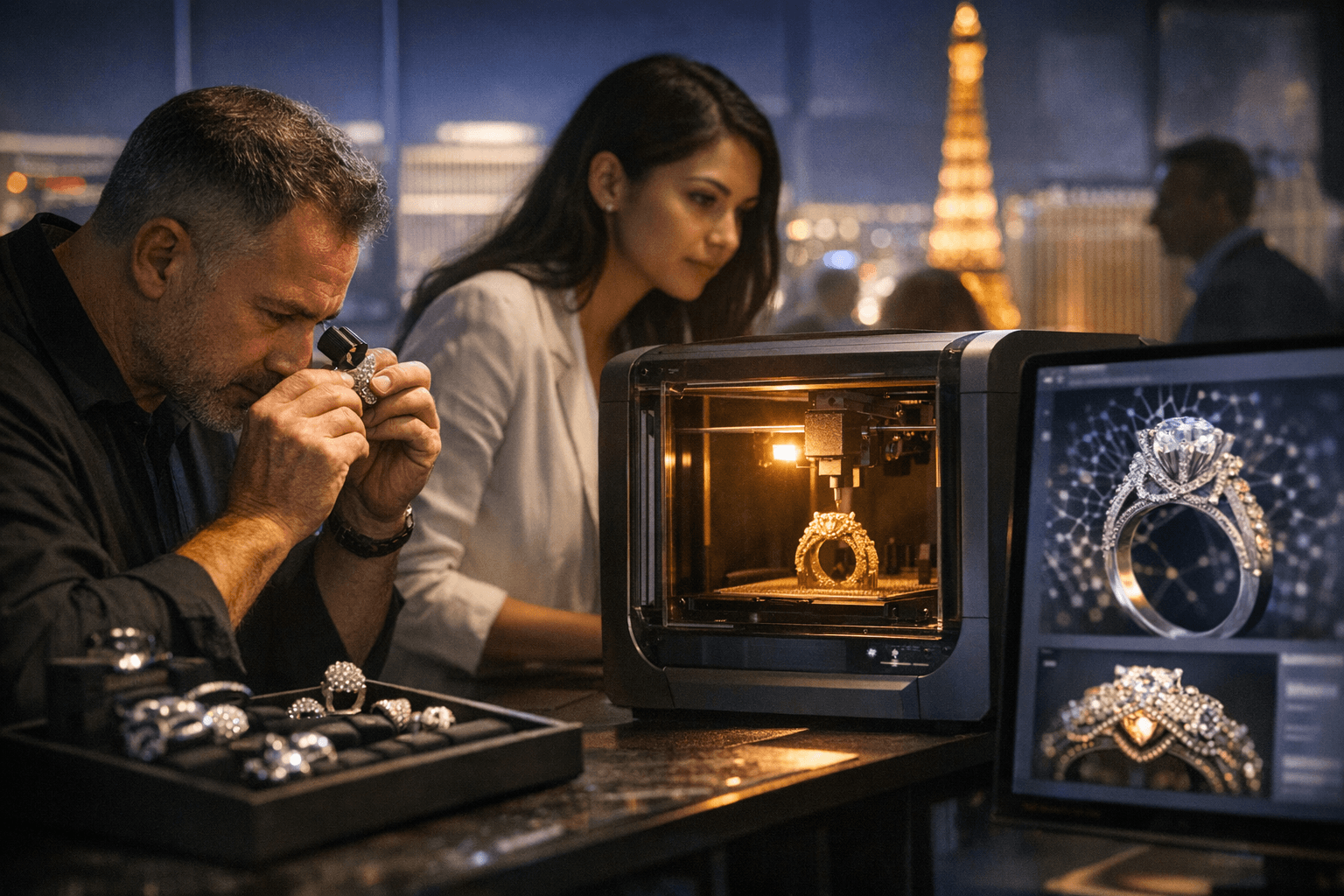
The trade show floor has always been where jewelry's future takes shape, but JCK Las Vegas 2026 is arriving with a more pointed argument than usual: that technology is no longer a peripheral concern for the industry, but the central one. A preview published in mid-March 2026 framed the event's editorial thesis with unusual directness, describing the show as "foregrounding technologies that change how meaningful jewelry is designed, authenticated and retailed." Those three verbs, design, authentication, retail, map the entire lifecycle of a piece of jewelry, from the designer's first sketch to the moment it passes across a counter into someone's hands.
The Technologies Taking Center Stage
Three specific technology areas have been identified as focal points for the 2026 show, each addressing a different pressure point in the modern jewelry business.
The first is 3D printing, described explicitly in the show's preview as a tool for "bespoke and low-waste production." That framing matters. The jewelry industry has long wrestled with the tension between custom work, which clients increasingly want, and the material waste that traditional casting and fabrication methods generate. Additive manufacturing dissolves that tension in principle: a piece can be designed to exact specifications and produced with minimal excess material. For the artisan jeweler who has historically hand-carved wax models, or the mid-size manufacturer running limited production runs, 3D printing represents a workflow shift with genuine implications for both cost structure and environmental footprint.
The second focus area is AI-driven design. Artificial intelligence is arriving in jewelry design not as a gimmick but as a functional tool, one that can accelerate iteration, suggest proportional relationships between stones and settings, and help translate a client's vague aesthetic instincts into a workable technical brief. The 2026 show positions AI design tools as part of the core conversation, not a satellite seminar topic.
The third is inventory management. This is less glamorous than the other two, but arguably the technology with the most immediate bottom-line impact for retailers. AI-assisted inventory tools can help retailers anticipate demand, reduce overstock on slow-moving categories, and identify which price points and stone types are actually driving sales. For a small independent jeweler running a shop where margins are thin and cash is tied up in cases full of slow-moving product, that kind of intelligence can be the difference between a profitable quarter and a difficult one.
Authentication and Retailing: Where Technology Meets Trust
The preview's explicit mention of authentication as one of the three spheres technology will change is significant, and worth pausing on. Authentication in jewelry is not a new problem, but it is an accelerating one. As lab-grown diamonds have moved from novelty to mainstream, as vintage and estate pieces circulate in larger volumes through online platforms, and as consumers have grown more skeptical and more informed, the question of what a piece actually is, and what it is actually worth, has become more urgent. Technologies that can verify stone origin, confirm metal purity, or create immutable provenance records are no longer theoretical; they are commercially available and increasingly expected. The 2026 show's framing of authentication alongside design and retail suggests a mature industry acknowledgment that trust infrastructure is as important as creative output.
Retail technology, meanwhile, is evolving beyond point-of-sale. The convergence of AI tools with customer relationship management, virtual try-on, and personalization engines is changing what it means to sell jewelry, particularly for retailers whose clients now begin their research online and arrive in-store already knowing what they want. Technology that helps jewelers meet that client where they are, rather than starting from zero at the counter, is increasingly a competitive necessity.
Sustainability as the Thread Running Through All of It
One of the show's organizing ideas, described in preview materials as a "symbiotic relationship" between sustainability and technology, reflects a broader industry reckoning. The two concerns are genuinely linked. 3D printing's waste-reduction potential is the most concrete example, but AI design tools can also reduce the number of physical samples a jeweler needs to produce before arriving at a final design, and better inventory management means fewer pieces are manufactured only to sit unsold and eventually melt down. The environmental logic of technology adoption is not incidental to the creative or commercial logic; it runs alongside both.
JCK Las Vegas as Catalyst, Not Just Convention
JCK Las Vegas has operated as a vital platform for jewelry professionals to connect, discover new trends, and conduct business for decades. What the 2026 edition is attempting is something more specific: to be, in the show's own framing, "a catalyst for change in the jewelry industry" rather than simply a marketplace. The distinction is meaningful. A marketplace is where transactions happen. A catalyst is where the conditions for future transactions, and future practices, get established.
The show aims to accelerate technology adoption across the entire jewelry value chain by bringing designers, manufacturers, retailers, and technology providers into direct conversation with one another. That cross-sector dialogue is where the most productive friction tends to happen: a retailer explaining to a 3D printing vendor exactly what a custom client actually needs, a designer pushing back on what an AI tool currently cannot do, a manufacturer pressing a sustainability claim until it becomes a verifiable standard rather than a marketing line.
The jewelry industry, as previews of the 2026 show acknowledge, is undergoing rapid transformation driven by both technological change and shifting consumer expectations. Those two forces are not moving independently. Consumers who care about provenance are creating demand for authentication technology. Clients who want bespoke pieces without bespoke price tags are creating demand for additive manufacturing. Retailers who need to run leaner operations are creating demand for smarter inventory tools. The technologies on the floor at JCK Las Vegas 2026 are not solutions in search of problems; they are responses to pressures that are already reshaping the market.
For professionals navigating this landscape, the Jewelry Business Growth Playbook has been cited as a companion resource offering additional strategies for adapting to these shifts, though the show floor itself will be the more immediate curriculum.
What This Means for the Industry
The jewelry trade has always absorbed new tools, from the introduction of the flexible shaft machine to CAD-CAM rendering to online diamond grids. Each time, the technology changed some practices without erasing the craft logic underneath them. What is different now is the speed and scope of change, and the degree to which multiple technologies are converging simultaneously. A jeweler in 2026 who wants to stay competitive may need to think simultaneously about how AI can improve their design process, how additive manufacturing can reduce their production waste, how inventory tools can sharpen their buying decisions, and how authentication technology can give their clients the confidence to spend more and worry less.
JCK Las Vegas 2026 is positioning itself as the place where that thinking happens in concentrated, cross-disciplinary form. Whether it delivers on that ambition will be measured in the conversations that leave the floor and become actual business decisions, the workflows that change, the pieces that get made differently, the clients who are better served. The meaningful jewelry of 2030 is being imagined now.
Know something we missed? Have a correction or additional information?
Submit a Tip