JCK spotlights five Jewelers’ Choice winners with bold, distinctive design
A praying mantis brooch turns JCK’s awards roundup into a lesson in color, craft, and symbolism. These winners prove fine jewelry stands out most when it feels alive.
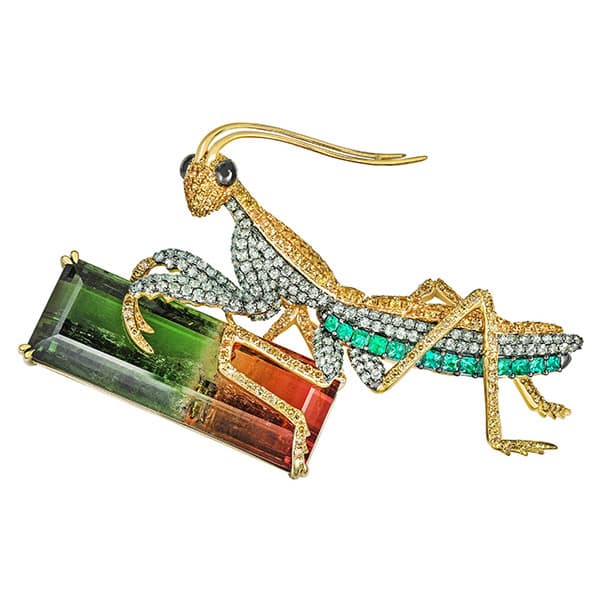
The most arresting jewel in JCK’s Jewelers’ Choice spotlight is a brooch that looks almost alive. The 2026 winners were announced on May 4, and JCK’s editors followed with a May 8 look at the pieces that felt most singular, in a competition judged by retailers and sometimes amplified with separate Editors’ Choice and Influencers’ Choice honors. The next entry period opens after Labor Day.
The praying mantis brooch that steals the scene
Nelson Jewellery’s Best Statement Piece winner is the kind of object that stops the eye before it even registers as jewelry. Priced at $27,000, the brooch centers on a 93.68-carat tourmaline and is further set with 5.85 carats total weight of sapphires, 1.4 carats total weight of diamonds, and 1.22 carats total weight of emeralds. The result is less a generic cocktail pin than a miniature creature with posture, wit, and a pulse.
Karen Dybis responded to it as if it were animated, praising its craftsmanship, playfulness, and the sense of life it projects. That matters, because the mantis form does more than decorate a lapel: it turns scale, anatomy, and gemstone weight into a narrative object. In a market crowded with pretty but forgettable brooches, this one makes a case for jewelry as character study.
Trésor’s sapphire drops bring back the joy of color
Trésor’s Desir 18k yellow gold multi-sapphire drop earrings show how strong color can feel both exuberant and precise. At $4,950, they sit at a far more approachable price point than the headline-grabbing statement jewels around them, yet they still carry 15.23 carats total weight of blue, pink, orange, and yellow sapphires. The mix of hues gives the earrings a buzzy, almost kinetic energy that reads immediately in motion.
Melissa Rose Bernardo pointed to the brand’s long memory, recalling a multicolored bracelet from JCK 16 years ago and noting the groovy color combinations, mixed-shape gems, and fluid 18k gold settings that let the stones catch and throw light. That combination of saturated palette and easy flow is one of the clearest style signals in the roundup: color is not being treated as an accent anymore, but as the design itself.
Khepri’s cartouche necklace turns symbolism into luxury
Khepri Jewels’ Cartouche charm fancy color diamond necklace is the most overtly symbolic of the group, and at $286,000 it wears that symbolism with confidence. Victoria Gomelsky described it as evoking Cleopatra-era opulence while still feeling current, and the piece’s natural fancy colored diamonds make the point sharper in a market crowded with look-alike lab-grown stones. The visual effect is warm, desert-toned, and unapologetically rare.
JCK’s product directory says the Cartouche Collection draws from the ancient Egyptian cartouche, the sacred oval associated with protection and power, then reimagines it as a modern talisman meant for layering. That detail gives the necklace more weight than mere ornament: it is jewelry that wants to carry meaning, not just sparkle. In a season full of polished minimalism, Khepri argues for pieces that are loud about their lineage.
Vanessa Fernández proves the power of the hand
Vanessa Fernández’s Las Olas ring is the most quietly persuasive of the spotlighted pieces, and it earned both Editors’ Choice and Influencers’ Choice in Diamond Jewelry over $10,000. Priced at $50,000, it is built around two pear-shape diamonds just over 2 carats each, a pairing that depends on proportion, balance, and the confidence to let shape do the talking. It feels refined rather than flashy, which makes its impact last longer than a louder setting might.
Fernández’s separate Grand Prize win for her Curva necklace, set with 32.14 carats of lemon-yellow chrysoberyls, deepens the picture. JCK has described her as a Miami jeweler trained in traditional goldsmithing who handcrafts and hand-fabricates her work at the bench, and that labor shows in the sculptural firmness of her pieces. Her style celebrates the female form with curves that feel sensual and deliberate, not fussy, and that sensibility gives her jewelry a distinct voice inside a crowded field.
Why these winners matter beyond the awards table
Taken together, the winners form a clear editorial argument: the strongest jewelry in 2026 is not trying to disappear into a wardrobe. It wants to stand apart through creaturely forms, saturated stones, talismanic symbols, and the unmistakable evidence of a maker’s hand. That is why Nelson’s mantis reads as sculpture, Trésor’s earrings read as movement, Khepri’s necklace reads as heritage, and Fernández’s ring reads as architecture in miniature.
JCK’s wider awards coverage reinforces the point by highlighting other risk-takers such as Pompos’s opal ring and Rahaminov’s $725,000 diamond necklace. The message is consistent across the slate: the pieces that win attention are the ones willing to be specific, whether that means natural fancy colored diamonds instead of a generic white-diamond gloss, a brooch shaped like an insect, or goldwork that reveals the maker’s discipline at every turn. That is the direction readers will recognize in the next wave of fine jewelry, and it is already here.
This article was produced by Prism’s automated news system from verified source data, official records, and press releases, then run through automated quality and moderation checks before publishing. The system is built and supervised by the people who set the standards it runs under. Read our full AI policy.
Did this article answer your question?