Le Vian's Montana Sapphire Documentary Turns Provenance Into Personal Meaning
Le Vian's 15-minute Montana sapphire documentary transforms a mining site into a keepsake origin story — and reveals exactly what provenance-minded buyers should demand at the counter.
The pieces that carry the most meaning rarely announce themselves loudest. They carry something quieter: a place, a person, a process you can trace back to the earth. Le Vian understood that when it committed not just to sourcing Montana sapphires but to filming the journey — from gravel deposit to goldsmith's bench — in what became its first-ever documentary. Released on the brand's YouTube channel in November 2025 and now the subject of trade analysis reported by Karen Dybis in JCK, *The Story of the Montana Sapphire: America's Rare Treasure* is a 15-minute film that has quietly accumulated more than 9,000 views. That number understates its influence. What Le Vian built is less a marketing asset than a provenance playbook, and for anyone shopping Montana sapphires in 2026, it doubles as a consumer-protection lens.
A Film Built Around Place
The documentary is anchored to two specific addresses: Rock Creek, near Philipsburg in southwestern Montana, and Yogo Gulch in Judith Basin County in the state's central plains. These are not interchangeable stand-ins for "American mining." They are geologically distinct sources that produce sapphires of fundamentally different character, and the film treats them that way.
Gem explorer Yianni Melas, described in trade coverage as a "modern-day Indiana Jones of gems," guides viewers through both deposits alongside Steven LeVian, who represents the brand on camera. Together, they move through soaring Big Sky vistas to arrive at something intimate: family-run mines, the workers who pull sapphires from gravel and dike rock, and the cutters who transform raw material into finished gems. Steven LeVian has said it was his first time visiting any mine, and that the experience shaped how he understood the stones themselves. Jonathan LeVian, vice president of sales and marketing, offered the distillation: "It is more than jewelry. It is a love letter to America."
That framing is deliberate. Le Vian's 2026 trend forecast centers on patriotism and American heritage, and the Montana sapphire sits squarely at that intersection, connecting the frontier gold-rush history of the 1860s — when prospectors first stumbled on blue stones while working Missouri River gravel bars — to a contemporary fine jewelry proposition.
Two Sources, Two Stories
Understanding why the film dwells on both Rock Creek and Yogo Gulch matters enormously if you plan to buy a Montana sapphire. These deposits are not variations on a theme; they are distinct gems.
Rock Creek sapphires are alluvial stones pulled from gravel deposits near Philipsburg. Their defining trait is chromatic range: pastel blues, sea greens, soft purples, and pinks all emerge from the same deposit, making Rock Creek the primary source for the kind of teal and color-shift stones that dominate the current market. They tend toward lighter saturation in their natural state, which is why heat treatment is standard practice for commercial-grade Rock Creek material. That treatment is not inherently problematic, but it must be disclosed.
Yogo Gulch produces an entirely different gem. Found within a vertically dipping igneous dike in Judith Basin County, Yogo sapphires are cornflower blue by nature, with exceptional clarity and a consistency of color that requires no enhancement. Their rarity is structural, not just geological: the deposit's physical configuration has made large-scale mining sporadic and rarely profitable since Jake Hoover first discovered the stones in 1895 while searching for gold. A fine, unheated Yogo sapphire is among the most honest gems in the American market. Its color is what the earth made it.
The Ombré Collection: Seven Shades as a Design Argument
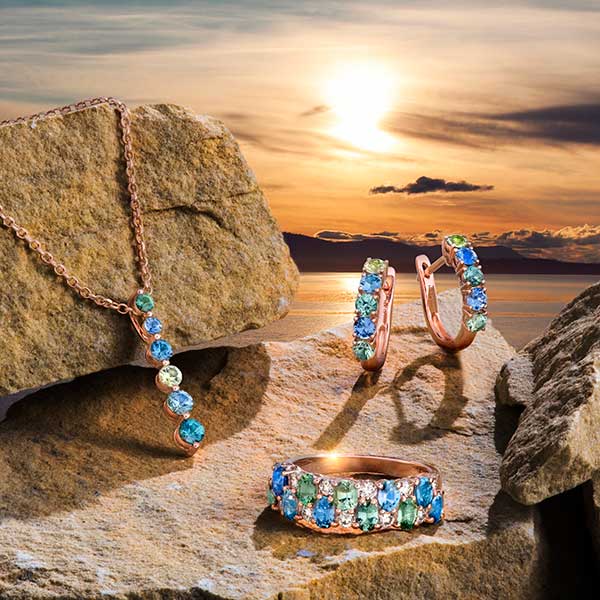
The film was built to support the Montana Sapphire Ombré collection, and the collection was built to make Rock Creek's color range its selling point rather than a liability. Pieces arrange Montana sapphires in gradient sequences spanning seven shades: glacier blue, through a range of teal and sage midtones, to prairie green and golden dawn. The effect is visual storytelling in metal and stone, a wearable echo of the landscapes shown in the documentary.
The collection spans tennis necklaces, anniversary bands, hoops, and bracelets, all crafted in the United States and set in gold, with prices beginning at $999. It is available through authorized retailers including Kay Jewelers and luxury independent jewelers, as well as Le Vian's One Day Only pop-up events. For a branded collection with documented American provenance and a starting price under $1,000, the entry point is competitive against comparable colored-stone collections that make similar ethical claims without the same paper trail.
How Cinematic Provenance Becomes Personal Meaning
The strategic logic behind the documentary is worth naming plainly, because it is a model the entire industry is watching. Fine jewelry has historically sold on aesthetics and material value. What Le Vian is testing is whether showing a buyer the mine, the miner's face, and the cutter's hands can transfer emotional weight to the finished piece in the same way a handwritten note tucked inside a box might.
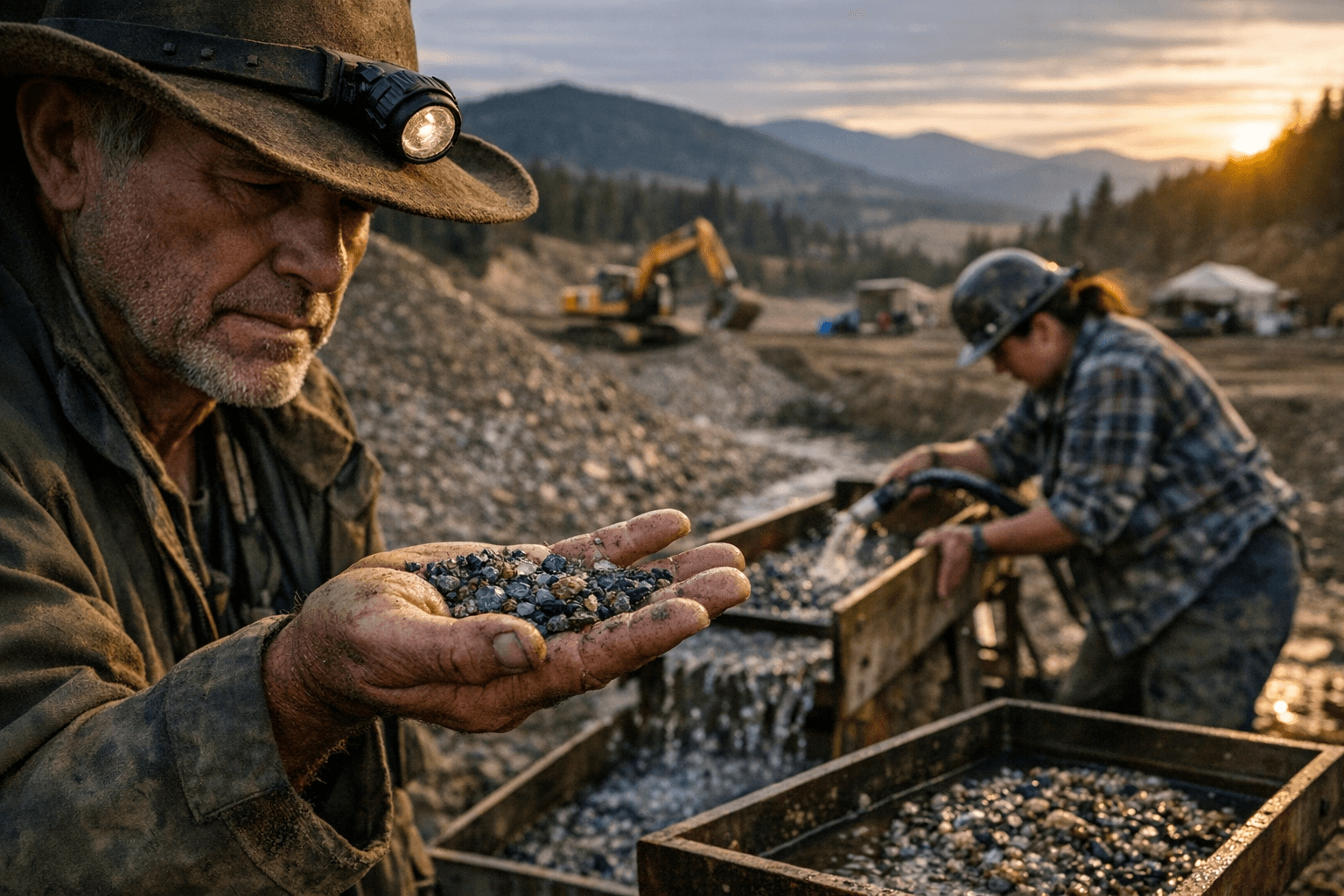
The answer, based on viewer engagement and the JCK coverage the film generated, appears to be yes. More importantly, the approach converts marketing language into something verifiable. When a brand says "sustainably sourced from Montana," that claim has previously been difficult to evaluate. A 15-minute film showing family operations, sustainable extraction practices, and named participants raises the evidentiary bar for the brand and, usefully, for every competing brand that makes the same claim with less documentation.
Le Vian's heritage as a family-owned jewelry house traces back to 15th-century Persia, with modern American operations founded in 1950. The brand has built its identity on transforming overlooked materials, most famously with the launch of Chocolate Diamonds in 2000. The Montana sapphire play follows the same logic: take a domestic gem that had been treated as a secondary market product, document its origins with care, and reframe it as collector-grade.
A Buyer's Guide to Montana Sapphires
The documentary raises the right questions. Here is how to ask them when you are standing at a jewelry counter.
*Color range and the "teal" spectrum.* Montana sapphires span a wider palette than any other single American gem source. Rock Creek material runs from icy pastel blue through blue-green teal to pine green, lavender, and occasionally pink. The teal stones, which sit at the intersection of blue and green, currently command premium attention from designers and collectors. Yogo sapphires are distinctly cornflower blue, consistent in hue and saturation, without the color-shift that defines Rock Creek material. If a seller describes a stone as a "Montana sapphire" without specifying origin, ask which deposit it came from. The answer changes the stone's character entirely.
*Treatments to ask about.* Heat treatment is standard for most Rock Creek alluvial sapphires; it stabilizes and brightens color that would otherwise appear pale or brownish. An honest retailer will disclose this upfront. Unheated Rock Creek stones exist and command a premium, but they are the exception. Yogo sapphires are almost universally unheated, a natural advantage that should be noted in any documentation. The treatment to watch for closely is beryllium diffusion, a more invasive process that drives color deep into the stone at high temperatures. This is detectable only by laboratories with specialized equipment, including GIA, GRS, and GIT.
- Ask directly: "Has this stone been heat treated, and is that disclosed in the certificate?"
- Ask about beryllium: "Does the lab report confirm no beryllium treatment?"
- Unheated stones: If a seller claims "unheated," require lab documentation. Sellers with unheated material make that clear because it commands a price premium.
*Paperwork that matters.* For any Montana sapphire purchase of meaningful value, a gemological certificate from GIA or AGL is the minimum standard. These reports confirm country of origin, treatment status, and quality indicators. Origin determination for Montana material is well established at both labs. A report that says "no indications of heating" is meaningfully different from one that is silent on treatment.
*Which Montana sources are typically cited.* The four historically documented commercial sapphire sources in Montana are Yogo Gulch, Rock Creek, Dry Cottonwood Creek, and the Missouri River gravel bars near Helena. The Le Vian documentary focuses on Rock Creek and Yogo Gulch, the two sources with active or recently active mining operations. When a retailer cites "Montana origin," a certificate from GIA or AGL can specify which deposit the stone came from, not just the state.
What the Documentary Actually Proves
The real achievement of *The Story of the Montana Sapphire: America's Rare Treasure* is not that it tells a beautiful story, though it does. It is that it makes the story checkable. The mines are named. The people are named. The collection is priced and available. The brand's commitment to American sourcing is a matter of public record, on film, for anyone who wants to verify it before spending $999 or considerably more.
That is the standard Le Vian has set for itself, and it is worth using as a benchmark for every other brand that invokes the word "provenance." A mine on a map, a miner with a name, a cutter whose craft you can watch: these are the details that transform a sapphire from a blue stone into a story worth keeping.
*The Story of the Montana Sapphire: America's Rare Treasure is available on Le Vian's YouTube channel. The Montana Sapphire Ombré collection is available through authorized Le Vian retailers, including Kay Jewelers and luxury independent jewelers.*
This article was produced by Prism’s automated news system from verified source data, official records, and press releases, then run through automated quality and moderation checks before publishing. The system is built and supervised by the people who set the standards it runs under. Read our full AI policy.
Did this article answer your question?