The 2026 Vintage Jewelry Market: What Dealers Are Actually Buying Right Now
Signatures, provenance, and pieces that transform from brooch to pendant are what dealers are actually bidding on in 2026. Here's what to buy and what to leave.
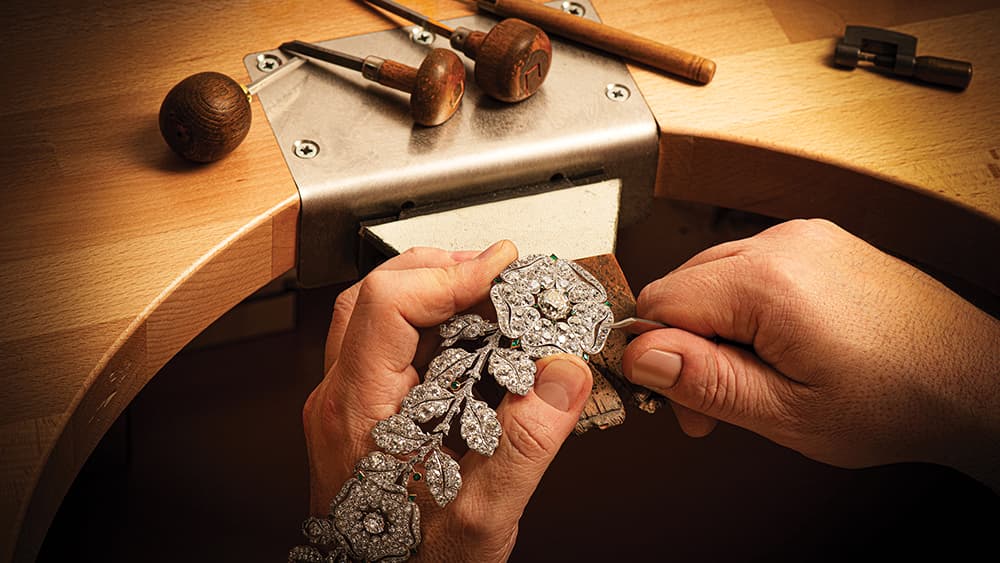
The pieces that matter most tend to carry a name behind them. Not the name of their current owner, or even the estate they passed through, but the name stamped invisibly into the metal at the moment of making: Cartier. Van Cleef & Arpels. Schlumberger. In the vintage jewelry market of 2026, that signature functions less like a label and more like a deed of trust, one that compounds in value with every passing year and every documented hand that held the piece before yours.
A practicing dealer's market-observation report from early April 2026 crystallizes what anyone who has been walking the floors of estate shows already senses: the vintage and estate category is no longer a specialty niche. It has become the category. Retailers, auction houses, and independent dealers are all pivoting toward it at once, and the buyers driving demand are not hunting for bargains. They are hunting for biography.
The Signed Piece Premium: Why the Name Outperforms the Stone
The dealer's report flags three houses as the primary engines of premium pricing right now: Cartier, Van Cleef & Arpels, and Tiffany & Co.'s Schlumberger line. The logic is not purely sentimental. Cartier estate pieces regularly recover 60-70% of their original retail value in the secondary market, far outperforming most non-designer jewelry. That is not a number you find attached to an unsigned, however beautiful, Art Deco platinum and diamond brooch. The signature is, functionally, the insurance policy.
Van Cleef & Arpels' prestige in the resale market is anchored by its legendary Alhambra clover motif, which has maintained extraordinary value retention. Collectors also prize the Maison for technical innovations such as the Mystery Set and the transformable Zip Necklace, which frequently command record-breaking prices at elite auction houses. The Zip Necklace is instructive here: it is both a signed piece and a convertible one, a topic the April dealer report treats as its own category of desire.
Jean Schlumberger's work for Tiffany & Co. occupies a particular corner of collector obsession. His sculptural vocabulary, enamel banana earrings rendered in platinum and 18-karat yellow gold, croisillon bracelets in vivid lacquered color, tapestry rings framing extraordinary gemstones in woven gold, reads as unmistakably authored. In a market hungry for narrative, Schlumberger signed pieces offer a complete story: a mid-twentieth century visionary, a great American house, and construction standards that modern production cannot replicate. When a piece carries that engraved signature, it is not just jewelry; it is an argument.
Global tariff shifts in 2025 raised primary market prices across handbags, watches, and fine jewelry, reinforcing the resale market's position. Rebag predicts consumers will snap up Van Cleef & Arpels, Rolex, and Cartier across the secondhand marketplace. The economic logic and the emotional logic have converged: the secondary market is not an afterthought, it is the smart play.
The Convertible Obsession
The April dealer report names "convertible" pieces, those designed to be worn in multiple configurations, as a quiet obsession among buyers in 2026. Quiet, because this is not a trend driven by marketing. It is driven by the desk drawers full of jewelry that never gets worn, and by a generation of buyers who want one extraordinary object rather than three mediocre ones.
In practice, this means brooches that detach from a pendant frame, necklaces that shorten into chokers, and earrings whose drops can be removed to leave a simple stud. The convertible category rewards the estate hunter specifically because the most sophisticated multi-wear mechanisms were engineered decades ago, before the industry optimized for low-cost production. A 1960s French couture brooch with a hidden clip mechanism, or a 1970s Italian gold necklace that separates at two points into a bracelet and a pendant, represents a kind of functional ingenuity the fast-fine market simply does not replicate.
When evaluating a convertible piece, scrutinize the mechanism before the stone. Hinges should move without resistance, clasps should engage fully, and any hidden clips should lock with authority, not suggestion. A convertible piece with a compromised mechanism is a single-use piece at a multi-use price.
Provenance as Emotional Currency
The April report makes a point that sounds obvious until you realize most buyers ignore it: documented history drives value not only for investors but for shoppers seeking pieces with narrative and family-legacy potential. These are not competing motivations. They are the same motivation expressed in different languages.
Van Cleef & Arpels lunar-inspired gold cuff bracelets were favorites of style icons, most famously Jacqueline Bouvier Kennedy Onassis, who was photographed wearing a pair alongside Muhammad Ali in 1977. In 2016, a pair owned by her stepsister, with serial numbers sequential to Onassis' own, sold for $162,500 against an estimate of $40,000 to $60,000, proving the added value of celebrity provenance. That is not a fluke. That is the market placing a hard dollar figure on a verifiable story.
Even without celebrity adjacency, a piece with original receipts, its house box, a period appraisal document, or a handwritten note from the original purchaser carries measurably more than an identical piece with none of those materials. Documentation, including gemological reports, receipts, and original packaging, provides credibility and often supports higher selling prices. Lee Siegelson, the New York-based dealer of museum-quality antique jewels, puts it plainly: "it's preferable to develop a relationship with a family and purchase a piece that has never been seen on the market before." Unmarketized provenance, the piece that has lived in one family, is the provenance dealers pay the most to find.
What Dealers Are Leaving on the Table
The same logic that governs what dealers buy governs what they pass. Common repairs, hidden reshanks, replaced stones, and resoldered clasps are not disqualifying on their own, but they become disqualifying when unacknowledged. A piece disclosed as having a replaced shank is a repaired piece with honest provenance. A piece presenting itself as entirely original while concealing a repolished setting and two replaced stones is a piece with a false story, and false stories do not hold value.
Unverifiable claims are the other category to treat with discipline. A piece described as "once belonging to" a notable figure, without documentation to support it, is not provenance. It is folklore. Randi Molofsky, founder of For Future Reference Vintage, advises buyers to "check that the piece feels sturdy and secure," and notes that with diamonds, buyers should ask if a cert or appraisal is available. That framework applies to provenance claims as well: if it cannot be verified, it should not be priced as if it were.
The Proof-of-Authenticity Workflow
Konstantinos I. Leoussis, founder of the NYC Jewelry, Antique, & Object Show, points to "growing consumer interest in luxury thrifting and vintage jewelry." That interest, now broad and mainstream, means authentication literacy matters more than it did even five years ago. Here is a working sequence to apply before any estate purchase:
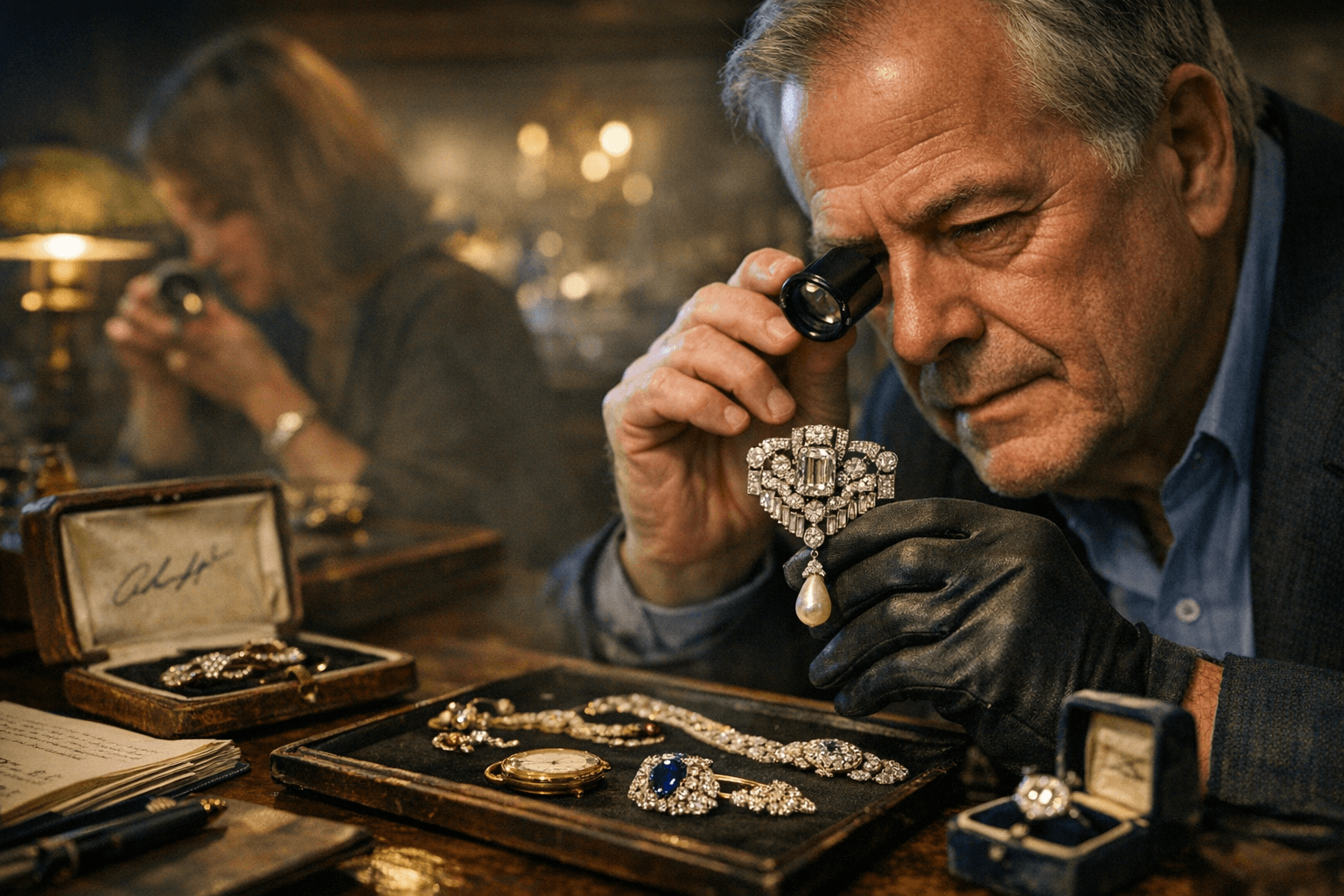
- Hallmarks first. Jewelry hallmarks include metal purity stamps, assay office symbols, and date letters; antique hallmarks pre-dating the 1920s are often hand-stamped and ornate, while vintage hallmarks from the 1920s through 1980s are more uniform, reflecting industrial production. A loupe and a hallmark reference guide are the first tools on the table.
- Maker's mark and designer signature. Vintage jewelry may feature date stamps, designer signatures, patent numbers, and trademarks, all of which can provide context and help verify the piece's age and authenticity. On a Cartier piece, look for the house signature engraved inside the shank or on the clasp, along with a reference number. On Schlumberger pieces, the signature appears alongside the Tiffany & Co. mark.
- Condition and construction audit. Examine the setting under magnification: prongs should be consistent in height and finish, indicating they have not been re-tipped or replaced unevenly. Bezel settings should be smooth and uninterrupted. Any evidence of solder that does not match the original metal color warrants a direct conversation with the seller.
- Request paperwork. Original receipts, prior appraisals, auction house provenance records, or correspondence referencing the piece are all material to value. Their absence is not automatically disqualifying; their presence is always additive.
- Independent appraisal before significant purchase. For any piece above a threshold you would not be comfortable losing, commission a GIA-certified appraiser with estate jewelry expertise. Not the seller's recommended appraiser. Your appraiser.
The Collector's Posture
Molofsky is characteristically direct on the subject: "I always say: Nothing haunts you like the vintage you don't buy." That is partly a joke and partly a genuine investing thesis. The signed, documented, convertible piece you hesitate over at an estate show in 2026 will likely not present itself again at the same price. The vintage market's upward trajectory is not a spike; it is a structural shift, one that reflects the broader realization that the most meaningful objects are the ones that already carry a life.
What dealers are buying right now are pieces with verifiable authors, documented histories, and the kind of functional versatility that earns daily wear. That combination, signature, story, and wearability, is not a formula for a trend. It is a formula for an heirloom.
This article was produced by Prism’s automated news system from verified source data, official records, and press releases, then run through automated quality and moderation checks before publishing. The system is built and supervised by the people who set the standards it runs under. Read our full AI policy.
Know something we missed? Have a correction or additional information?
Submit a Tip