Messika prepares necklace for Botswana’s largest blue diamond, Okavango Blue
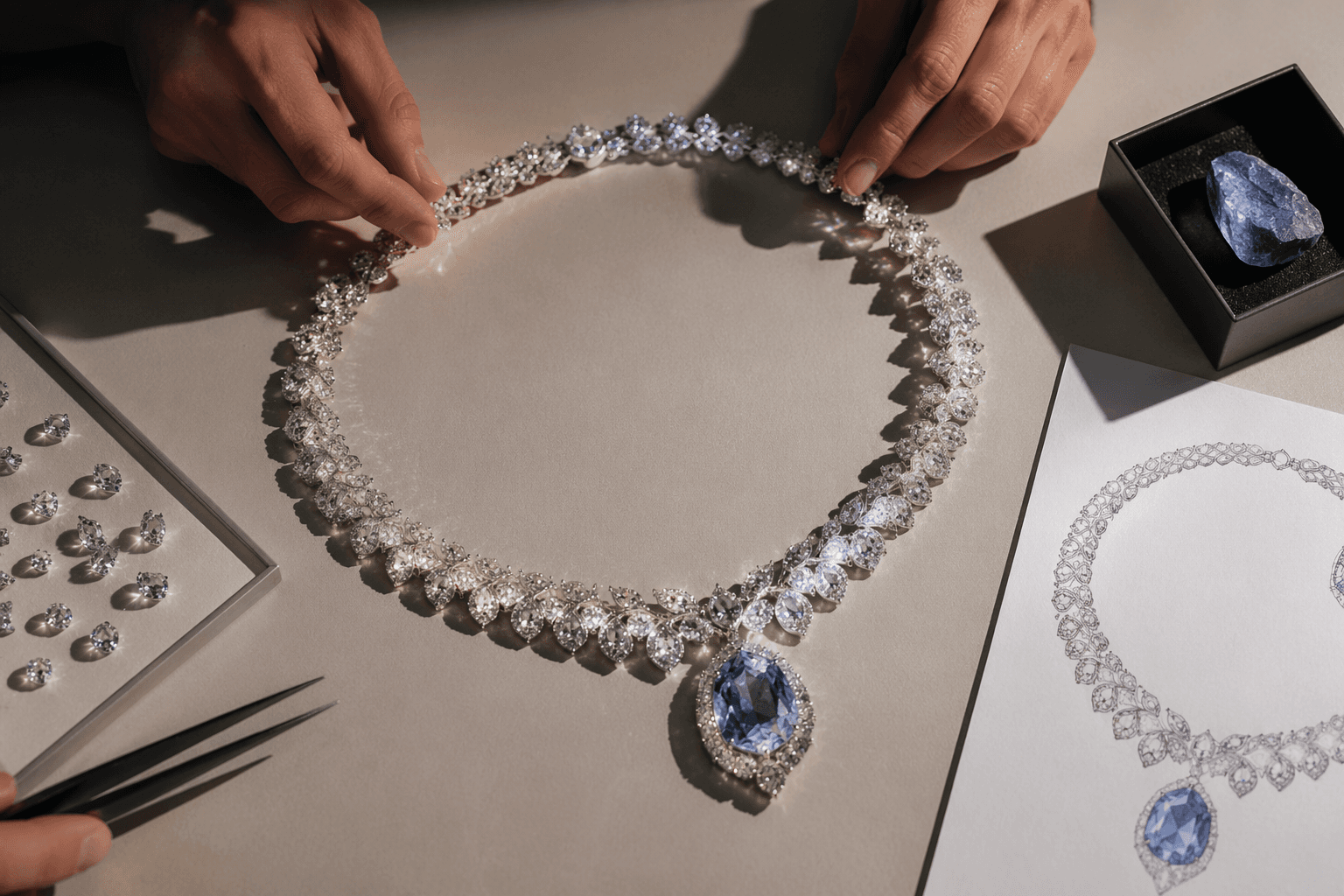
Messika is setting the 20.46-carat Okavango Blue in a necklace of more than 500 white diamonds, turning Botswana's largest blue diamond into a Paris couture centerpiece.

Messika is preparing a necklace around the 20.46-carat Okavango Blue, Botswana’s largest known blue diamond, and the setting is designed to make the stone seem to hover above the collar. The piece uses more than 500 white diamonds in a rivière-style frame, a high-jewelry gesture that turns a single blue gem into the visual and commercial center of the work.
The diamond itself carries the weight of a national object. It was discovered in May 2018 as a 41.11-carat rough stone at Orapa Mine, then cut and polished into a Fancy Deep Blue oval. Contemporary accounts have described it as Type IIb, with clarity reported as VVS2 or VVS1, underscoring how rare blue diamonds of this size and quality remain. Messika, founded in 2005 by Valérie Messika, spent nearly a year developing the necklace before its planned unveiling during Paris Couture Week on July 6, 2026.
Orapa Mine, operated by Debswana, the Botswana-De Beers joint venture, is one of the engines of the country’s diamond economy. Its output is commonly described as averaging about 10 million to 12 million carats a year, while Botswana’s diamond industry accounts for about 80% of exports and roughly one-third of government revenue. That makes the Okavango Blue more than a luxury headline: it is tied to the mineral wealth that has shaped Botswana’s post-independence rise and its standing as the world’s largest diamond producer by value.
Botswana first presented the stone publicly on April 17, 2019, in Gaborone at Diamond Park, where President Mokgweetsi Masisi called it “the rarest and most unique diamond ever discovered in Botswana.” The name Okavango Blue links it to the Okavango Delta, the UNESCO World Heritage site that has become one of the country’s defining natural symbols. In that context, the diamond reads as both geology and national identity, a polished fragment of Botswana’s landscape transformed into a diplomatic-scale jewel.
Messika’s treatment leans into that symbolism rather than hiding it. The white-diamond collar does not compete with the blue center stone; it isolates it, almost like a display mount worn at the throat. The result is a one-off object that is unlikely to enter the retail market, and that scarcity is part of the appeal. In an era when exceptional colored stones command the attention once reserved for the largest colorless diamonds, the Okavango Blue arrives with provenance, rarity and a story that can be traced back to the bedrock at Orapa.
This article was produced by Prism’s automated news system from verified source data, official records, and press releases, then run through automated quality and moderation checks before publishing. The system is built and supervised by the people who set the standards it runs under. Read our full AI policy.
Did this article answer your question?