Oscar Heyman's Spring 2026 Lookbook Unveils 35 Rare Gem Heirloom Pieces
Oscar Heyman's first-ever spring lookbook spotlights a 4.61-carat no-oil emerald and a 111-carat multicolour tourmaline necklace among 35 unrepeatable pieces timed for Mother's Day.
The pieces that survive between generations tend to share a small set of verifiable qualities: a documented stone, a specific hand, and a construction that can be maintained. That premise runs through Oscar Heyman's Spring 2026 Lookbook, the house's first spring publication in its 114-year history, which launched in early April with 35 one-of-a-kind creations, all designed and crafted in its Madison Avenue atelier. The timing is deliberate: Mother's Day, graduation season, and wedding anniversaries converge in the weeks ahead, and the house is positioning this catalog as an editorial preview for buyers who don't want to wait until the annual holiday book.
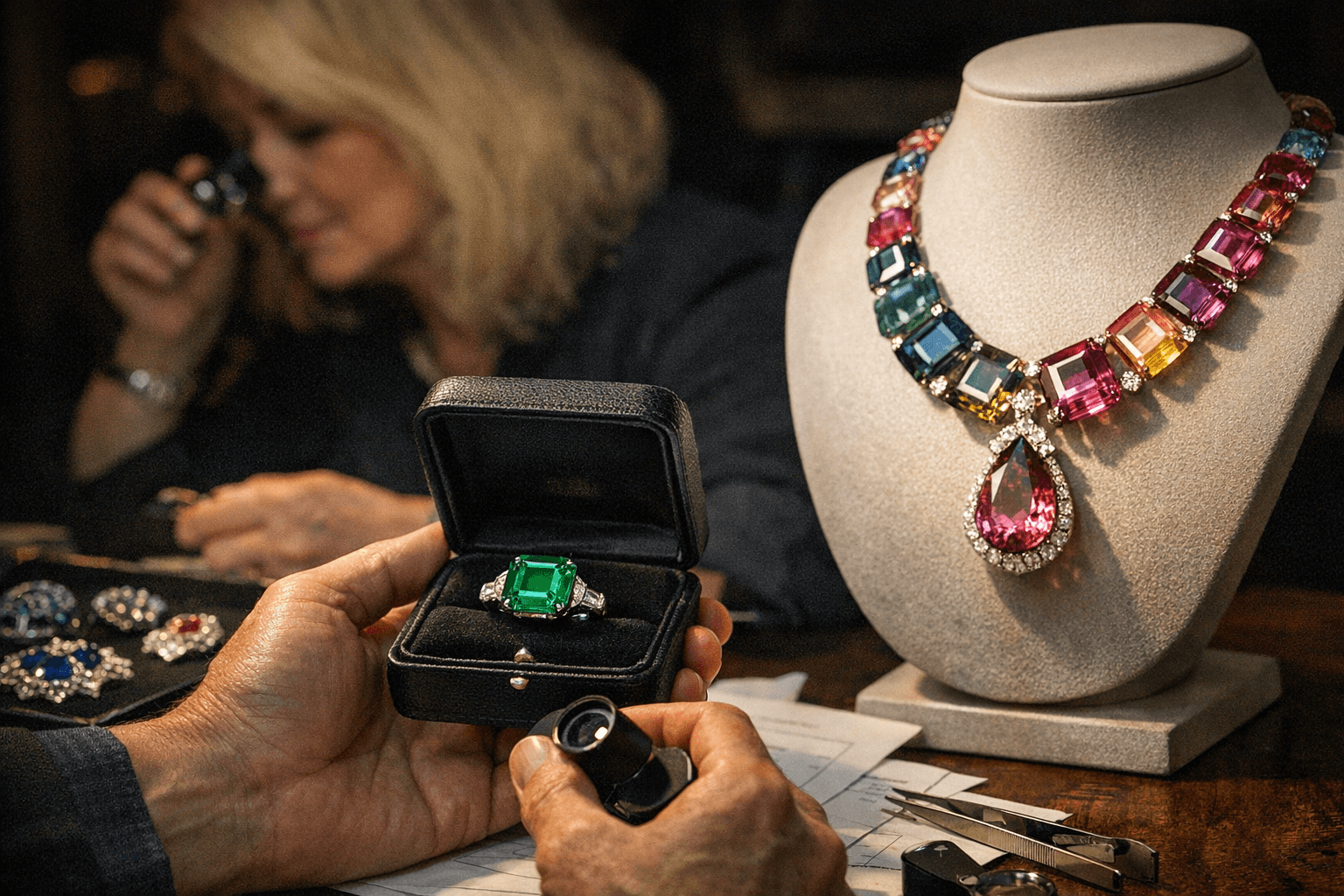
Tom Heyman, the company's president, highlighted three pieces by name: a 4.61-carat no-oil emerald ring, a new edition of the house's iconic pansy earrings, and a 111-carat multi-color tourmaline and diamond flower necklace. Each selection is a precise signal, not a general gesture toward luxury.
The "no-oil" designation on the emerald is the sharpest of those signals. The vast majority of emeralds on the commercial market undergo clarity enhancement through oiling, a process in which cedar oil or synthetic resin is introduced into surface-reaching fractures to reduce their visibility. The practice is so standard that "oiled" is effectively the baseline assumption for any emerald purchase. A no-oil certification, issued by a laboratory such as the American Gemological Laboratories or the Gübelin Gem Lab, confirms that the stone arrived with sufficient natural transparency to require no enhancement whatsoever. That distinction makes a 4.61-carat no-oil stone genuinely exceptional, and for a buyer thinking about provenance as a design quality rather than a footnote, a laboratory report confirming treatment status is the first document to request before any sale closes.
The 111-carat tourmaline necklace works on a different register of rarity. Tourmaline spans a broader color range than almost any other gem species, from chrome green to hot pink rubellite to the intensely saturated blue-green of Paraiba, the most coveted variety. At 111 carats of colored stone set inside a diamond flower structure, the necklace reads as sculpture more than accessory. Also new to the lookbook is an invisibly set ruby and diamond ring, a technically demanding construction in which stones are set without visible prongs, creating an uninterrupted surface of color. Invisible setting requires exceptional gem-cutting precision: stones must be calibrated to fit grooves in the metal framework rather than held by conventional prong work, and even slight irregularities in the cut render the design impossible to execute.
The cover piece is a platinum bracelet set with 20 pear-shaped emeralds, 10 sapphires, 10 oval-cut opals, and 44 diamonds, priced at $300,000. An aquamarine and diamond necklace is also featured at $240,000. Beyond those headlined pieces, the broader lookbook draws from a roster of rare gem species that would appear on any specialist's list: sphene, prized for extreme dispersion and fire; unheated spinel, whose value depends heavily on the absence of heat treatment; Paraiba tourmaline, among the most expensive colored stones by weight; and phenomenal gems including cat's-eye chrysoberyl, star rubies, star sapphires, and black opals.
"Our team blends old-world craftsmanship with modern styling to create what we call 'modern classics,'" Heyman said. "This lookbook previews our 2026 collection ahead of Couture Las Vegas."
That team is the quiet argument for longevity. Oscar Heyman maintains in-house lapidaries, setters, engravers, jewelers, and polishers at its Madison Avenue atelier, a concentration of distinct trades that has become increasingly rare in fine jewelry production. A lapidary shapes raw stone to specification. A setter places it into metal without compromising the gem's structural integrity. An engraver introduces fine surface detail. A polisher finishes the metal. Keeping all of these disciplines under one roof is not only a mark of heritage; it is the structural condition that makes a piece genuinely repairable. For a buyer evaluating a purchase on heirloom grounds, repairability is one of the least-discussed and most consequential criteria.
The right question to ask any jeweler before a significant purchase: who made this, and who can restore it? A piece assembled by a specialist team working from proprietary design records is a categorically different proposition from one sourced anonymously. Press further and ask whether the house performs its own repairs, and whether original design documentation exists for the specific piece. For a one-of-a-kind item, those records are the difference between a stone that can be faithfully re-set after a prong fails and one that becomes permanently altered.
On documentation, ask for gemological laboratory reports rather than accepting seller descriptions alone. For colored stones, the GIA, AGL, and Gübelin Gem Lab are the recognized standards. A report from any of these institutions will name the geographic origin of the stone, enumerate any treatments it has or has not undergone, and flag quality considerations relevant to long-term ownership. The "unheated" classification on a spinel or sapphire means the stone's color is entirely natural, a distinction that commands a substantial premium at auction. Knowing that before purchase is not overcaution; it is due diligence.
Treatment disclosure also has direct durability implications. Oiled emeralds should not be cleaned ultrasonically, since vibration can dislodge the filler material from fractures. Heat-treated rubies sometimes contain flux or glass within fracture sites, which affects stability under high heat. Asking specifically what treatments a stone has received, and whether laboratory documentation confirms that status, is a question any reputable seller will answer without discomfort.
Origin documentation is the final layer. Oscar Heyman has historically sourced rubies from Burma, sapphires from Sri Lanka and Kashmir, and emeralds from Colombia, regions that carry both gemological prestige and, in some cases, complex ethical and trade histories. A stone whose origin is traceable through a laboratory certificate is a fundamentally different asset from one listed as unknown. Vague provenance assurances from a seller are not an acceptable substitute for that documentation, regardless of the price point.
The Spring 2026 Lookbook has been distributed digitally to the brand's partner retailers nationwide and is displayed on the Oscar Heyman website. The full collection will be unveiled at Couture Las Vegas later this year. Founded in 1912 at 47 Maiden Lane in downtown Manhattan by Oscar Heyman and his brothers, the house built its industry reputation by supplying finished pieces to Tiffany and Co., Cartier, and Van Cleef and Arpels, often without prominent attribution. The Heyman family's decision to publish a first-ever spring catalog in 2026 reflects something beyond seasonal marketing. Buyers are increasingly arriving at conversations with the questions that once belonged only to auction specialists: Has this stone been treated? Where did it come from? Who can repair it? A no-oil Colombian emerald, an unheated Paraiba tourmaline, a piece crafted by the same atelier that can restore it: these are not premium features. They are the baseline of what heirloom actually means.
This article was produced by Prism’s automated news system from verified source data, official records, and press releases, then run through automated quality and moderation checks before publishing. The system is built and supervised by the people who set the standards it runs under. Read our full AI policy.
Did this article answer your question?