Vermeil Bridges Accessible Price Points and Meaningful Jewelry for Summer Retail
Not all gold-toned jewelry is equal: vermeil's FTC-regulated 2.5-micron minimum and sterling silver base make it the only plated category worth treating as a keepsake.

There is a certain kind of jewelry that doesn't announce itself. It sits close to the skin, carries a name or a birthstone or a shape that means something, and gets put on every morning without much deliberation. That habitual intimacy is what separates a meaningful piece from a decorative one, and it is precisely the territory that well-made vermeil occupies when it is done right. The challenge for anyone buying or selling it is that "done right" requires a level of specificity the marketing language rarely provides.
What Vermeil Actually Is (and Why the Definition Matters)
The word is French, derived from "vermilion," and in the United States it carries legal weight. To be sold as vermeil, a piece must meet three conditions set by the Federal Trade Commission: the base metal must be sterling silver (an alloy of 92.5% pure silver and 7.5% other materials); the gold layer must be at least 10 karats, meaning at minimum 41.7% pure gold; and that gold layer must be at least 2.5 microns thick, roughly 0.0025 millimeters. That last requirement is the one that separates vermeil from the catch-all category of gold-plated jewelry, which can be applied over brass, copper, or any number of cheaper base metals, and which often carries a gold layer well under 1 micron. In practical terms: standard gold plating is a cosmetic finish. Vermeil, at its legal floor, is a jewelry-grade construction.
The distinction matters not only structurally but morally. When a piece is marketed as a keepsake, a gift, something to be worn every day and remembered, the base it's built on is not a minor technical footnote. A brass-core pendant is not the same object as a sterling silver one, regardless of how identical they look at arm's length.
How to Vet Vermeil Before You Buy
The 2.5-micron FTC minimum is the floor, not the target. Brands that invest in their vermeil typically plate at 3 to 5 microns, and the difference in longevity is meaningful. When evaluating a piece or asking a retailer about their product, three questions cut through the marketing:
- What is the micron thickness of the gold layer?
- What is the base metal? (Sterling silver only qualifies as vermeil; anything else is simply gold-plated.)
- Does the brand offer replating or any warranty on the gold finish?
Mejuri, one of the category's clearest reference points, specifies that its vermeil is 18k gold plated on 92% recycled sterling silver. That combination, high-karat gold over a responsibly sourced silver base, reflects how the best vermeil makers treat the category as a distinct material proposition rather than a workaround for high gold prices.
The Summer Equation: Sunscreen, Sweat, and Chlorine
Summer is the season when vermeil gets put to its hardest test, and the honest answer is that it requires more care than solid gold in daily conditions. The chemicals and alcohol-based compounds in sunscreen are particularly corrosive to gold plating; they break down the surface layer gradually, accelerating dullness and tarnish. The protocol is simple but easy to ignore in a rush: apply sunscreen first, wait for it to fully absorb, wash your hands, and then put your jewelry on. Doing it in reverse order, which is what most people do, is the single fastest way to reduce the life of a vermeil piece.
Chlorinated pool water and saltwater carry similar risks. Both accelerate tarnishing and can compromise the integrity of the gold layer. The practical rule is to remove vermeil before swimming, and if pieces do get wet, rinse them with fresh water and pat them dry rather than leaving mineral deposits to sit. Perspiration is the subtler enemy: it's low-level and constant, and over time the salt content in sweat has a similar degrading effect. Pieces worn against skin during exercise or in high heat should be cleaned more frequently than those worn in cooler conditions.
None of this makes vermeil impractical for summer. It makes it a category that rewards attentiveness, which is, in its own way, appropriate for jewelry you've chosen to wear with intention.
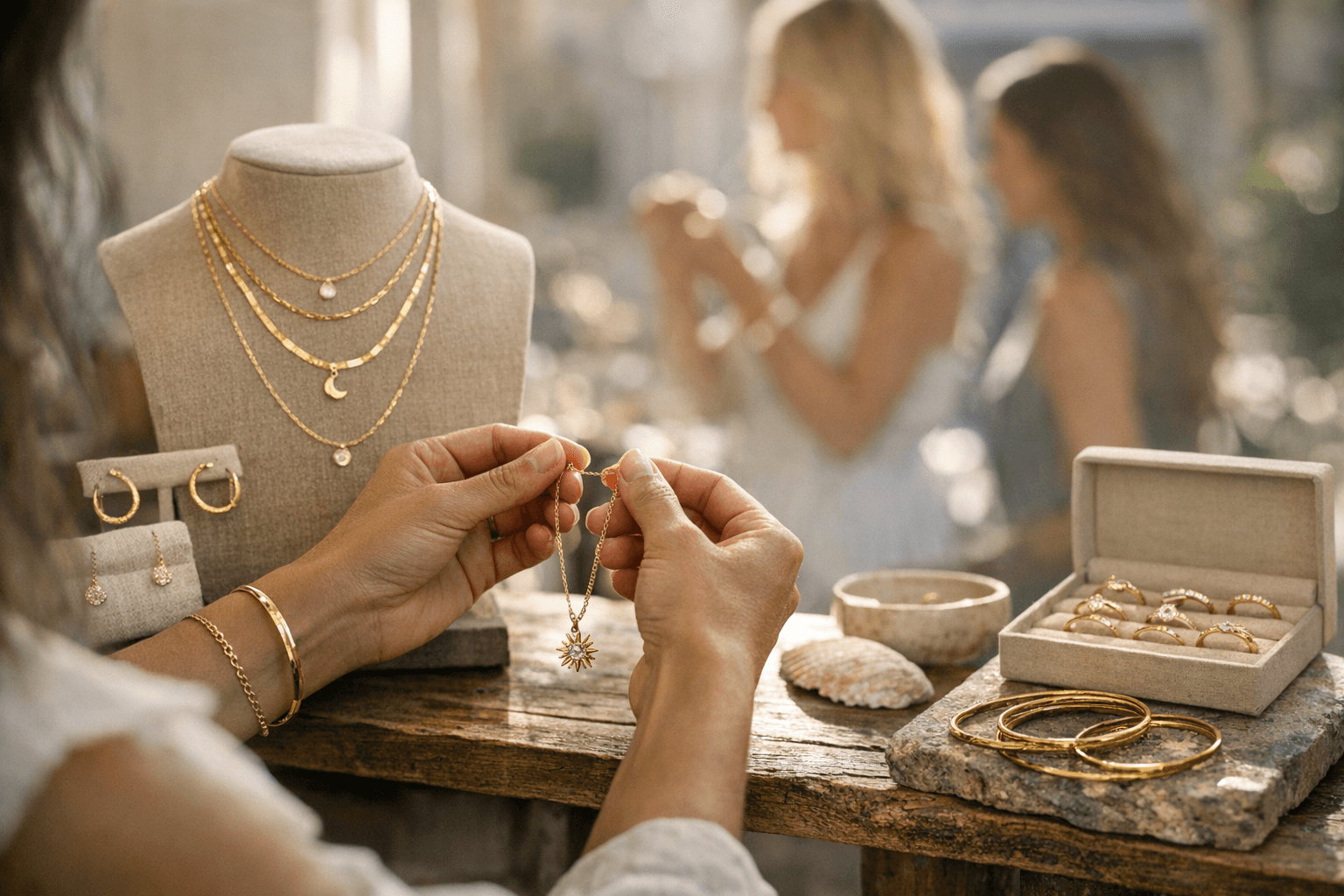
A Care Routine That Extends Wear
The routine that meaningfully prolongs vermeil's life is not complicated, but it requires consistency:
1. Clean pieces every one to two weeks with a soft, lint-free cloth. Avoid abrasive materials, which scratch the gold surface and accelerate wear.
2. Remove jewelry before any water activity: swimming, showering, washing dishes. Even mild soaps and shampoos leave residue that dulls the finish over time.
3. Apply all lotions, perfumes, and sunscreens before putting on jewelry, never after.
4. Store pieces individually, in soft pouches or separate compartments of a jewelry box, to prevent scratching from contact with other metals.
5. Ask the original retailer about replating services. Well-made vermeil over sterling silver can be re-plated and extended in life, a fact worth communicating at the point of purchase.
The Categories Worth Buying
Not every jewelry category translates equally well into vermeil. The pieces that hold up best are those with meaning embedded in their form: the design carries the symbolic weight so the material doesn't have to bear it alone.
Lockets are the clearest case. A gold vermeil locket, worn as a container for a photograph or a small keepsake, is as functionally sound as a solid gold version for daily wear, and the price difference is substantial enough to matter. Signet rings are similarly strong: the flat face, traditionally used for engraving initials or crests, lends itself to the category's surface quality, and a well-plated signet has a visual heft that belies its construction. Initial pendants fall into the same logic. The letterform is the jewelry; the metal is the medium.
Birthstone bars, the kind Mejuri merchandises through pieces like its Sia Birthstone Pendant and Bracelet in 18k gold vermeil, represent a different kind of meaning: personal chronology rendered in stone and gold. Common Era and Jenna London have built retail strategies around this same premise, packaging symbolic motifs and birthstone combinations as giftable keepsakes at price points that make a genuine piece of jewelry accessible without stripping the gesture of weight.
The Retail Logic Behind the Category
The commercial intelligence of vermeil is that it functions as what retailers call an escalation SKU: a piece that introduces a customer to a motif, a signet shape, or a locket format at an accessible price, and creates a natural path toward a solid gold version as the relationship deepens. Mejuri's Puzzle Ring system illustrates the dynamic with unusual clarity. A three-ring sterling silver starter stack runs roughly $354 to $384; the equivalent build in 18k gold vermeil starts at $384 and reaches $444. The $30 to $90 gap is low enough to be achievable and meaningful enough to feel like a genuine upgrade. Since the collection launched in August 2025, 60% of customers have purchased three or more Puzzle pieces, which suggests that once someone enters the system at any metal tier, the modular logic keeps them building.
What that figure also reveals is something less commercial and more fundamental: people want jewelry that grows with them. Vermeil, when it is made to its legal standard and cared for with even moderate attention, is capable of being that kind of jewelry. It is not a stand-in for gold. It is its own material argument, one that will last precisely as long as the person wearing it decides to take it seriously.
This article was produced by Prism’s automated news system from verified source data, official records, and press releases, then run through automated quality and moderation checks before publishing. The system is built and supervised by the people who set the standards it runs under. Read our full AI policy.
Did this article answer your question?