Queen Mary turns Danish crown jewels into living royal style
Queen Mary is recasting Denmark’s crown jewels as lived-in inheritance, not display-only history, with a redesigned rose-cut tiara and a bracelet reborn for Stockholm.
A royal collection meant to be worn
Queen Mary of Denmark is making one argument with every public appearance: heirlooms matter most when they leave the vault. The Danish crown jewels are unusual even by royal standards, because the Royal Danish Collection describes them as the only crown jewels in the world that are both displayed as museum artefacts and worn by the sitting queen. That dual life gives them a kind of authority that static jewels rarely have, and it explains why Mary’s choices feel less like costume and more like continuity.
The system behind those jewels is just as specific as the stones themselves. Kongehuset says the crown jewels primarily consist of four large sets, a brilliant-cut diamond set, an emerald set, a pearl-ruby set, and a rose-cut diamond set, reserved for the monarch and queen. They are brought out for major state occasions, including New Year’s receptions, state visits, and other royal events, which means each wearing is not merely decorative. It is public ritual, and the jewels are part of how Denmark stages monarchy in the present tense.
How Queen Mary changed the reading of the crown jewels
King Frederik X’s accession on January 14, 2024, gave Queen Mary access to these historic pieces as queen, and her first instinct has not been to preserve them at arm’s length. Instead, she has helped make them visible, legible, and newly relevant. The Royal Danish Collection says she collaborated on a new frame for the Rose-Cut Diamond Set in 2024, turning a historic jewel into something that could better meet the profile of a contemporary queen.
That detail matters because the Rose-Cut Diamond Set itself was created in the 1840s, when jewelry often followed the silhouette of fashion. Its original form, a heavy pendant and a long chain, reflects the era’s tightly corseted waists and vertical lines. By reworking it into a tiara frame, Queen Mary has not erased that history. She has altered its mode of display, making the set read less like a relic and more like a living object that can adapt without losing its identity.
There is an elegant tension in that choice. The stones remain the same, but the setting changes the message. A pendant and chain speak to one kind of bodily decoration; a tiara speaks to ceremony, presence, and face-framing visibility. Mary’s collaboration suggests that royal inheritance is not only about possession, but interpretation.
The rose-cut set, renewed for a modern profile
Rose-cut diamonds have a soft, antique glow that is quite different from the sharp brilliance of modern round cuts. They catch light in a gentler, more romantic way, which suits a historic set designed in the 1840s. When those stones were remounted into a new frame, the result was not a reinvention for novelty’s sake. It was a practical and aesthetic translation of old-world craftsmanship into a form that can be worn in the 21st century.
That is where Queen Mary’s instinct feels especially contemporary. She is not treating the crown jewels like untouchable archive pieces sealed behind glass at Rosenborg Castle. She is activating them, one occasion at a time, so that their old materials and old workmanship still produce meaning in public. In a culture often drawn to brand-new sparkle, she has made age itself part of the appeal.
A bracelet becomes a tiara in Stockholm
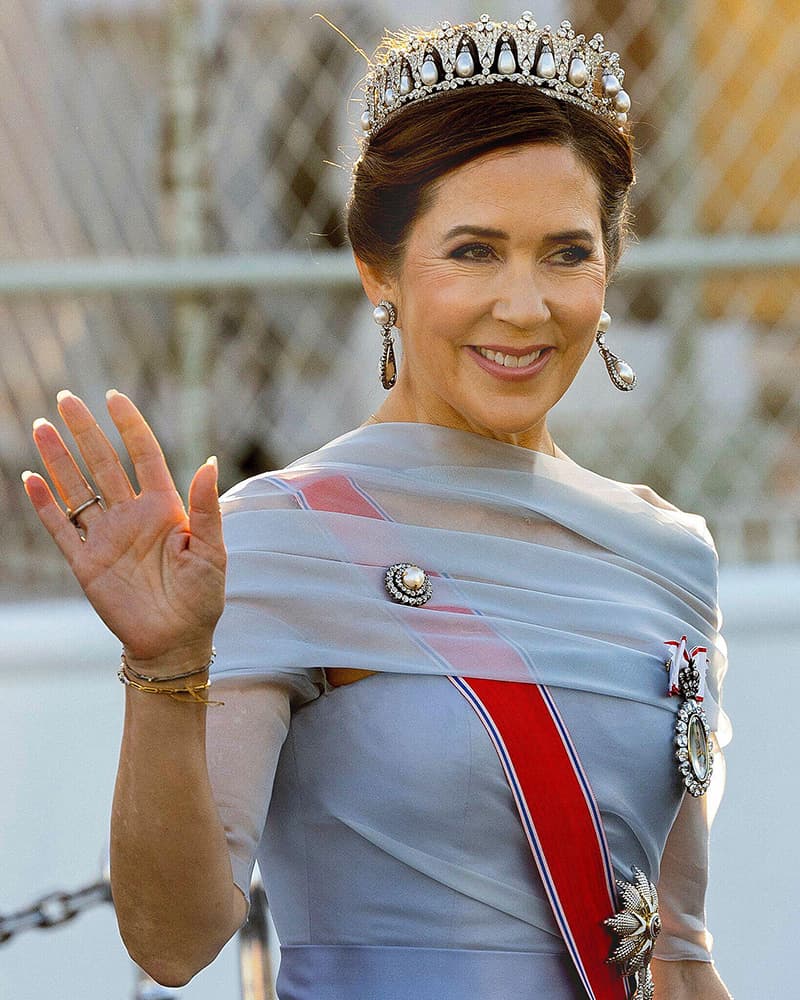
Mary’s most striking example arrived at King Carl XVI Gustaf of Sweden’s 80th birthday gala in Stockholm on April 30, 2026, when she wore a historic bracelet converted into a tiara. The piece was originally given as a wedding gift in June 1850 by Oscar I and Queen Josefina of Sweden to their daughter-in-law, the future Queen Louise of Sweden, which adds a layer of dynastic intimacy to its story. This was not simply a borrowed ornament; it was a diplomatic object with family history built into its metal.
The bracelet itself is constructed around a rosette-shaped center section, surrounded by diamond flowers and leaves set in gold and silver. That combination of materials is crucial. Gold and silver give the jewel structure and contrast, while the diamond foliage softens the geometry into something floral and ceremonial. Converted into a tiara, the bracelet becomes a new kind of crown, one that carries both Swedish and Danish resonance in a room filled with Nordic royalty.
The conversion also shows how royal jewelry can operate as fashion, not just heritage. A bracelet worn at the wrist and a tiara perched at the hairline create entirely different visual energies. By moving the same jewel into a new category, Mary made the object more legible to a modern audience while preserving its original architecture. The result was a public reminder that royal adornment still has the power to surprise.
Why these jewels still matter now
The Danish royal court says the jewelry worn by female members of the royal family is divided among personal pieces, jewels owned by the Danish Royal Property Trust, and the crown jewels. That structure, set in place after Frederik VIII and Queen Lovisa established the trust in 1910, shows how carefully Denmark has organized the life of its jewels. Some pieces are private, some are institutional, and some belong to the Crown itself, which means provenance is not an afterthought. It is built into the category.
That is why Queen Mary’s role feels especially important. She is not just selecting ornaments for photographs. She is moving pieces across time, from 19th-century gift to 21st-century gala, from museum display to state portrait, from heirloom status to living style. In doing so, she is proving that the most valuable jewels are not the ones left untouched, but the ones allowed to continue their public life with their history intact.
This article was produced by Prism’s automated news system from verified source data, official records, and press releases, then run through automated quality and moderation checks before publishing. The system is built and supervised by the people who set the standards it runs under. Read our full AI policy.
Did this article answer your question?