Statement jewelry takes center stage as the outfit’s new hero
Jewelry is stepping out of the supporting role and becoming the look itself, with sculptural pieces that signal taste, identity, and staying power.
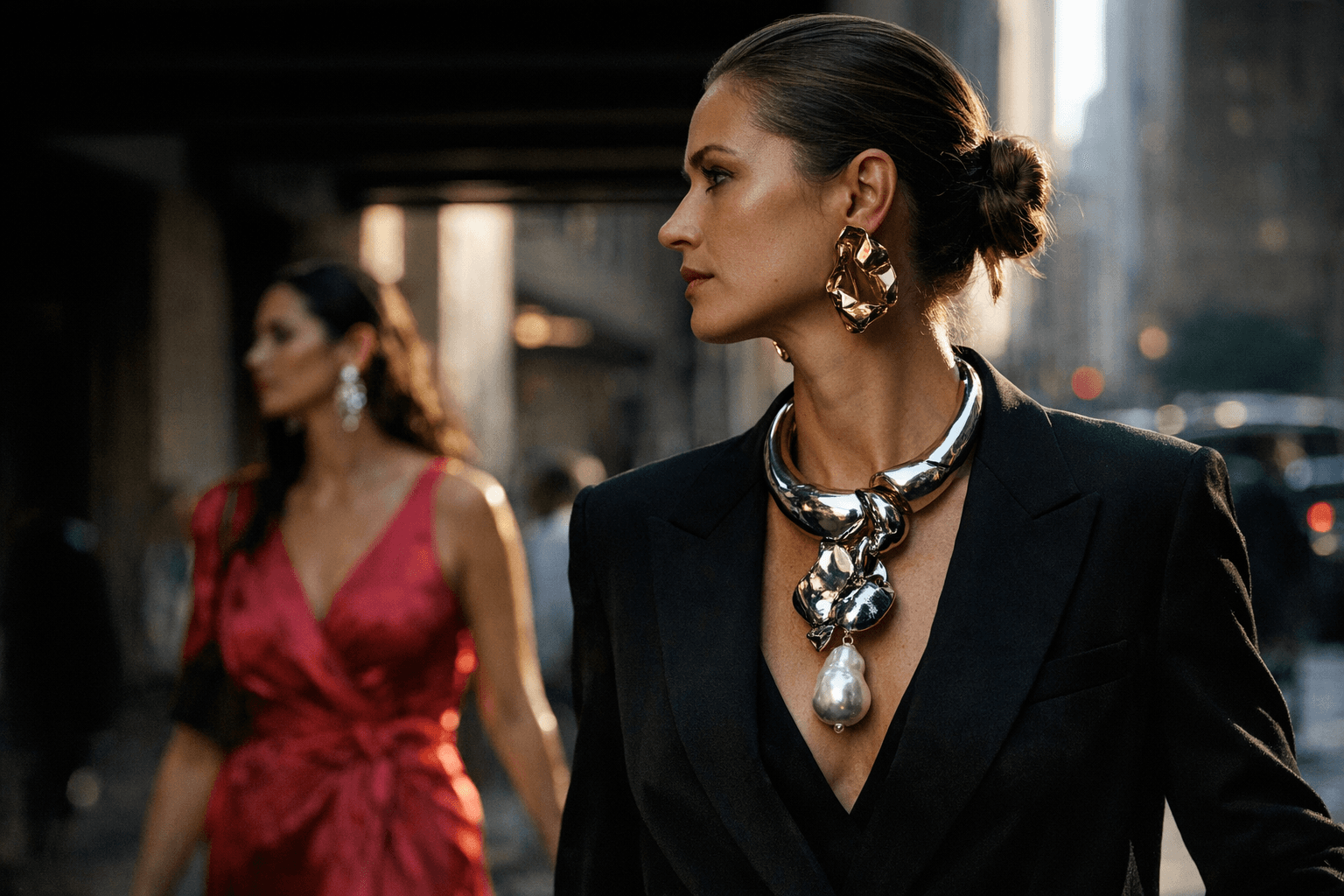
Jewelry as the starting point
The most interesting statement pieces right now do not finish an outfit. They set its entire mood. That is the shift at the heart of jewelry’s new hero role: sculptural, chunky, deliberate pieces that command attention without needing anything else to compete with them. The logic is practical as much as aesthetic. When a ring, choker, or cuff has enough presence, the rest of the wardrobe can stay restrained, and the jewelry does the work.
That is why this new approach feels less like trend-chasing and more like editing. A well-chosen statement jewel should carry personal meaning, read clearly from across a room, and still feel wearable enough to live with. The best versions have a signature shape, a recognizable maker, and a material story that can be understood at a glance.
What makes a hero piece worth the investment
A true hero piece balances scale with control. It may be bold, but it should not feel random. The strongest examples usually have one anchoring idea: a clean cuff line, a concentrated stone setting, a strong silhouette, or a motif that repeats across a designer’s work. That coherence matters because it keeps the piece from looking like a passing accessory and turns it into a visual signature.
Material also matters, especially when the jewelry is meant to anchor an outfit rather than decorate it. 18k gold has heft and warmth; silver inlay adds contrast and a more graphic finish; gold vermeil offers a lower-entry way into a sculptural look, though it sits in a different category from solid gold. When diamonds are involved, the setting and proportion should be as considered as the stones themselves. A piece feels lasting when every element, from metal choice to line and curvature, looks intentional.
Three pieces that show the range
JCK’s curation makes the point clearly through three very different jewels. Tiffany & Co.’s Angela Cummings 1981 bracelet in 18k yellow gold with silver inlay, priced at $48,100, is the most archival of the group. Its value is not only in the precious metal but in the name behind it, and in the kind of design language Angela Cummings became known for: disciplined, recognizable, and exacting.
The Back Vault’s Coral Wrap choker, in 18k gold with 3.68 carats total weight of diamonds and priced at $18,010, lands in a different register. It is still highly polished, but its choker form gives it a more assertive, close-to-the-neck impact. The diamonds add brilliance without making the piece look fragile, which is exactly what a modern statement jewel needs if it is meant to stand on its own.
Shams Fine Jewelry’s Shima cuff bracelet in 18k gold vermeil, priced at $2,550, shows how the hero-piece idea can be translated for a broader range of buyers. Vermeil changes the economics, but not necessarily the visual effect. A cuff of this kind works because its shape carries the style conversation first; the material simply determines how far up the investment scale it sits.
Why branded jewelry keeps gaining ground
The appetite for pieces with a named identity is not just a runway mood. De Beers data shows that branded diamond jewelry made up two-thirds of all diamond jewelry purchases in the United States in 2021, double the share in 2015. Even more telling, almost 80 percent of diamond jewelry sales by value were branded, and 76 percent of Gen Z diamond jewelry purchases were branded, compared with 64 percent for Gen X and 38 percent for Baby Boomers.
That split says a lot about how younger buyers think about jewelry. They are not only looking for sparkle; they are looking for authorship, design codes, and proof that a piece means something beyond price. In practice, a branded jewel often carries more social and emotional clarity than an anonymous one. It signals taste, but also self-definition.
How to choose a piece that lasts
The most useful rule is to buy for silhouette first, sparkle second. A good hero piece should be recognizable even before anyone notices the stones. Look for a shape that feels distinct on the body, whether that is the curve of a cuff, the geometry of a bracelet, or the way a choker frames the collarbone.
- Does the scale feel bold enough to anchor simple clothes?
- Does the motif feel tied to a designer’s language, or is it just loud?
- Can the piece move from day to evening without feeling costume-like?
- Is the material choice honest about what you are paying for?
It also helps to ask a few plain questions before buying:
That last question matters because vague luxury language can hide weak construction. A piece described as sculptural should still show good finishing, secure settings, and a clear relationship between design and materials. If those elements are missing, the statement is mostly noise.
The broader luxury context
McKinsey says the luxury sector, including jewelry, posted a 5 percent compound annual growth rate between 2019 and 2023, powered by strong demand for personal luxury goods. But it also warns that 2025 brings macroeconomic headwinds, shifting customer preferences, and a deteriorating value proposition. That tension helps explain why statement jewelry is moving toward clarity rather than excess. Shoppers still want impact, but they want pieces that feel justified, not merely expensive.
The industry’s current direction reflects that balance. Bold gold, oversized pendants, and chunky necklaces continue to dominate editorial and runway conversations, but the most compelling versions are controlled, not chaotic. They look designed to be worn often, and to say something specific about the person wearing them.
In that sense, the new hero piece is less about fashion noise and more about identity. The right ring, necklace, or cuff can carry a wardrobe, but it can also carry a name, a memory, or a point of view. That is why the strongest statement jewelry feels less like decoration and more like a signature.
This article was produced by Prism’s automated news system from verified source data, official records, and press releases, then run through automated quality and moderation checks before publishing. The system is built and supervised by the people who set the standards it runs under. Read our full AI policy.
Did this article answer your question?