Women in Jewellery 2026: Eleanor Taylor-Roberts
Eleanor Taylor-Roberts launched Eleanor Juliet Atelier with a Pink Puff capsule that reframes a dismissed colour as a deliberate emblem of feminist authority and agency.
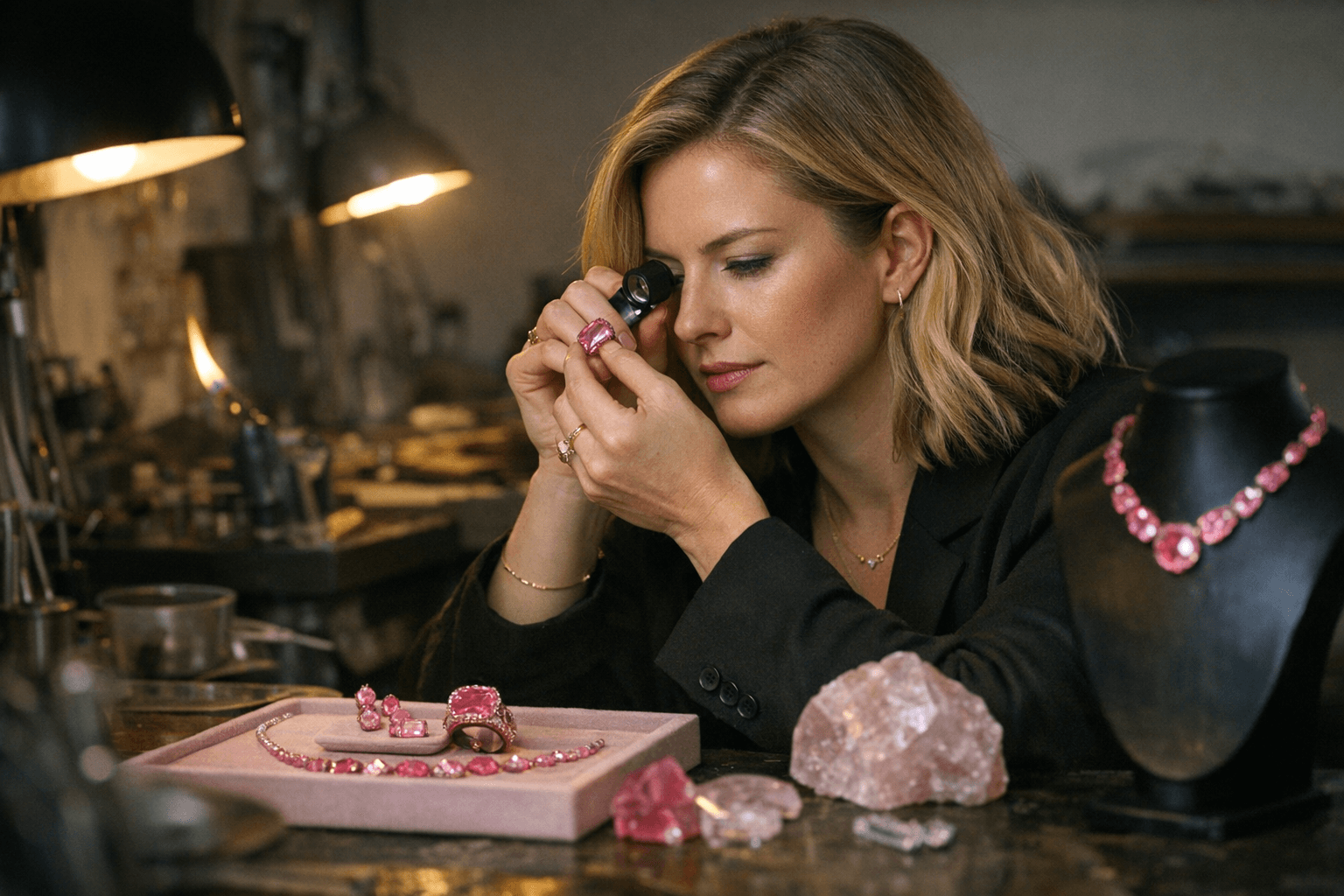
Pink is not a passive colour. For Eleanor Taylor-Roberts, founder of Eleanor Juliet Atelier (EJA), it is a provocation: a shade loaded with centuries of contested meaning, and precisely the right material for a designer who approaches jewellery as cultural commentary.
Founding a Conversation
Taylor-Roberts launched EJA with the Pink Puff capsule, a limited edition collection of individually handcrafted pieces intended, in the brand's own words, as "a playful symbol of feminism, championing women under a fresh and blush-hued wave of female liberation." Each piece is made entirely by hand, which means no two are identical: a deliberate gesture in an industry increasingly dominated by production-line uniformity. The collection sits at the intersection of craft and critique, asking wearers to consider what they signal when they choose to adorn themselves in blush.
Pink's Complicated Past
The conceptual architecture of Pink Puff rests on a serious piece of colour history that most people carry only dimly in their cultural memory. Taylor-Roberts traced it precisely: "At the beginning of the 20th Century, pink was widely regarded as a colour of masculinity, symbolising vitality, strength, and power, whilst blue was associated with femininity. By the 1940s, marketing narratives had reversed these associations."
That reversal is not a footnote; it is the foundation of the entire collection. Pink's journey is longer still: in 18th-century Europe it was a symbol of aristocratic elegance, before becoming a post-war emblem of domesticity, and later a rebellious hallmark of punk femininity. Each transformation reveals less about the colour itself than about the cultural anxieties and ambitions projected onto gender.
Taylor-Roberts extended that arc into the present: "Today, the conversation has evolved into a broader exploration of identity and gender expression. Take the somewhat recent Warner Bros film Barbie with Margot Robbie at the cultural forefront, the discourse shifted once more reflecting a modern interpretation that intersects with themes of motherhood and contemporary womanhood." That the designer can draw a straight line from 18th-century court dress to a 2023 blockbuster speaks to how precisely she has mapped the terrain.
Reclaiming the "Girly" Shade
What EJA does with this history is not nostalgic. The Pink Puff collection does not celebrate pink's domestic associations, nor does it simply dismiss them. It deepens the conversation on why pink is so controversial and the re-appropriation of the "girly" shade, positioning pink not as a frivolous hue but as a nuanced statement, one that reclaims softness as strength rather than evidence of vulnerability. The word "puff" in the collection's name carries its own weight: something light and airy that, on closer inspection, holds considerable volume and force.
By choosing pink as the primary idiom of its debut, EJA invites re-appraisal for the women who wear these pieces. There is authority in choosing the colour that culture spent decades trying to diminish. The research around EJA frames that choice explicitly as agency, reframing pink from a dismissed cliché into a deliberate emblem of power.
Jewellery as Active Cultural Text
The Pink Puff capsule reflects a broader design philosophy at EJA: jewellery is not decoration but conversation. The collection aims to contribute to this ongoing dialogue, encouraging wearers to engage with ideas of identity, gender and power through jewellery. In this sense, EJA positions its wearers as participants in a cultural argument rather than passive consumers of aesthetic objects.
This approach has real implications for how Pink Puff pieces function beyond the jewellery case. A pair of blush earrings from the collection is not simply an accessory; it is a legible signal, a position taken. The brand's framework asks more of both the maker and the wearer than most debut collections dare to.
Craft as Commitment
The handcrafted nature of every Pink Puff piece reinforces the collection's ideological premise. Each piece is individually handcrafted, meaning no two will be the same. In an era when "handmade" is frequently deployed as marketing shorthand, that commitment to individual craftsmanship means the variation between pieces is real: a physical record of the maker's hand. That specificity matters when the stated purpose of the work is to deepen personal and cultural meaning.
There is also something worth noting in how EJA chose to debut as a limited edition capsule rather than a full permanent line. A capsule format concentrates intent: every piece included is there because it earns its place conceptually, not because a range needs filling out. It is a disciplined opening move.
A Designer to Watch
Eleanor Taylor-Roberts is working in a space that few designers occupy so deliberately: the junction between fine craft, feminist theory, and widely accessible cultural reference. The Pink Puff capsule is a launch statement as much as a collection, one that announces EJA's intentions without ambiguity. Whether the brand can sustain that level of conceptual rigour across future work will be the more interesting question to track.
For now, the debut makes a strong case that jewellery, when designed with genuine intellectual purpose, is among the most efficient forms of cultural expression available. A single earring, worn at the right moment, can carry more argument than a thousand words. Taylor-Roberts appears to understand that completely.
This article was produced by Prism’s automated news system from verified source data, official records, and press releases, then run through automated quality and moderation checks before publishing. The system is built and supervised by the people who set the standards it runs under. Read our full AI policy.
Did this article answer your question?