Casey Perez’s Loma pendant turns everyday forms into sculptural gold
A fluted teapot, a scalloped lampshade and Blossfeldt’s botanicals converge in Casey Perez’s Loma pendant, where repetition becomes softness, structure and light.
From ordinary objects to a pendant with shape
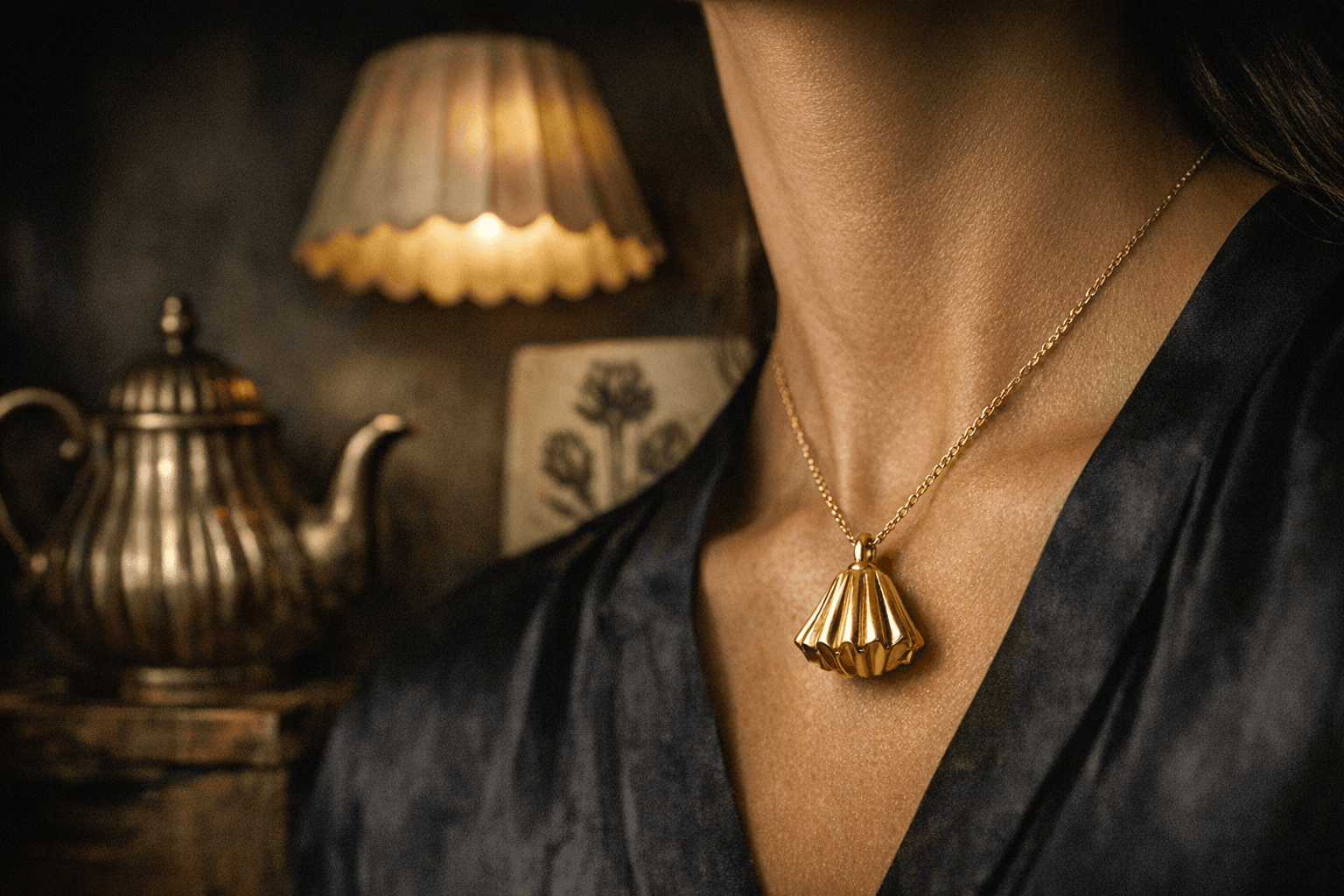
Casey Perez built the Loma pendant from the kind of forms most people pass without thinking: a fluted teapot, a scalloped lampshade, and the disciplined silhouettes of Karl Blossfeldt’s botanicals. In gold, those references stop reading as decoration and start acting like structure. The result is a pendant with soft radial fluting, a shape designed to catch light while still feeling easy to wear every day.
That balance is the key to understanding the piece. Perez describes it as soft yet structural, and the repetition at its surface is what keeps it from becoming precious in the wrong way. The rhythm of the fluting gives the pendant a calm, almost architectural presence, while the gentle curves keep the silhouette approachable rather than severe. It is sculptural, but not static.
How the references become the final shape
The fluted teapot is the clearest clue to the pendant’s surface language. Its vertical ridges translate into the Loma pendant’s radial fluting, a treatment that gives gold movement without relying on excess ornament. Fluting is one of jewelry’s oldest visual tools, but here it is used with restraint, so the relief becomes a way to animate the metal rather than overwhelm it.
The scalloped lampshade contributes something different: softness at the edge. Scalloping introduces a rounded, repeating contour that keeps the design from ending in a hard line. That matters in a pendant, because the edge is what the eye registers first against the body. Perez’s version uses that familiar domestic outline to make a compact jewel feel warm, rhythmic and wearable rather than formal.
Blossfeldt’s influence adds the final layer of intelligence. His plant photographs are not merely botanical references, they are studies in form. The Metropolitan Museum of Art notes that Blossfeldt began exploring forms in nature in 1890, and that his images were little known until Urformen der Kunst, published in 1928. What made the work lasting was the way it revealed the architectural clarity of plant forms, the same kind of clarity Perez seems to seek in gold.
A New York-made jewel with a broad design vocabulary
Perez’s background helps explain why the pendant feels so resolved. She is a first-generation Mexican-American artist and goldsmith based in New York, and she discovered metalsmithing while studying at NYU. That route into jewelry matters, because the work carries both academic discipline and the instinctive curiosity of someone who came to the craft by accident and stayed for the possibilities.
Her broader design language reaches beyond nature studies. Casey Perez Jewelry says her work draws inspiration from modernist architecture, the Bauhaus, Memphis and Swedish minimalism, and all of those references can be felt in the Loma pendant’s proportions. Modernism contributes the clean silhouette, the Bauhaus the devotion to form following function, Memphis the willingness to play with pattern, and Swedish minimalism the sense that beauty should feel calm and usable.
The piece is also made to be worn, not merely admired. Casey Perez Jewelry says the pendant is handcrafted between Perez’s Brooklyn studio and New York City’s jewelry district using traditional techniques. That combination suggests a useful distinction for anyone shopping sculptural jewelry: the finish may look modern, but the making remains rooted in old-world discipline. The difference shows in the surface, where precision and handwork keep the metal from feeling machine-flat.
The natural white diamond featured in the pendant adds a final note of contrast. Against the gold and the broad, repetitive fluting, the stone acts as a point of light rather than the center of the story. That restraint is important. In minimalist jewelry, the stone should sharpen the design, not compete with it.
Why the pendant fits the current appetite for sculptural minimalism
Perez’s work has already drawn serious attention. The Couture Show featured her in its Luminaries by COUTURE spotlight in April 2024, a sign that her vocabulary of clean lines and tactile surfaces sits comfortably within the high-craft conversation around contemporary jewelry. Her Mexican-American heritage also informs her work, adding personal and cultural depth to forms that might otherwise read as purely formal exercises.
What makes Loma compelling is that it treats minimalism as an act of editing, not stripping. The pendant does not feel bare. It feels considered. Every ridge, curve and softened edge serves a purpose, and that purpose is to make a geometric object feel almost domestic in its ease. It has the clarity of a small sculpture, but the intimacy of something meant to be worn close to the body.
How to read sculptural minimalist jewelry when shopping
Look first at the surface. If a pendant or ring uses fluting, ridging or scalloping, ask whether those details are doing visual work, catching light, softening scale or guiding the eye. In the best minimalist pieces, texture is not decorative noise. It is the architecture of the design.
Pay attention to the silhouette before the stone count. A well-made minimalist jewel often looks inevitable from a distance because its shape is doing the heavy lifting. If the outline feels balanced, the piece can remain interesting even when it uses very few materials.
- Favor pieces where repetition creates calm rather than clutter.
- Look for hand-finished surfaces, because subtle irregularities often give sculptural jewelry its warmth.
- Choose designs that feel as comfortable as they look intentional, since the most successful minimalist jewels are the ones that can live on the body every day.
Loma succeeds because it turns an everyday visual memory into a wearable form with discipline and tenderness. That is what makes it more than a pendant. It is a lesson in how minimalism, when handled well, can feel richly human.
This article was produced by Prism’s automated news system from verified source data, official records, and press releases, then run through automated quality and moderation checks before publishing. The system is built and supervised by the people who set the standards it runs under. Read our full AI policy.
Did this article answer your question?


