Designing Minimalist Gemstone Jewelry with Restraint, Intention, and Subtle Impact
A single diamond can feel like an attitude. Restraint, not quantity, is what makes minimalist gemstone jewelry the most precise form of personal expression.
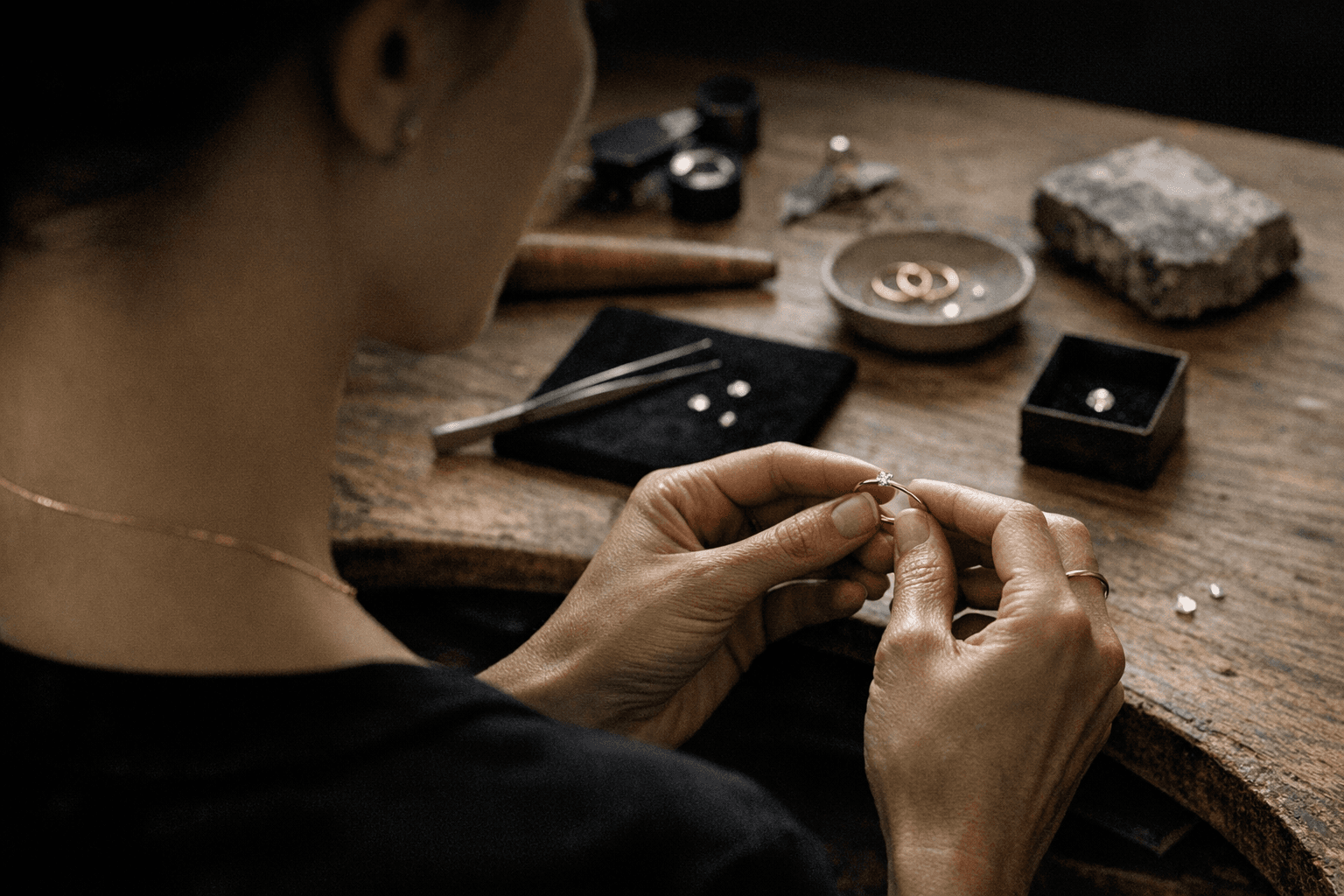
Minimalist gemstone jewelry begins with a deceptively simple idea: every element must justify itself. Fewer stones. Low-profile settings. Nothing that doesn't earn its place. That design philosophy, which runs through how the most considered jewelry makers approach this category, produces pieces that feel far more intentional than their scale suggests. As one formulation puts it, "minimalism turns jewelry into a visual language. Your necklace becomes a message. Your ring becomes a reminder. You don't decorate yourself — you define yourself."
That is not metaphor for its own sake. It is a design brief.
The Principles of Minimalist Gemstone Design
Minimalist jewelry is defined by clean lines, refined proportions, and quiet confidence. The Rodgersdiamonds framework for this aesthetic is worth keeping in hand: clean lines mean sleek shapes and unfussy silhouettes; lightweight feel means pieces are delicate, designed to layer or stand alone; neutral metals — yellow gold, white gold, rose gold, and platinum — anchor the look with timeless appeal; and subtle sparkle means diamonds and gemstones are used sparingly, for a hint of brilliance without excess.
What that list doesn't fully communicate is the discipline required to achieve it. While minimalist designs may seem simple, each piece is carefully considered, with attention to proportion, negative space, and detail. The simplicity is the work. Stripping a piece down to its essential geometry while keeping it structurally sound and visually resonant is harder than loading a design with ornament.
The Symbolic Language of Shape and Space
Designers working in this idiom don't choose shapes arbitrarily. Geometric motifs carry specific communicative weight. A circle speaks to unity, wholeness, eternity. A bar or line suggests direction, ambition, clarity. A triangle carries connotations of balance, growth, purpose. Negative space offers room for imagination. And a single gemstone, used as the sole focal point, represents pinpoint focus, a moment frozen in time.
These meanings aren't decorative philosophy. They are the reason a single bezel-set stone on a slim chain can feel more considered than a fully pavé band. The emptiness around the stone is load-bearing. Negative space does as much work as the metal itself.
Metal Mood and Material Choices
The choice of metal in minimalist jewelry is a tonal decision as much as a material one. Gold offers warmth and confidence, catching the light in a soft, glowing way. Silver feels cooler, sharper, sleek, creating a modern edge. Rose gold adds a romantic or artistic tone, playful but refined. Rodgersdiamonds adds platinum to the neutral metals roster, a choice that reads as precise and architectural, particularly suited to low-profile settings where the metal's durability supports a thinner profile.
The interplay between metal temperature and gemstone color is where the real design conversation happens. A pale sapphire reads differently against warm yellow gold than against cool white gold. A champagne diamond on rose gold creates a tonal harmony that would dissolve against platinum. These are decisions that minimalist design forces into sharp relief, precisely because there is nowhere else to look.
The Single-Stone Strategy
The most radical expression of minimalist gemstone design is the single-stone approach: one stone, one setting, one statement. The thinking behind this is that when one stone becomes the entire expression, the quality of that stone, its cut, its placement, its relationship to the setting, carries the full weight of the piece. Lab-grown jewelry brand SOLO for Diamonds has built its identity entirely around this premise: a brand "built around the idea of highlighting one perfect element," where the power comes from concentration rather than accumulation.
This is the practical embodiment of the idea that "a thin band can hold a memory, a single diamond can feel like an attitude. The impact comes from clarity, not quantity." That sentence deserves to be read as gemological instruction, not just editorial flourish. Clarity of concept. Clarity of execution. The stone doesn't need company.
Quiet Luxury Versus Loud Trends
There is a cultural argument embedded in minimalist jewelry that has become increasingly legible. "Huge logos, oversized stones, or complicated shapes pull focus immediately. But they rarely hold attention. Their appeal fades once the novelty wears off." Loud accessories sometimes demand attention without earning it — and the difference between demanding attention and earning it is exactly where quiet luxury positions itself.
Rodgersdiamonds frames this shift precisely: "In the age of overstimulation and fast fashion, there's something quietly powerful about subtlety. Minimalist jewelry represents a refined and intentional way of expressing personal style, one that whispers rather than shouts." The phrase "quiet luxury" has become something of a cultural shorthand, but its jewelry application is specific: pieces that do not reference trend cycles, that hold their proportion and purpose across decades, and that read as personal expression rather than cultural signaling.
How to Wear It: The One Focal Point Rule
Minimalist jewelry is among the most versatile categories in fine jewelry, adapting to a white T-shirt, a slip dress, a power blazer, or a silk blouse with equal ease. The jewelry remains honest. It never overwhelms the outfit. It highlights your face and gestures instead of pulling attention away from them.
The governing styling principle is the One Focal Point Rule: choose one element to lead the look. If the necklace stands out, keep earrings subtle. If a bold ring takes the attention, skip the extra wrist pieces. A single highlight creates balance and makes the styling look intentional instead of crowded. This rule is less a constraint than a clarifying device. It asks the wearer to make a decision, and that decision is itself a form of self-expression.
Building a Capsule Collection
A minimalist collection doesn't require quantity; it demands intention. The foundation that Little Treasury Jewelers recommends to their clients in the Baltimore-Annapolis area is instructive in its simplicity: diamond studs, a timeless watch, a simple chain. From that foundation, statement pieces can be added incrementally, creating a layered approach that allows flexibility without sacrificing coherence.
The items most consistently associated with this category in practice are delicate chains, small diamond studs, slim gold or platinum bands, subtle pendants, and understated bracelets. These are not exciting descriptions. They are, however, descriptions of pieces that survive every wardrobe change, every context shift, every decade. A simple diamond pendant or classic stud earrings can transition seamlessly from a morning meeting to dinner, without requiring a costume change or a rethink.
From the Jeweler's Bench: Craftsmanship Details
The technical demands of minimalist jewelry are often underestimated. Because the pieces are spare, there is no ornament to absorb or disguise construction flaws. A minimalist ring must be precisely engineered. Slim bands require structural integrity. Small prongs must be secure. Fine chains must be durable.
The craftsmanship challenges shift rather than diminish for statement work: larger gemstones require thoughtful setting design, weight distribution matters, and comfort becomes essential. But in minimalist work, the engineering is more visually exposed. A prong that sits even slightly off-axis on a solitaire reads as a flaw in a way it might not on a heavily set cocktail ring. The setting, whether a delicate claw prong or a clean bezel, is as much a design element as the stone it holds. Whether subtle or bold, quality construction ensures the jewelry lasts, but in minimalist work, quality construction is the jewelry.
The discipline required to design and make at this scale is the same discipline that defines the category itself: restraint, precision, and the conviction that what you remove can matter as much as what you keep.
This article was produced by Prism’s automated news system from verified source data, official records, and press releases, then run through automated quality and moderation checks before publishing. The system is built and supervised by the people who set the standards it runs under. Read our full AI policy.
Did this article answer your question?


