Expert Tips for Layering Minimalist Necklaces With Effortless Harmony
Three necklaces beat two every time — here's why odd numbers, a 16-inch anchor, and mixed textures are the secret to a layered look that reads as intentional, not accidental.

A thin gold chain sitting just above the collarbone can do something remarkable: it makes every other necklace you add feel necessary. That is the quiet power of the base layer, and it is where every well-considered necklace stack begins. Layering minimalist necklaces is not about accumulation; as Velvet Luminance puts it, "layering jewelry doesn't mean piling on — it's about harmony."
Start With Your Anchor
The foundation of any layered look is a short, simple piece worn closest to the neck. John Hardy's styling guidance is direct: "Start with a short, simple piece that will anchor your layered look. A classic choker or 16" chain works perfectly." That 16-inch length is the industry standard for a reason: the circumference of your neck influences how a necklace fits, and necklaces hang lower on a narrower neck while a broader neck creates a shorter drape — which means a 16-inch chain behaves differently on every person who wears it, but it reliably sits just at or above the collarbone, leaving room for everything that follows.
The base does not have to be precious or elaborate. John Hardy describes two valid approaches: a chunky piece at the base for a contrasting look, or "an elegant, whisper-thin choker" for a more cohesive, all-delicate result. The choice determines the entire character of what you build above it.
Establish a Focal Point
Once the anchor is in place, choose one piece to serve as the visual center of gravity. As Hurdlesjewelry explains, "a successful necklace layer starts with one central piece. This is often a pendant, charm, or locket — something that creates visual interest and serves as an anchor." Critically, it does not need to be large: a diamond solitaire in yellow gold at 18 inches can quietly command an entire neckline without raising its voice.
Velvet Luminance frames this beautifully: "Start with a simple, subtle chain — your foundation. Then add a pendant or charm as your story's focal point. According to a third-generation jeweler, this approach keeps the look elegant and intentional." A sentimental choice works especially well here. Centering an A-to-Z initial necklace as the focal piece turns a purely aesthetic decision into something personal and specific. Every other necklace in the stack should support that central piece, not compete with it.
Map Your Lengths
Spacing is where most layered looks either succeed or collapse into tangles. The practical rule is simple: give each necklace its own vertical territory. Maintaining at least two inches of difference between necklaces reduces contact points and allows each chain to lie flat on the body without sliding into its neighbor. John Hardy recommends adding "one piece every two to four inches," which gives a cleaner, more architectural separation between layers.
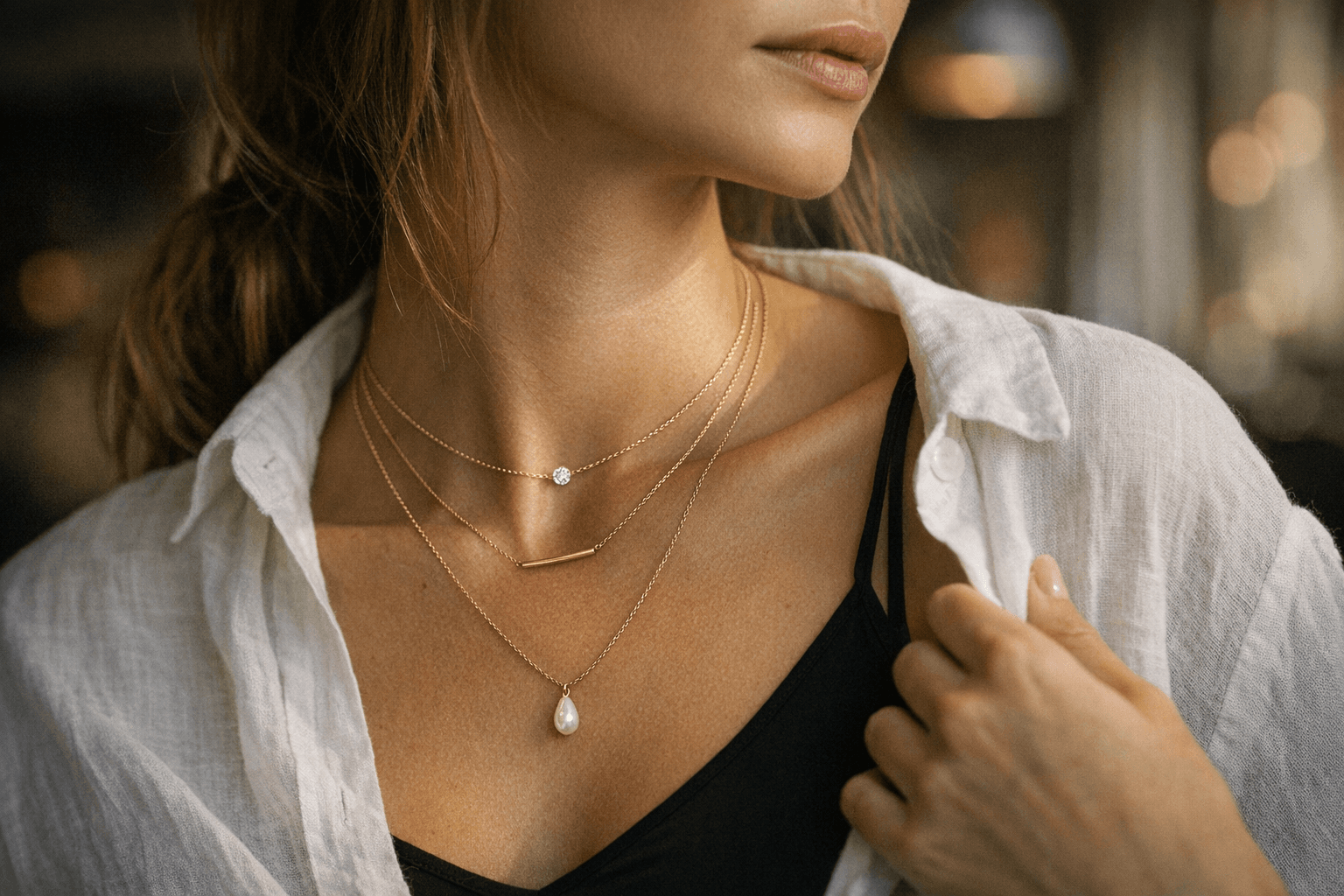
A proven sequence: begin with a 16-inch base, move to an 18 or 20-inch mid-layer carrying the focal pendant, and close with a drop-style Y-necklace that draws the eye down toward the sternum. For a no-fail pairing, spacing necklaces two inches apart in length works consistently: if a choker falls at 16 inches, an 18-inch middle layer and a 20-inch bottom layer follow naturally. The Y-necklace, with its distinctive downward drop, earns its place because its shape is immediately distinct from any chain — it never competes for the same visual lane.
Neckline is an equally important variable: higher necklines limit space and may look best with fewer, longer pieces, while open necklines provide more canvas for extensive layering. A V-neck practically calls for a pendant that mirrors its geometry. A crew neck works best with shorter pieces that stay above the fabric. Going longer suits a deep V-neck, while keeping it shorter complements a high-neck vibe.
Mix Your Textures
Chain texture is the detail that separates a thoughtful stack from a tangled one. The key is variety: box, rope, and figaro chains each have a distinct link structure that naturally resists interlocking with the others. Velvet Luminance extends this list to include rolo, snake, and beaded styles, each adding a different quality of light and movement to the neckline. Integrating various textures adds variation even when sticking to a single metal; mixing gold jewelry with pearls, colored beads, or leather pieces creates a dynamic tapestry of color and texture.
Necklaces that tangle together are generally ones that are similar in thickness and weight, so variety prevents tangling; choosing varying lengths and weights gives all chains a chance to lie flat rather than intertwine. As John Hardy notes, mixing chain styles "is the best part of layering necklaces. Each style adds a different texture to your neckline so that when you bring multiple styles together, you create a varied, eye-catching look." Box chains and snake chains in particular tend to tangle less than more flexible chain styles — worth knowing when building a stack you plan to wear all day.
Embrace Mixed Metals
The old prohibition against mixing gold and silver is finished. The rule about never mixing metals is thoroughly retired; mixed metal jewelry is now not just acceptable but actively preferred by stylists and fashion-forward wearers. Velvet Luminance makes the case directly: "Gone are the days of matching metals. Mixing gold with silver and rose tones modernizes the look and increases versatility." A practical starting point: layer an 18K gold-plated chain with sterling silver hoops, or choose a two-tone pendant that bridges both metals within a single piece.
Mixing gold and silver tones is a modern, stylish way to add contrast to a layered look; starting with one dominant metal and using the second as an accent keeps the stack cohesive. The two-tone pendant is particularly useful here — it speaks both metal languages simultaneously and holds the look together without effort.
The Odd-Number Rule
Composition matters in jewelry the same way it matters in photography. Hurdlesjewelry articulates the principle plainly: "Three necklaces tend to form a complete, balanced composition — without feeling overly symmetrical or styled. One necklace alone makes a statement. Two can feel accidental. Three or five creates intentionality." Choosing three different necklaces is an easy and effective way to curate an appealing look, and odd numbers create variety while allowing a favorite pendant to sit naturally in the middle.
Two necklaces can work, but only when their lengths, weights, and focal points are clearly different from each other. Any ambiguity between two pieces reads as an oversight rather than a choice. Three removes that ambiguity entirely.
Layer With Meaning
The most compelling stacks are not just well-proportioned — they carry weight beyond the physical. Hurdlesjewelry makes a compelling case for incorporating pieces with personal significance: a vintage charm passed down from a grandparent, a birthstone pendant for a child, a chain bought on graduation day. Layering necklaces is not just about style — it is about storytelling; the pieces chosen, how they are combined, and the way they sit against a neckline all reflect something personal, transforming a trend into something uniquely one's own.
Velvet Luminance captures the cumulative effect: "each chain, each charm, each bead, quietly building your personal story." A meaningful piece does not need to be the largest or the most expensive element in the stack. It simply needs to be present.
The Mirror Test
No amount of theoretical guidance replaces standing in front of a mirror and moving. John Hardy's advice is the most practical in any layering guide: "The best advice for layering necklaces is to experiment. Start with a few necklaces of different lengths and materials, then gradually create more complex combinations in front of your mirror at home." Starting with the shortest piece and working outward, carefully arranging each layer before adding the next, is the most reliable method for achieving a finished look without tangling.
Flat necklaces help avoid knotting, as they are less likely to roll and become tangled; varying lengths and thicknesses also keeps necklaces from clumping together. If everything feels too busy, remove one piece. A stack that requires constant adjustment is not the right stack. The goal, as Velvet Luminance frames it, is "style without shouting" — a quietly curated neckline that reads as both considered and completely your own.
This article was produced by Prism’s automated news system from verified source data, official records, and press releases, then run through automated quality and moderation checks before publishing. The system is built and supervised by the people who set the standards it runs under. Read our full AI policy.
Did this article answer your question?


