Hemmerle's minimalist jewelry uses copper, red gold, and brown diamonds
Hemmerle shows minimalist jewelry can feel warmer and stranger, pairing copper, red gold, and brown diamonds with clean lines and Bauhaus roots.
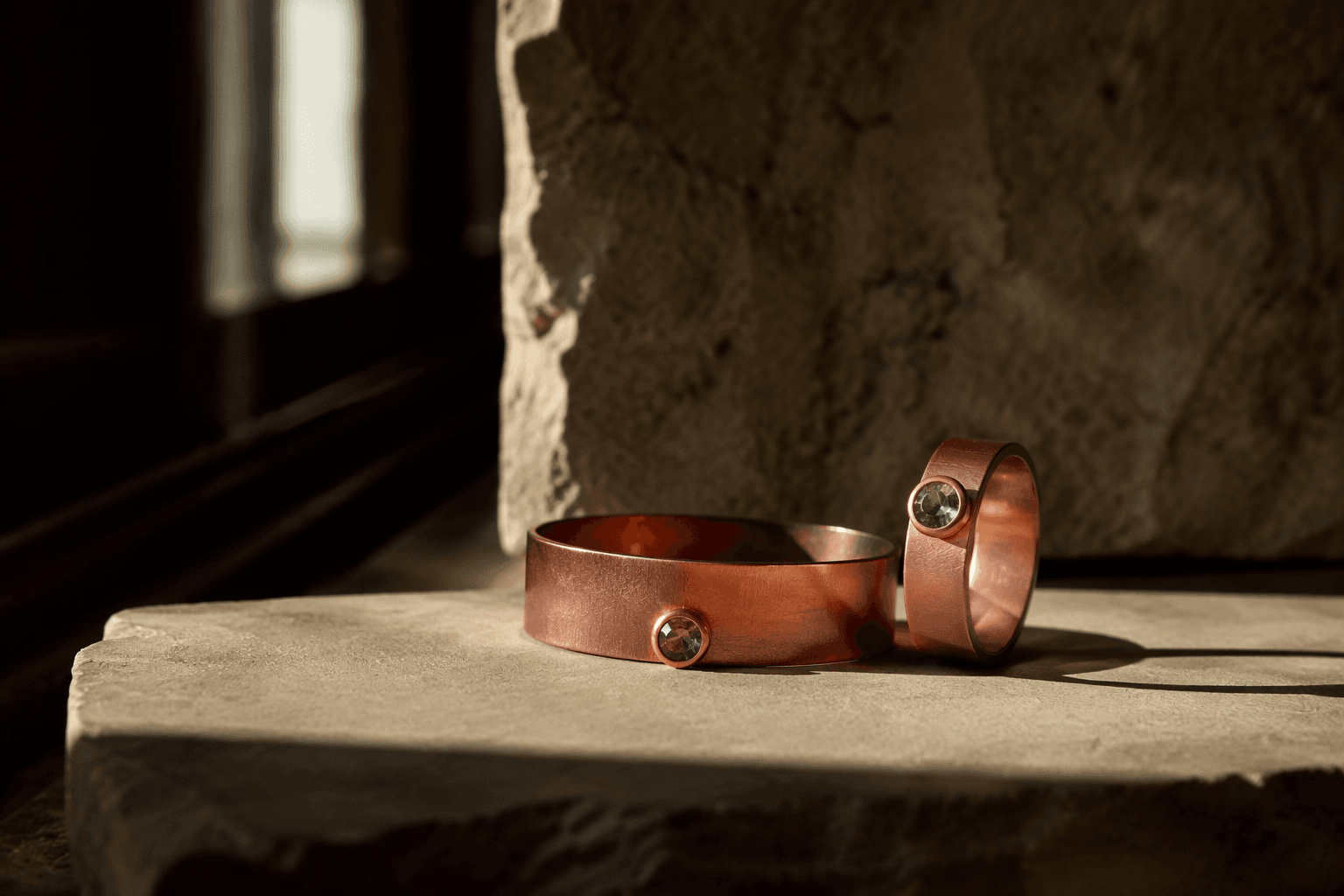
Hemmerle makes a strong argument that minimalist jewelry does not have to mean slick gold, polished silver, or icy white stones. In its hands, restraint becomes warmer and more tactile, shaped by copper, red gold, brown diamonds, and other unexpected materials that keep the silhouette clean while giving the surface real depth.
Why Hemmerle changes the minimalist formula
The Munich house was founded in 1893, when Josef and Anton Hemmerle took over an established goldsmiths’ company, and that long continuity still shapes the brand’s point of view. Hemmerle is now a fourth-generation family-run house, with Christian and Yasmin Hemmerle running the business alongside Stefan and Sylveli Hemmerle. The company says its more than 130 years of history inform its design principles, and that history includes a willingness to push boundaries rather than repeat a safe formula.
That matters because Hemmerle’s version of minimalism is not thin or sterile. Its heritage is tied to German art movements such as Bauhaus and Neue Sachlichkeit, also known as New Objectivity, which helps explain the disciplined geometry behind the work. The result is jewelry that feels modernist in structure but unexpectedly earthy in material, a combination The Jewellery Editor captures as bold simplicity with earthy materials.
The bangle that makes the case
A particularly clear example is a bangle made with copper, red gold, and brown diamonds. Each material does different work: copper brings an amber, grounded tone; red gold adds warmth without turning brassy; brown diamonds add depth instead of the hard sparkle of colorless stones. The piece stays minimal because the form is controlled, not because the materials are reduced to the blandest possible choice.
That distinction is the real lesson. In Hemmerle’s language, minimalism is not about stripping away character. It is about limiting the composition so the texture of the materials becomes more legible, which is why a piece with only a few elements can still feel richly considered. A restrained bangle becomes memorable when the eye can register the slight difference between warm metal, earth-toned stone, and a surface that is not trying to look mirror-perfect.
Christie’s describes Hemmerle as a house known for one-of-a-kind creations made with high quality gemstones and non-traditional materials such as copper, oxidised iron, rare woods, and steel. Sotheby’s similarly points to innovative material combinations and bold creations. Put those descriptions beside the copper, red gold, and brown diamond bangle, and the through line is clear: Hemmerle treats material contrast as the main form of ornament.
The house language of subtle surprise
Hemmerle has repeated that idea for decades. On its project page for the Harmony bangle, the house says: “The Harmony bangle has always pushed us to be innovative, to experiment and rediscover what we thought we knew. It is anchoring so many milestones of what Hemmerle has achieved and as we evolved with our materials, the Harmony bangle evolved with us.” Katerina Perez noted in October 2021 that the piece was celebrating 30 years, which places its origin around 1991 and shows that this experimental minimalism has been building over time, not invented as a recent aesthetic refresh.
The Mushroom brooch project, which Hemmerle says emerged in 2004, makes the same point in a different register. The house describes it as a study in subtle surprise, using earthy woodland tones and textures with materials including pock wood, copper, and white gold. Here again, the form is not overloaded, but the surface carries more life than a flat expanse of polished metal ever could. That is one reason Hemmerle’s work reads as serene from a distance and intricate up close.
There is also a broader market context for this shift. A New York Times article from December 6, 2021 noted that brown and other offbeat diamonds, once shunned, were increasingly in demand. That helps explain why a brown-diamond bangle now feels forward-looking rather than eccentric. What once sat outside the luxury hierarchy now gives minimalist jewelry a warmer palette and a less predictable finish.
Hemmerle’s museum presence reinforces that this is design with institutional gravity, not just retail appeal. The house says its creations sit in the permanent collections of the Victoria & Albert Museum in London, the Metropolitan Museum of Art and Cooper Hewitt Smithsonian Design Museum in New York, and Die Neue Sammlung in Munich. That placement matters because it shows the work is understood as design history as much as adornment.
How to shop minimalist jewelry with more texture and character
If you want minimalist jewelry that feels earthy rather than bare, look for pieces that are controlled in shape but specific in material. The Hemmerle playbook suggests a few practical details to watch for:
- A single strong silhouette, such as a bangle, brooch, or ring with clean architecture
- Warm or unconventional metals, including red gold, copper, oxidised iron, or steel
- Stones with depth rather than maximum brilliance, such as brown diamonds or other offbeat diamond shades
- Natural materials that introduce grain or tone, such as rare woods or pock wood
- Makers who name their materials precisely instead of hiding behind vague language like “organic” or “earth-inspired”
The key is proportion. When the line is disciplined, the material becomes the point of interest, and the piece feels quieter, not louder. That is what separates Hemmerle’s work from generic minimalism: it keeps the outline calm while letting color, texture, and provenance do the emotional work.
In the end, Hemmerle shows that minimalist jewelry can still have a pulse. The most compelling pieces are not the blankest ones, but the ones where copper, red gold, brown diamonds, and a sharply edited form come together with enough restraint to feel elegant and enough texture to feel lived in.
This article was produced by Prism’s automated news system from verified source data, official records, and press releases, then run through automated quality and moderation checks before publishing. The system is built and supervised by the people who set the standards it runs under. Read our full AI policy.
Did this article answer your question?