How Hand Sanitizer Can Tarnish Minimalist Silver and White Gold
Hand sanitizer is usually safe for your skin, but not always for your jewelry. Sterling silver and white gold can dull quietly if the residue is left to sit.
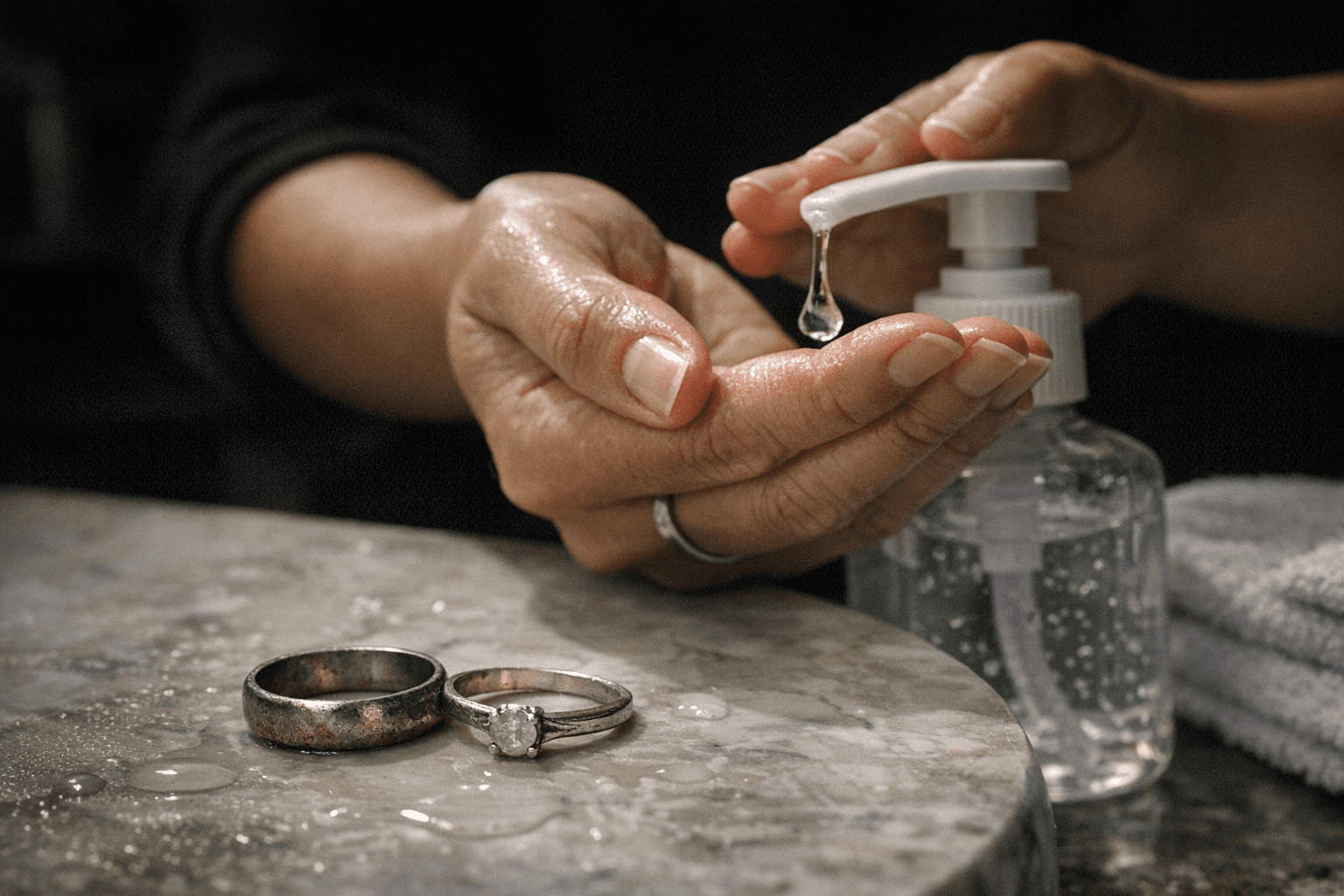
The sanitizer trap
A thin sterling chain at the collarbone, a white gold ring worn from breakfast to bedtime, a pair of clean-lined hoops that disappear into the ear: these are the pieces that make minimalist jewelry feel intimate. They are also the pieces most likely to pick up the quiet wear of modern life, including the alcohol, surfactants, and residue left behind by constant hand sanitizing.
The good news is simple. Alcohol-based sanitizer is generally benign for hands and, when it is the right kind, it is not a disaster for jewelry at a glance. The trouble starts when formulas stray from that lane. Non-alcohol sanitizers and some soaps can contribute to tarnish or surface wear, especially on sterling silver and low-karat white gold. The rule for your hands is clear, but the rule for your jewelry is more careful: let sanitizer do its job on skin, then keep it away from the metal.
The number that matters
The Centers for Disease Control and Prevention recommends hand sanitizer with at least 60% alcohol when soap and water are unavailable. The U.S. Food and Drug Administration echoes that guidance, specifying that alcohol-based hand sanitizer should contain at least 60% ethanol if soap and water are not available. That threshold is useful not just for hygiene, but for knowing what kind of residue you are likely dealing with on rings, bracelets, and chains.
There is another important reminder from the CDC: hand sanitizer may not remove harmful chemicals like pesticides and heavy metals from hands. That matters because sanitizer is not a universal cleaner, for skin or for objects. It disinfects under the right conditions; it does not scrub away every contaminant, and it certainly is not a jewelry bath.
Sterling silver: beautiful, and visibly sensitive
Sterling silver is the material that tends to show the story first. Its polished surfaces catch light beautifully, but they also reveal dulling, haze, and the kind of surface change that can make a crisp chain or a petite pendant look tired before its time. If you wear a silver curb chain, a fine box chain, or a delicate pendant every day, repeated contact with sanitizer residue can make the finish look less bright, especially when formulas are not alcohol-based.
The best habit is almost insultingly easy: sanitize your hands first, then wait until they are fully dry before touching your jewelry. That one pause keeps liquid from pooling in links, clasp joints, and tiny crevices where wear builds up. If a piece does get damp, wipe it gently with a soft, dry cloth rather than reaching for more product.
White gold and the problem of plating
White gold asks for a more nuanced eye. In many minimalist pieces, especially those designed to look bright and seamless, the metal is finished with rhodium plating. Stuller describes rhodium plating as a very thin layer applied to jewelry, most often white gold, to mask natural yellow or warm tones and enhance reflectivity. That finish is part of the illusion of white gold at its most polished: crisp, cool, and mirror-bright.
Because the layer is so thin, aggressive habits can shorten its clean, luminous look. Repeated exposure to soaps and non-alcohol formulas can wear at the surface over time, and once the plating begins to thin, warmer tones underneath become more visible. The result is not damage in the dramatic sense, but a subtle shift in color and sheen that is especially noticeable on small, minimal silhouettes where every surface is exposed.
For rhodium-plated rings, hoops, and slender bangles, the safest routine is restraint. Put jewelry on after hands are dry. Take it off before frequent sanitizing sessions. If a piece is frequently exposed, expect that its finish may need more attentive maintenance than solid metal pieces.
Low-karat gold: sturdy, but not invincible
Low-karat white gold and other lower-karat gold alloys deserve extra caution because they rely on a mix of metals that can be more vulnerable to surface change than higher-karat pieces. In minimalist jewelry, that often shows up in the very forms people wear most: a plain band, a narrow cuff, a line bracelet with polished edges. These designs look effortless, which is precisely why any dulling or wear becomes visible so quickly.
The practical lesson is not to baby the jewelry into a box forever. It is to avoid turning sanitizer into a finishing product. A quick spray or rub on your hands is one thing; soaking a ring, rubbing alcohol over a chain, or cleaning metal with sanitizer is another. Jewelry-industry expert Melanie Nicolosi has been blunt about that point: using alcohol to clean jewelry is a bad idea.
Safe after-sanitizer habits
The simplest routines are the ones most likely to protect minimalist pieces.
- Sanitize first, then let your hands dry completely before putting jewelry back on.
- Avoid spraying sanitizer while rings, bracelets, or necklaces are still on your skin.
- Never use hand sanitizer as a jewelry cleaner.
- If a piece feels tacky after repeated hand cleaning, wipe it with a soft, dry cloth rather than adding more liquid.
- Pay special attention to rhodium-plated white gold, sterling silver, and low-karat alloys, because their surfaces are the most likely to show subtle wear.
Those habits are small, but they matter because minimalist jewelry has nowhere to hide. A bezel-set diamond on a thin band, a slim silver chain, a carabiner-link necklace, or a polished white gold hoop depends on surface clarity. When that surface is dulled by residue or over-cleaned with the wrong product, the whole design loses the sharpness that made it compelling in the first place.
The cleanest rule
Hand sanitizer belongs to your hands, not your jewelry. Use the CDC and FDA threshold as your guide for hygiene, let the product evaporate before you touch metal, and treat sterling silver and white gold as finished surfaces rather than indestructible accessories. In minimalist jewelry, where one chain, one clasp, or one ring edge carries the entire design, the difference between bright and tired can come down to a few seconds of patience.
This article was produced by Prism’s automated news system from verified source data, official records, and press releases, then run through automated quality and moderation checks before publishing. The system is built and supervised by the people who set the standards it runs under. Read our full AI policy.
Did this article answer your question?


