Spring Floral Jewelry Blooms Across Gold, Titanium, Horn, and Porcelain
Florals are looking leaner this spring, recast in titanium, suede, horn, and porcelain with petals that read more architectural than sweet.
A bloom with sharper edges
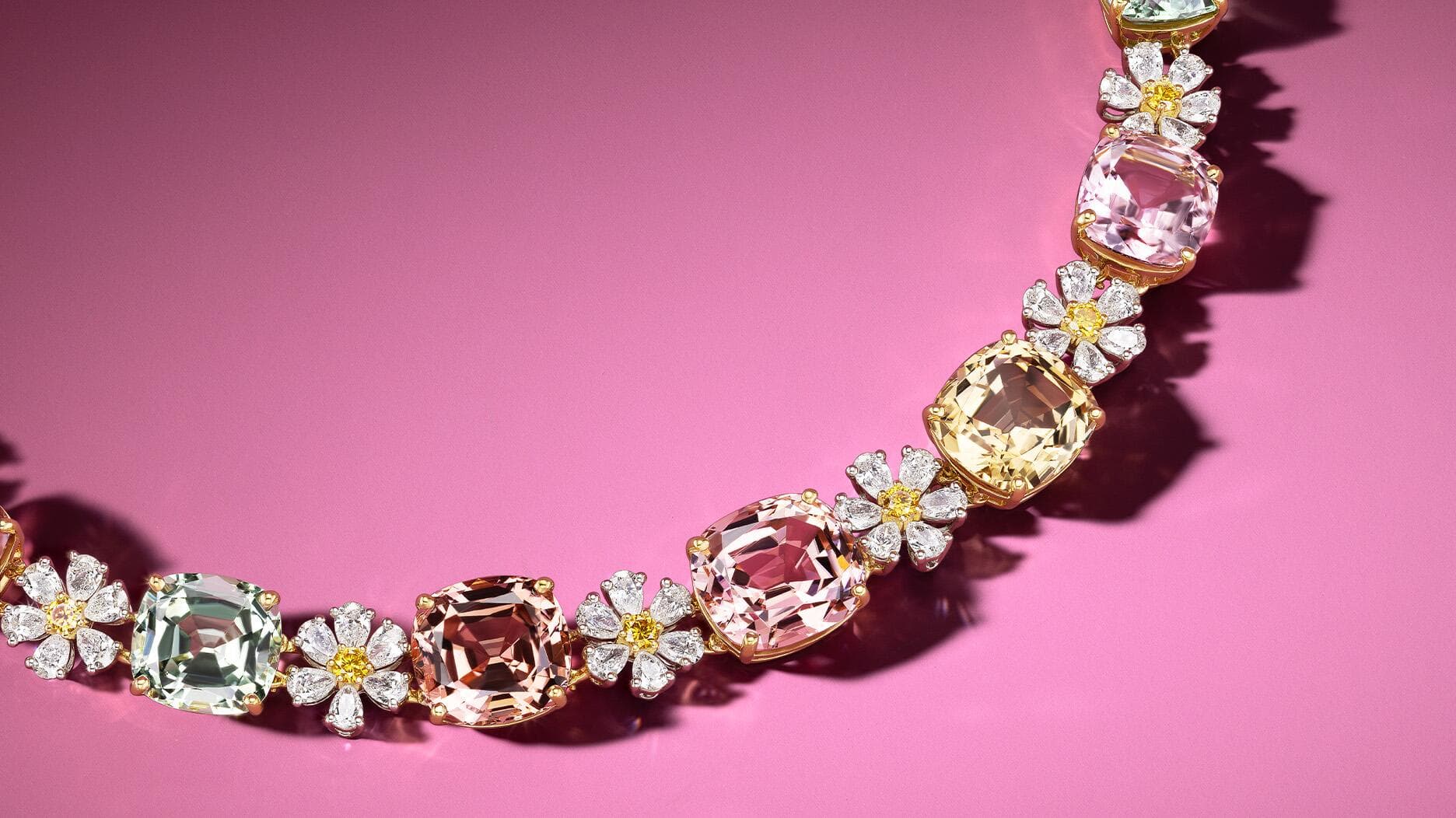
The season’s most persuasive floral jewels do not look like bouquets. Oscar Heyman’s $400,000 flower necklace turns petals into an architectural cluster of cushion-cut multicolor tourmalines, pear-cut white diamonds, and round-cut fancy color diamonds, proving that a bloom can read as serious high jewelry when the proportions are disciplined and the color is handled like a painter’s palette.
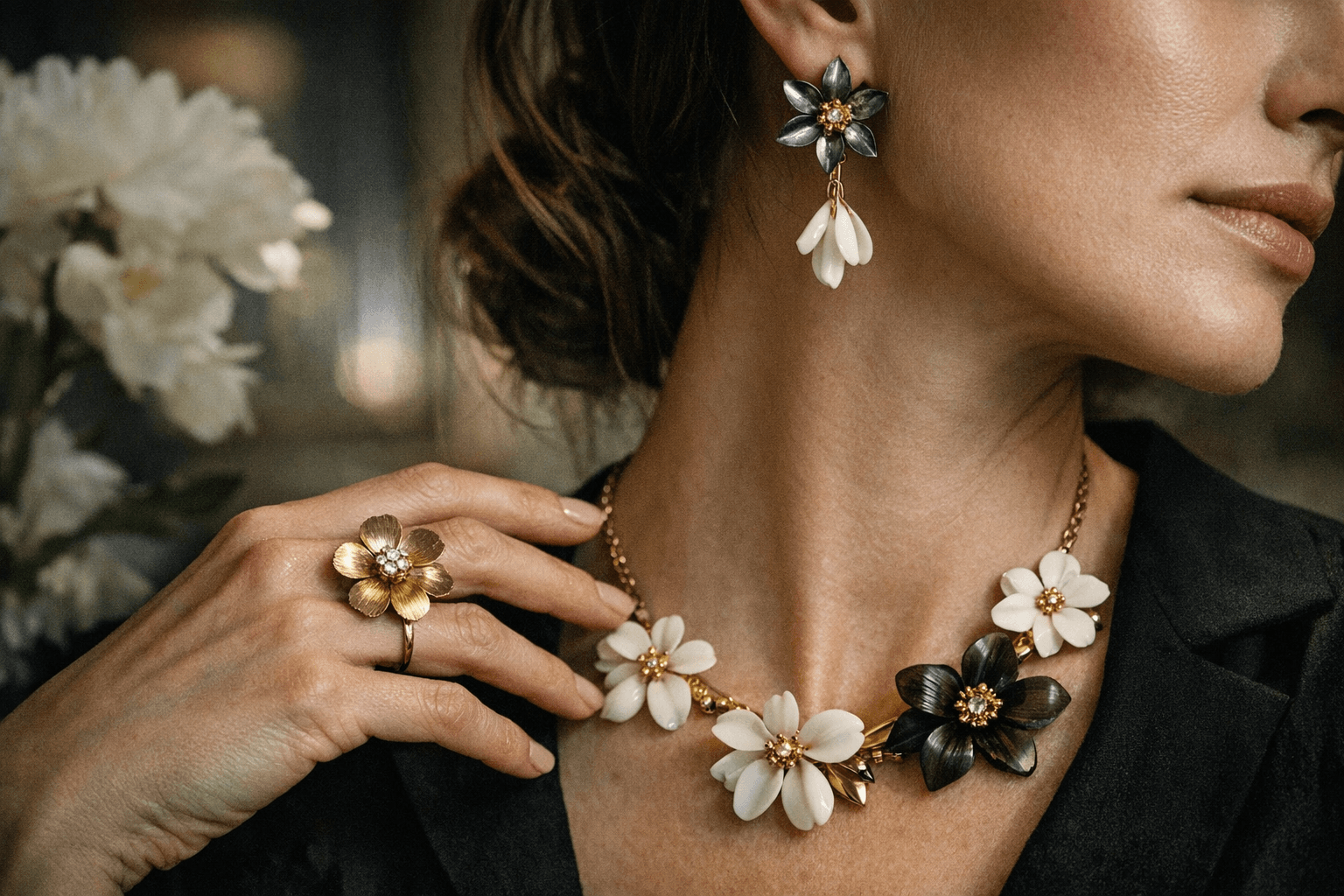
That is the larger story of spring 2026: floral jewelry is multiplying, but it is also slimming down. More collections this year are built around flower and petal designs from the first sketch, and the strongest examples avoid sweetness in favor of line, tension, and negative space. The result feels aligned with the broader runway mood, where spring jewelry has been defined by self-expression, minimal lines, craftsmanship, and statement pieces, while the runway itself leans into intentionality, scale, and high-fashion function.
Why the flower motif feels modern now
A floral piece feels current when it behaves like a graphic object rather than a literal bloom. Tacori’s “Dahlia” sculpted double-petal engagement ring is a good example of that shift. Instead of piling on petals, it compresses the motif into a cleaner silhouette, using the flower as a structural idea rather than a decorative excess.
That same restraint shows up in Monica Rich Kosann’s daisy necklace and flower studs, which translate the motif into compact, wearable forms. Oscar Heyman’s “Pansy” earrings and Pippa Small’s “Flora” pieces also belong to this quieter camp, where the flower is pared back into recognizable but streamlined shapes. The appeal is not nostalgia. It is the ease of wearing something botanical without surrendering a clean aesthetic.
Materials that change the mood
The spring 2026 floral story is as much about material as motif. National Jeweler’s roundup stretches from gold and diamonds to titanium, suede, horn, and hand-painted porcelain, and that breadth matters. Each of those materials pulls the flower in a different direction: gold and diamonds keep it luxurious, titanium gives it an industrial edge, suede softens it, horn makes it feel elemental, and porcelain lends a hand-painted delicacy that can look more like an object of design than a conventional jewel.
Adam Neeley’s “Callara” earrings show how powerful that material contrast can be. Their anodized titanium, paired with tourmaline, garnet, white gold, and diamonds, gives the floral reference an engineered sharpness that keeps the palette from drifting too pretty. His “Rosa Petula” necklace extends that same modern language, giving the flower a cool, precise vocabulary rather than a sentimental one.
Emily P. Wheeler takes an even more unexpected route with a flower bolo tie made from suede cord and anchored by a 45.14-carat antique carved turquoise center. The piece has the informality of a necktie and the presence of a collectible object, which is exactly why it lands. Wheeler’s “Tiare” ring follows that same instinct for texture and emphasis, using the flower as a point of focus rather than a full flourish.
How designers are keeping florals light on the body
The most successful floral jewelry this season uses absence as intelligently as presence. Petals are often abstracted into curves, seams, or pairs rather than rendered in full blossom. Boochier’s “Flower Puff” bracelet and pendant, which were covered separately earlier in the season, take the flower into a puffed, rounded form that feels playful but not twee. In 18-karat gold with diamonds and colored gemstones, the motif has the buoyancy of a charm and the finish of fine jewelry.
Nada Ghazal’s enamel-and-amethyst “My Muse” ring proves that color can also sharpen the motif. Enamel flattens and clarifies the surface, while amethyst adds a concentrated note of violet that makes the flower feel graphic rather than sugary. That kind of clarity is what separates modern floral jewelry from the overworked kind: the eye reads the shape immediately, then notices the craftsmanship.
Pippa Small’s “Flora” pieces sit in a similarly thoughtful space, where the botanical idea is present but never overdesigned. The flower becomes a whisper of form, which is often more compelling than a literal bouquet worn at the collarbone or hand. That restraint is what lets floral jewelry coexist so easily with otherwise minimal wardrobes.
From recurring spring staple to collector’s statement
Floral jewelry may feel newly ascendant, but it has never really disappeared. JCK’s 2024 coverage summed up the category’s staying power neatly, noting that flower jewels “never get old.” The point was not that florals are stuck in repetition, but that they keep returning because designers know how to recalibrate them for the moment. In 2024, that often meant maximalism and oversized blooms; in 2026, it means structure, precision, and a cleaner silhouette.
That is why the category now spans both delicate studs and high-jewelry statements without feeling contradictory. A daisy stud, a titanium flower earring, and a $400,000 tourmaline necklace all belong to the same conversation if the design is sharp enough. The flower endures because it can be translated into almost any scale, from a slim line at the ear to a monumental collar at the throat, and still read as desirable.
Spring’s floral jewelry does not ask to be admired for its sweetness. It asks to be noticed for its control, its materials, and the way it uses a familiar symbol to create something spare, wearable, and exact. That is what keeps the bloom from feeling decorative, and what makes it worth collecting now.
Know something we missed? Have a correction or additional information?
Submit a Tip