How to Care for Your Minimalist and Dainty Jewelry Every Day
Chlorine, heavy lotions, and sleeping in thin chains are quietly destroying your dainty jewelry. Here's how to stop that.

The chain you barely notice you're wearing is often the one most at risk. Minimalist and dainty jewelry, precisely because it feels like a second skin, tends to get the least deliberate care. You shower in it, sleep in it, and reach for hand cream without a second thought. That casualness has a cost: stretched links, tarnished surfaces, and snapped threads that could have lasted years with a little more intention.
This guide is built for everyday wearers, the people who choose a fine 14-karat gold vermeil choker or a slender sterling silver stack because they want beauty that disappears into their life. The care these pieces require is minimal, but it is specific, and getting it wrong is surprisingly easy.
The enemies you encounter every day
Chlorine is the most destructive chemical your jewelry is likely to meet. Whether it's a swimming pool, a hot tub, or even some municipal tap water, chlorine reacts with both gold alloys and silver at a molecular level, weakening the metal structure and accelerating tarnish. The damage is cumulative and often invisible until a chain snaps or a clasp fails. Remove any fine chain, thin hoop, or thread-through earring before you swim, before you soak in a hot tub, and ideally before a long shower.
Heavy lotions and creams present a different but equally persistent problem. Body butters, thick moisturizers, and oil-based perfumes leave a residue that coats the surface of metal and stones, dulling their finish and, over time, trapping grime in settings and around prong bases. The rule of thumb: put your jewelry on last. Let your moisturizer absorb fully, let your perfume dry, and then reach for your pieces. This single habit extends the life of a delicate finish dramatically.
Sleeping in thin chains or thread-through earrings is a habit that feels harmless but compounds damage night after night. During sleep, chains catch on pillowcases and hair, creating micro-kinks in links that weaken over time. Thread-through earrings, those ultra-fine styles that pass entirely through the lobe without a backing, are particularly vulnerable: the friction of fabric can bend them at the point where they meet the ear, and the weight, even slight, causes gradual elongation of the ear piercing itself. Take them off. Set a small dish on your nightstand and make it a ritual.
Routine cleaning: what works and what doesn't
Dainty jewelry doesn't need aggressive cleaning, and aggressive cleaning will ruin it. The goal is to remove the thin film of oils, lotions, and environmental dust that accumulates with daily wear, without stripping protective plating, loosening settings, or introducing moisture into areas where it can't easily escape.
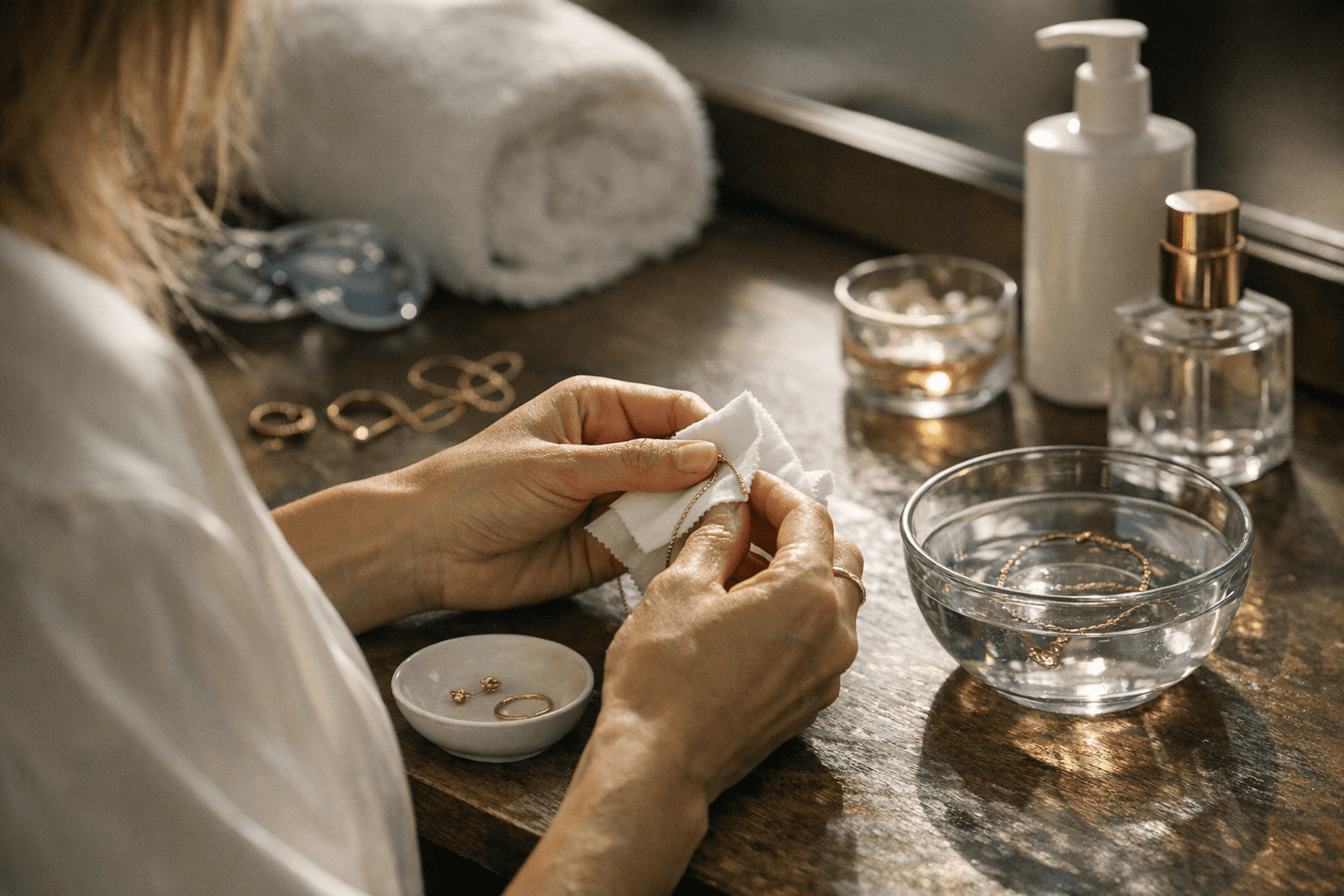
A warm water and mild dish soap solution is the standard starting point. Use lukewarm water, never hot, and a tiny drop of a fragrance-free, gentle dish soap. The process is straightforward:
1. Fill a small bowl with lukewarm water and add one drop of mild, fragrance-free dish soap.
2. Place your piece in the solution and let it soak for no more than five minutes. For plated pieces, keep soak time to two minutes.
3. Use a soft-bristled toothbrush, ideally one designated solely for this purpose, to gently work around settings, chain links, and textured surfaces.
4. Rinse thoroughly under cool running water, ensuring no soap residue remains in crevices.
5. Pat dry with a lint-free or microfiber cloth. Never rub; pat and press.
6. Allow the piece to air-dry completely before storing it. Even a small amount of trapped moisture accelerates tarnish on silver and can lift plating on vermeil or gold-filled pieces.
Ultrasonic cleaners, a popular tool in professional jewelry settings, are not recommended for dainty or minimalist pieces. The vibrations that work well on a robust diamond solitaire can loosen the tiny pavé stones set in a delicate band, or stress the fine wire of a twisted ring. Steam cleaning carries similar risks for fragile settings.
For silver pieces that have progressed past surface dullness into actual tarnish, a paste of baking soda and water applied with a soft cloth can help, but use it sparingly and only on plain silver surfaces, never on oxidized or intentionally darkened silver finishes, which the paste will strip. And never use it on pieces with stones, as it can dull softer gems.
Storage: the overlooked half of jewelry care
How you store dainty jewelry matters as much as how you clean it. Chains stored loosely together tangle, and untangling a fine chain without kinking it is an exercise in frustration that often ends badly. Each piece deserves its own space.
- Individual zip-lock pouches or small fabric drawstring bags prevent chains from crossing and tangling.
- Jewelry boxes with separate compartments lined in anti-tarnish fabric slow oxidation on silver significantly.
- Hanging necklace organizers work well for chains but keep them away from humid environments like bathrooms.
- Store pieces away from direct sunlight and heat, both of which degrade plating and can affect certain stones.
- Keep silver pieces in airtight containers or anti-tarnish bags when not in regular rotation.
A silica gel packet placed inside a jewelry box is a simple and inexpensive step that draws ambient moisture away from your pieces, particularly valuable in humid climates or during summer months.
Knowing when to take pieces off entirely
There are situations beyond chlorine exposure that warrant removing your jewelry completely: gardening, cooking with acidic ingredients like lemon juice or vinegar, applying sunscreen, doing dishes, using cleaning products, and exercising. Sweat is mildly acidic and, with repeated exposure over gym sessions, will dull the surface of gold-plated pieces and contribute to tarnish on silver.
The logic isn't to treat your jewelry as precious and untouchable; it's to understand that minimalist pieces, by design, use less metal and often thinner gauges, which means they have less material tolerance for repeated chemical stress. A heavier chain can absorb more abuse. A 1mm gold-filled bar necklace cannot.
The investment logic behind consistent care
Dainty jewelry occupies an interesting price range: fine enough to feel special, often affordable enough that replacing it seems easier than maintaining it. But the cumulative replacement cost of pieces lost to chlorine damage, tangled chains, or tarnish that goes too far to reverse adds up. More to the point, the pieces worth caring for are often the ones with meaning: the thin band you wear as a placeholder for something larger, the earrings that suited a moment, the chain someone gave you.
Consistent care, which amounts to a few minutes of cleaning every two weeks and a handful of before-bed habits, is genuinely all that stands between a piece that lasts a decade and one that doesn't make it to next year.
This article was produced by Prism’s automated news system from verified source data, official records, and press releases, then run through automated quality and moderation checks before publishing. The system is built and supervised by the people who set the standards it runs under. Read our full AI policy.
Did this article answer your question?


