John Hardy’s 50-Year Milestone Signals Men’s Jewelry’s Everyday Turn
Four hours to weave a single inch says it all: John Hardy’s anniversary reset is pushing men’s jewelry toward tactile pieces meant for daily wear.

Heritage you can wear
Four hours of labor go into a single inch of John Hardy’s Icon Chain, and that detail explains the brand’s 50-year message better than any slogan. The point is not flash. It is touch, weight, and proof of handwork, the kind that makes a chain feel less like an accessory and more like part of a uniform.
John Hardy says the company was founded in Bali in 1975 by artist and eco-activist John Hardy, and its anniversary year has become a statement about where luxury is headed next. Reed Krakoff has helped steer that shift since joining as Creative Chair in 2022, bringing a cleaner, more modern edge without stripping away the Balinese craft language that made the house distinct in the first place.
Why Bali still matters
The brand’s Kapal Bamboo Boutique & Artisan Workshop, just outside Ubud, is central to the story. John Hardy says more than 600 master artisans work there, and chain-weaving, wax-carving, and hand-finishing remain core to production. That matters because minimalism in jewelry can easily become generic, reduced to thinness alone; here, restraint is backed by labor, technique, and place.
The chain itself carries that lineage. John Hardy says the weaving tradition dates back centuries in Bali, was revived by the founder in the 1970s, and still relies on traditional tools and techniques. For men looking at subtle jewelry in 2026, that heritage makes a small object feel considered rather than decorative. It also gives the simplest pieces, especially chains and rings, the kind of depth that can justify everyday wear.
John Hardy has also made a concrete sustainability claim that goes beyond vague green language: it says its production facilities have run on 100% renewable energy since 2021. That does not solve every question around provenance, but it does give the brand a harder-edged environmental fact to stand on, especially in a category where sustainability is often treated as a marketing mood rather than a measurable practice.
Reed Krakoff’s men’s reset
The men’s category arrived with intent. In March 2024, WWD reported that Krakoff introduced John Hardy’s first official men’s jewelry collection, with roughly 75 styles across necklaces, bracelets, earrings, rings, and related pieces. At that point, the assortment was still about 75 percent women’s styles and 25 percent men’s styles, which made the launch less like a takeover and more like a recalibration.
Krakoff’s framing was telling. He said men increasingly view jewelry as part of the wardrobe, like a sneaker or watch, and that is exactly the language that explains the category’s growth. Men are not being asked to adopt a costume; they are being invited to add another daily layer, one that works with denim, tailoring, and the kind of off-duty clothes that already rely on materials and texture to do the talking.
The brand’s men’s direction also shows up in silhouette. WWD reported that familiar motifs such as Naga were translated into a more masculine assortment through chunkier forms and materials like sterling silver and gunmetal. That move matters because it shifts the conversation away from preciousness alone and toward surface, mass, and feel, all of which are central to minimalist jewelry when it is done well.
The categories that signal the strongest wearability
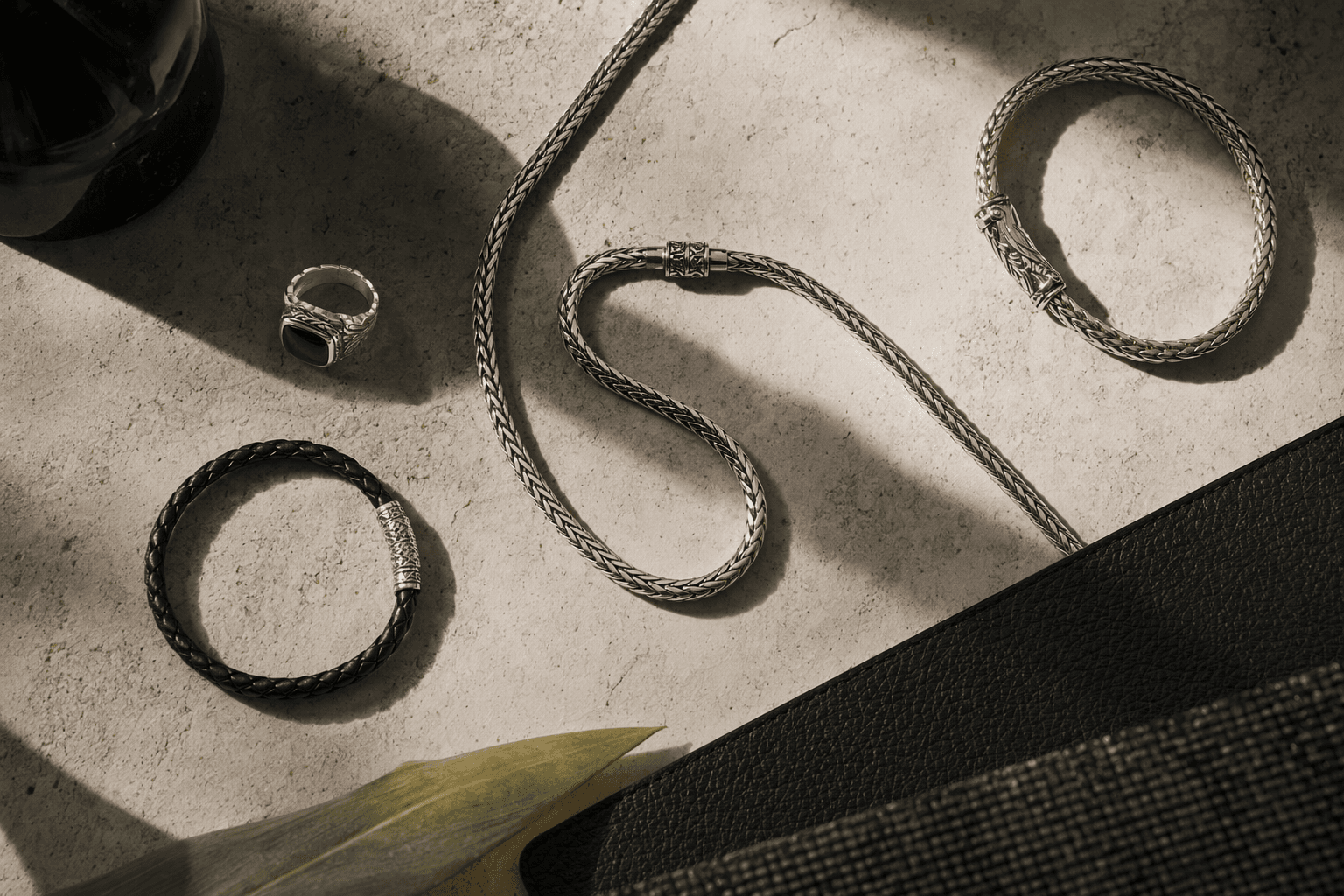
Chains are the clearest growth category because they are the easiest to wear every day and the easiest to read from a distance. John Hardy’s Icon Chain story makes the case plainly: this is not a flat, industrial link, but a hand-built object with a centuries-old lineage and a visible amount of labor in every inch. For men, that kind of chain works because it can sit under a shirt, catch light quietly, and still feel intentional on its own.
Cuffs and bracelets follow the same logic. They have enough presence to register with a watch, but not so much scale that they feel ceremonial. In a market that increasingly rewards tactile minimalism, a cuff in sterling silver or gunmetal becomes a practical anchor piece, the sort of object that can be worn repeatedly without looking overworked.
Rings are the most intimate version of this shift. Thin rings worn close to the knuckle, or a single signet-like form with a slightly rough surface, satisfy the same appetite for restraint that drives the best men’s jewelry right now. They are also the easiest entry point for first-time buyers, because a ring can carry texture, metal contrast, and heritage cues without asking for a full wardrobe change.
Mixed textures are the quietest signal of all, and maybe the most important. The combination of sterling silver, gunmetal, hand-finishing, and, in some cases, lab-grown stones gives minimalist jewelry dimension without noise. That is where John Hardy’s 2025 Lovestruck collection fits in: WWD reported it as the brand’s first lab-grown diamond line, created to mark five decades of the house and paired with Billie Eilish and Finneas O’Connell. Krakoff described it as jewelry for “everyday life” and said the brand wanted to preserve a “perfectly imperfect hand.”
The anniversary pieces that sharpen the story
John Hardy’s 50th anniversary has also been used to revisit and refresh the archive, which is smart. The Spear collection debuted as a new modern chapter after Krakoff joined, and in 2024 the Artisan Series brought limited signature silhouettes up to high-jewelry status. Then the brand returned to the Dot collection, a motif that first appeared in the 1990s, was inspired by Balinese art and culture, and remained one of the most requested styles among longtime customers.
That combination of old and new is the key to understanding where men’s jewelry is headed. The strongest pieces are not trying to look futuristic for the sake of it, and they are not leaning so hard on nostalgia that they feel fixed in time. They are built to move through the day, to sit beside a watch or beneath a cuff, and to carry enough provenance that their restraint feels earned.
John Hardy’s milestone is not just a celebration of endurance. It is a reminder that in men’s jewelry, the most persuasive luxury now looks tactile, well-made, and personal enough to become part of the everyday wardrobe.
This article was produced by Prism’s automated news system from verified source data, official records, and press releases, then run through automated quality and moderation checks before publishing. The system is built and supervised by the people who set the standards it runs under. Read our full AI policy.
Did this article answer your question?


