Keep Your Minimalist Jewelry Gleaming With These Essential Care Tips
Your minimalist pieces deserve more than a quick wipe-down. Here's how to clean, store, and protect them so they last a lifetime.

Jewelry carries meaning beyond simple adornment. It marks milestones, celebrates relationships, and often becomes part of a family story." That truth, articulated by the team at Bremer Jewelry, is precisely why the thin gold chain you wear every day or the delicate silver ring stacked on your finger deserves more than benign neglect. Minimalist and dainty jewelry, by its very nature, is unforgiving: a fine-gauge chain can kink, a small bezel setting can loosen, and a sliver of sterling can tarnish quickly when left in a humid bathroom. The good news is that preserving these pieces requires neither expensive equipment nor hours of effort. As Nelson Coleman Jewelers puts it, "maintaining most jewelry requires just a bit of mindful attention."
Caring for Gold
Gold is, in many ways, the most forgiving metal in a minimalist wardrobe. A solution of gentle soap and warm water is all you need for routine cleaning, and gold dries well without streaking or water-spotting. Work gently, rinse thoroughly, and pat dry with a soft cloth. Where gold can suffer is at the hands of chlorine, saltwater, and household cleaners, all of which weaken metal over time. The delicate prong setting on a thin gold ring, the kind common in minimalist stacking jewelry, can become brittle after repeated chemical exposure well before you'd notice anything visually. Remove your gold pieces before swimming, exercising, or cleaning the kitchen.
Caring for Silver
Silver demands a slightly more attentive approach because it tarnishes when exposed to air and humidity, and dainty silver pieces, with their high surface-area-to-volume ratio, tarnish faster than chunkier designs. The first line of defense is a silver polishing cloth, which handles light tarnish quickly and without risk of scratching. For a more thorough clean, a mild soap solution with warm water works well. When tarnish has darkened significantly, reach for a silver-specific cleaner and follow the manufacturer's instructions carefully; these products vary in concentration, and overexposure can dull certain finishes.
The one rule that applies across all silver care: avoid abrasives. Even a well-meaning scrub with a textured cloth can leave micro-scratches that catch light the wrong way and dull the surface permanently. And if your silver piece is set with a gemstone, resist the temptation to apply any cleaner without first confirming it's safe for that specific stone. Softer or treated stones, including many turquoise and coral cabochons frequently used in delicate silver jewelry, can be damaged by cleaners intended only for the metal itself.
A Note on Organic and Porous Materials
Pearls, coral, turquoise, and amber occupy their own category and require separate handling, both in cleaning and in storage. These are porous, organic, or treated materials that can dry out, crack, or lose their surface quality when exposed to the same conditions that would simply clean a metal. They should be stored away from silica gel packets, which are useful for absorbing moisture around metal jewelry but can over-dry organic materials and cause irreversible damage. Store these pieces separately, in their own pouches or compartments, and clean them only with methods appropriate to their specific composition.
Daily Habits That Make a Difference
The most effective care for minimalist jewelry happens before you even reach for a cleaning cloth. Oils, lotions, and skincare residue accumulate on fine metal surfaces and dull their finish faster than almost anything else. Allow serums, moisturizers, and sunscreens to fully absorb into your skin before putting on jewelry. This single habit, consistently applied, extends the time between cleanings noticeably.
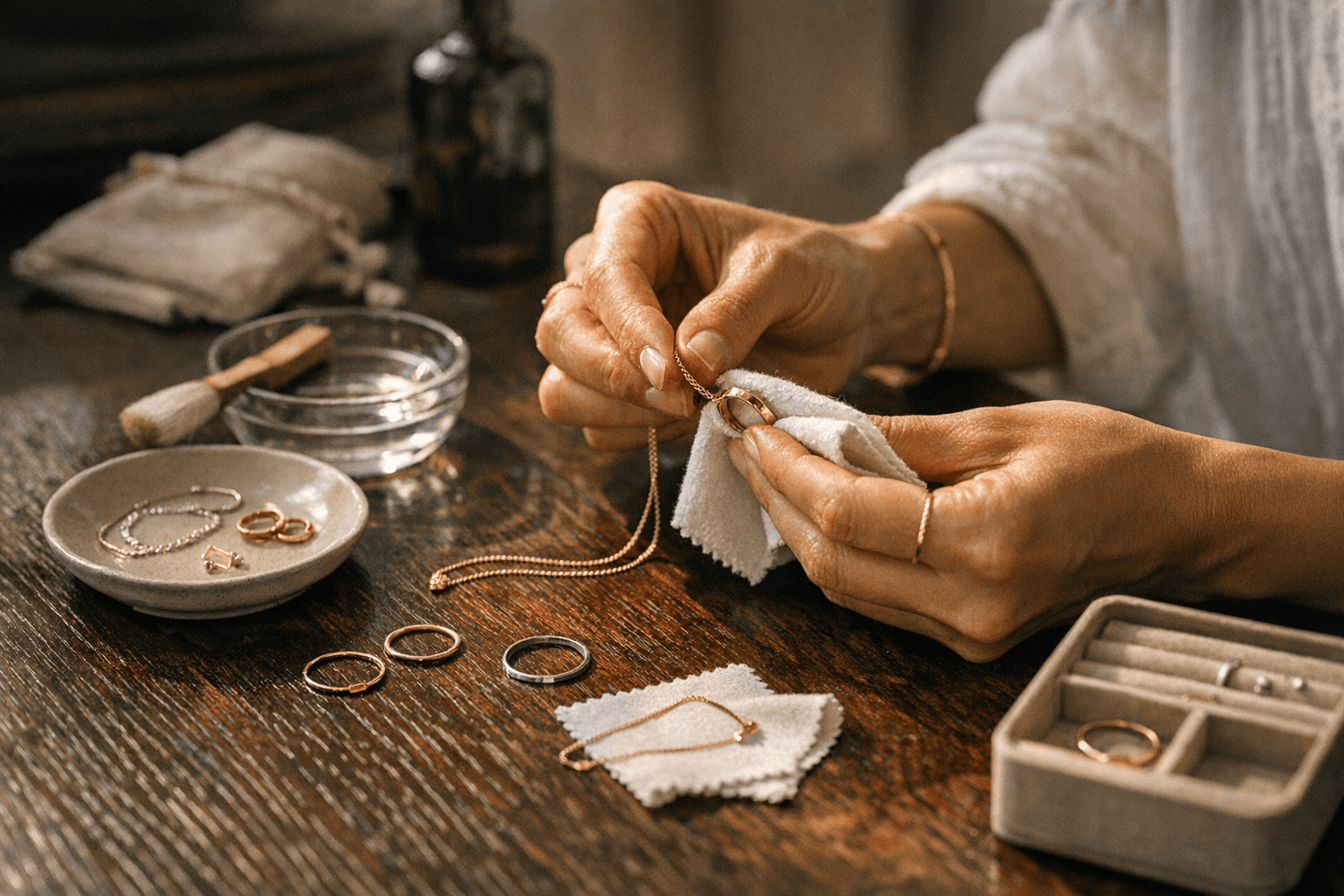
Equally important is knowing when to take pieces off. Chlorine in pools, salt in seawater, and the active chemicals in household cleaning products can all weaken metals and damage gemstones, often invisibly at first. Remove your jewelry before swimming, exercising, or any task involving physical impact or chemical exposure. Dainty chains and thin band rings are particularly vulnerable to being bent or kinked during physical activity, and a prong setting that catches on fabric can loosen a stone without your realizing it until the piece is in your hand without its center.
Smart Storage
Storage is where many jewelry owners underinvest, and it's where dainty pieces suffer the most. Humidity is one of the primary drivers of tarnish, so the goal is a cool, dry environment. Anti-tarnish pouches, cloths, and lined jewelry boxes all minimize silver's exposure to air and airborne moisture. Adding silica gel packets to a jewelry box or drawer provides an additional layer of protection for metal pieces.
Separation matters as much as environment. Storing pieces together in a single dish or tray invites scratching, tangling, and in some cases chemical reactions between dissimilar metals. Individual pouches or divided compartments solve this cleanly. For necklaces specifically, hanging them prevents the fine-chain tangles that can take considerable time to undo and, in delicate chains, risk damage during the untangling process. Store silver away from other metals entirely; even brief contact with harder metals can scratch a silver surface.
Routine Inspection
Even pieces you wear daily deserve a closer look every few weeks. Check the settings, prongs, clasps, and links for any sign of looseness or wear. A prong that has shifted even slightly may no longer hold a stone securely. A worn clasp on a dainty necklace will fail at the least convenient moment. If anything feels or looks loose, take it to a professional jeweler before wearing it again; the cost of a prong retipping is a fraction of the cost of replacing a lost stone.
Professional Care
At-home maintenance keeps jewelry looking its best between professional visits, but it cannot replicate what a jeweler can do with specialized equipment. Jewelers use professional methods to restore luster and, crucially, to inspect the structural components that are difficult to evaluate at home: loose stones, worn prongs, stretched chain links, compromised clasps. Nelson Coleman Jewelers recommends professional cleaning and inspection every six months for silver jewelry, and offers complimentary basic cleanings and inspections on that schedule. These visits are worth treating as a routine part of ownership rather than a response to a problem. Catching a worn prong at a cleaning appointment is categorically different from catching it after a stone is already gone.
"Proper care is essential for keeping your jewelry both beautiful and safe," as Nelson Coleman's team notes, and the evidence bears that out: "simple habits like careful wearing, proper storage, and occasional at-home cleaning can go a long way toward preserving your treasured pieces." For minimalist jewelry, where the design relies on the integrity of every fine detail, that care is not optional. It is part of owning something worth keeping.
This article was produced by Prism’s automated news system from verified source data, official records, and press releases, then run through automated quality and moderation checks before publishing. The system is built and supervised by the people who set the standards it runs under. Read our full AI policy.
Did this article answer your question?


