Nautilus Shells Inspire a New Wave of Sculptural Minimalist Jewelry
Silvia Dusci's Le Sundial and Sophie Buhai are among the designers treating the nautilus spiral as a blueprint for jewelry that is simultaneously sculptural and deeply minimal.
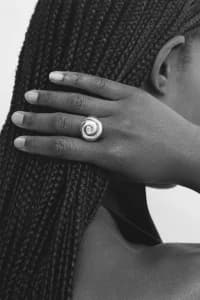
Sophie Buhai's Nautilus Ring sits on the finger the way a found object sits in the palm: weighted with intention, quietly geometric, impossible to ignore. That a single mollusk's architecture could generate this much creative momentum across fine jewelry says something about where the discipline is headed.
The nautilus shell, with its logarithmic spiral and chambered interior, has long fascinated mathematicians, architects, and decorative artists. In jewelry, it offers something rarer: a motif that is simultaneously ancient and contemporary, ornate in its source material yet restrained in translation. Designers working at the intersection of minimalist form and sculptural detail have found in it a kind of permission slip. You can make a piece that reads as spare, even severe, while drawing on one of nature's most complex geometries.
The Aesthetic Argument Against Beachside Clichés
What separates this wave of sea-inspired jewelry from the coastal trinkets that have always populated the accessory market is its commitment to abstraction. The designers participating in this moment are not rendering literal shells or casting sand dollars in gold. They are extracting the nautilus's formal logic: the swelling curve, the proportional recession, the sense of a continuous line folding in on itself. The result, as the styling platform Theundone observed in its July 2025 feature "Inspired by the Sea," is jewelry that "feels elemental, sophisticated, and deeply wearable" rather than decorative or novelty-driven.
The distinction matters enormously from a craft perspective. A literal shell pendant and a piece informed by spiral geometry may occupy the same conceptual territory, but they demand completely different techniques and produce completely different objects. One is reproduction; the other is interpretation. The designers driving this particular trend are firmly in the second camp, producing "sculptural, considered pieces that evoke the ocean's quiet strength and organic beauty" without resorting to what Theundone aptly called "beachside clichés."
Why the Nautilus, and Why Now
The nautilus spiral carries an unusual weight of meaning for a natural form. It represents, as Theundone noted, "harmony, geometry, and cosmic order" — concepts that have made it a recurring reference in architecture and design history long before any jeweler picked it up. The Fibonacci sequence, the golden ratio, the logarithmic spiral: these mathematical principles appear in the nautilus's cross-section as clearly as they appear in Gothic vaulting or Modernist furniture. That dual citizenship, in both the natural world and the constructed world of human proportion, gives the motif a seriousness that purely decorative references rarely achieve.
There is also a cultural dimension worth noting. "The rise of these sea-inspired styles speaks to a growing desire for symbolism in our adornment — pieces that ground us in nature and evoke something timeless." That framing, from Theundone's 2025 analysis, positions the trend not as a seasonal aesthetic whim but as a response to a deeper appetite for meaning in personal jewelry. The pieces being made in this vein are not conversation starters in the conventional sense; they are more private than that. The symbolism is legible to those who know it and invisible to those who don't, which is precisely the register that serious jewelry collectors tend to prize.
Le Sundial: Art Deco Rigor Meets Organic Form
Among the designers who have made the nautilus genuinely central to their practice, Le Sundial stands apart for the specificity of its commitment. Founded in 2023 by Milanese designer Silvia Dusci, the brand has made the nautilus its signature rather than a seasonal gesture. Dusci works in handcrafted sterling silver, producing chokers, pendants, and earrings that are rooted in Art Deco influences but softened by the organic curves that the nautilus naturally provides.
That combination is harder to execute than it sounds. Art Deco at its most rigorous tends toward hard angles, geometric precision, and a certain architectural severity. The nautilus, by contrast, is all curve and continuous motion. The tension between those two formal languages is what gives Le Sundial's pieces their particular charge: the discipline of Deco holding the organic in check, the organic preventing the Deco from becoming cold. "The swirl of the nautilus," as Dusci's work demonstrates, is indeed "a recurring symbol in architecture and design history" made tangible in silver at the scale of the body.
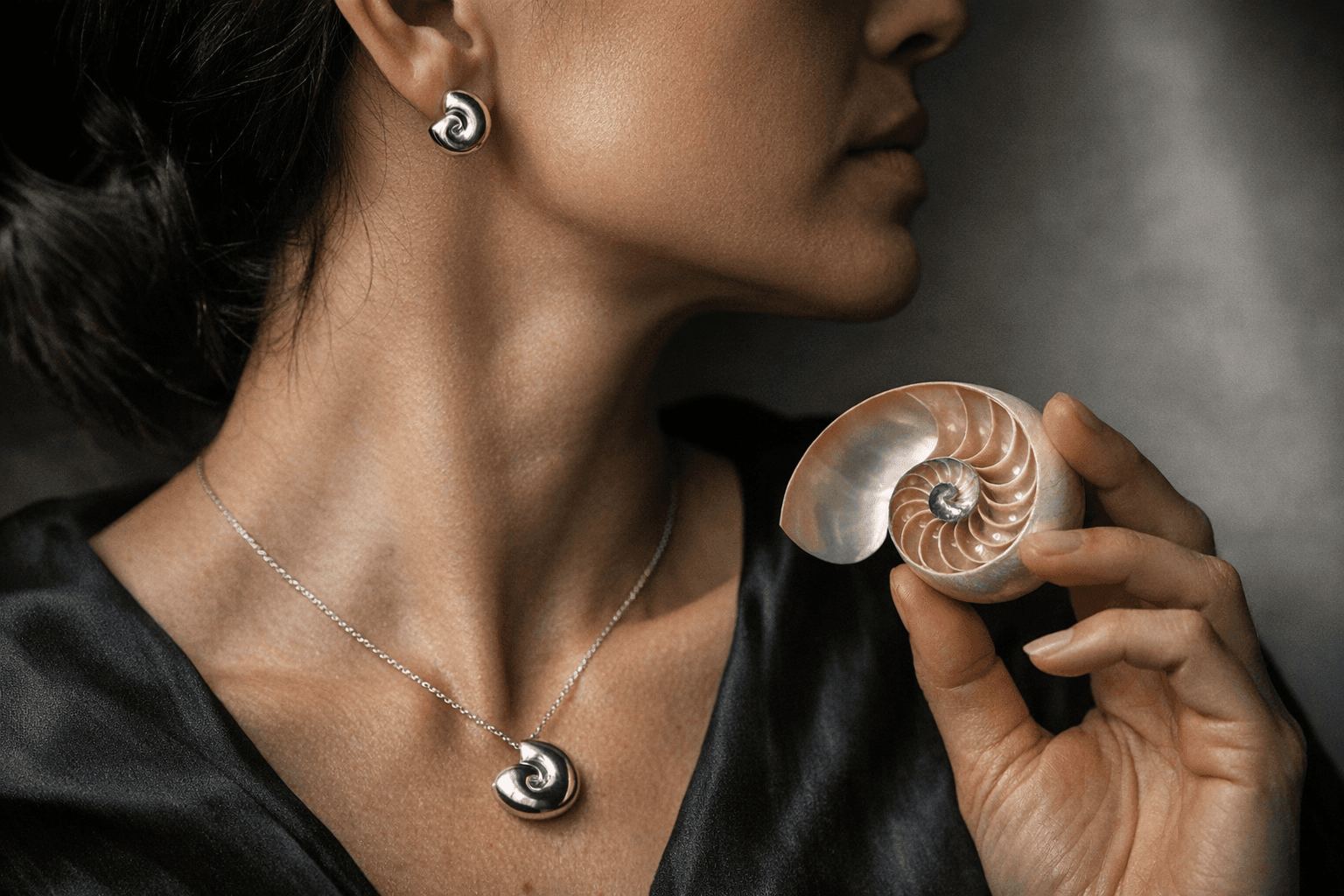
Sophie Buhai and the Expanded Object
Sophie Buhai approaches the nautilus from a different angle, and her range of pieces reveals an interest in testing how far a single motif can travel across object types. The Sophie Buhai Nautilus Ring and Nautilus Choker Pendant occupy familiar jewelry categories, but the Nautilus Pill Box suggests a designer who sees the spiral as an organizing principle rather than a decorative device. A pill box is a functional object, and applying the nautilus to it implies that the geometry carries meaning independent of any specific material or form factor. It becomes, in effect, a design philosophy.
Buhai's presence in this conversation sits alongside that of Juju Vera and AGMES, both named by Theundone as participants in the current sea-inspired mood, and both bringing their own interpretations to the shared vocabulary. The range across these names is considerable: "from raw and sculptural to delicate and architectural," as Theundone put it, "offering pieces that are poetic and powerful in equal measure."
The Long Shadow of Elsa Peretti
Any serious discussion of organic form in fine jewelry eventually circles back to Elsa Peretti, whose decades of work for Tiffany & Co. established a vocabulary that designers are still drawing from. Peretti's genius was precisely this: she understood that the body's curves, and the curves of natural forms, could be translated into objects that felt inevitable rather than designed. Her influence on the current generation of designers working with nautilus geometry is part of what Theundone described as an "enduring legacy" — a set of formal discoveries that have not been exhausted and may not be for some time.
The difference between Peretti's era and the present moment is one of emphasis. Her organic jewelry was, in its time, a radical departure from the prevailing conventions of fine jewelry. Today, designers like Dusci and Buhai are working in a landscape that has largely absorbed that lesson, which means they must push further: into greater specificity of motif, into the complexity of combining organic and geometric references, into the question of what a piece of jewelry is permitted to be beyond adornment.
Form That Holds
The nautilus has lasted this long as a design reference because it solves a problem that never goes away: how to give a flat or linear form a sense of interior logic, of movement that continues beyond the visible edge. In jewelry, where scale is intimate and every millimeter of surface is legible, that quality is particularly valuable. A ring or pendant informed by the nautilus spiral carries within it the suggestion of depth and progression, even when the object itself is thin and minimal.
That is the real argument for this trend's staying power. It is not seasonal in the way that color stories or silhouette shifts are seasonal. The designers participating in it are making objects that engage with proportion, symbolism, and formal history at a level that transcends the calendar. The nautilus spiral, as it turns out, is not just a motif. It is a way of thinking about how forms relate to each other, and that is the kind of idea that serious jewelry keeps finding uses for.
This article was produced by Prism’s automated news system from verified source data, official records, and press releases, then run through automated quality and moderation checks before publishing. The system is built and supervised by the people who set the standards it runs under. Read our full AI policy.
Did this article answer your question?


