Sophie Buhai marks 10 years with Paris exhibition of minimalist design objects
Sophie Buhai’s Paris milestone shows minimalist jewelry at its best: heavy sterling silver, sharp lines, and objects that feel as collectible as they do wearable.

A Paris milestone that reads like a field guide
Sophie Buhai’s 10-year anniversary is not being marked with a standard jewelry launch. In Paris, she is presenting *Jewelry Objects* at Galerie Anne-Sophie Duval, a show that treats minimalist jewelry as a design language, not a trend category. The display includes 19 unique or limited-edition pieces, among them a bud vase, magnifying glass, toothpick case, cigarette holder, minaudière, and letter opener, all of which extend her silver-first vocabulary beyond the wrist, neck, and ear.
That matters because Buhai’s work has always been more exacting than the word “minimal” suggests. Her pieces rely on clean lines, sculptural silhouettes, and a modernist restraint that feels deliberate rather than bare. The Paris exhibition also lands as Galerie Anne-Sophie Duval reopens after a renovation led by Sylvain Dubuisson, so the setting itself reinforces the idea that Buhai’s jewelry belongs in the same conversation as collectible design.
How Buhai built a modernist signature
Buhai founded her namesake jewelry brand in 2015 after co-founding Vena Cava in 2003, the year she graduated from Parsons School of Design. That path explains a lot about the work. It did not emerge from a trend cycle or a wholesale pivot into accessories; it came from a designer already fluent in clothing, proportion, and the power of a silhouette to hold its shape in real life.
Her later stint designing jewelry for Lemaire from 2016 to 2018 sharpened that connection to pared-back French modernism. The result is a brand language that is easy to describe but hard to imitate: solid sterling silver, substantial weight, and forms that can look nearly severe until the light catches an edge or a stone shifts the line of a ring. This is minimalist jewelry with architecture in its bones.
What the Paris show reveals about the category
The objects in *Jewelry Objects* are useful because they show where minimalist jewelry becomes more interesting than a simple chain or a plain hoop. A letter opener or magnifying glass in silver is not a stunt when it is built from the same visual grammar as a ring or cuff. It becomes a clue to how the designer thinks about proportion, utility, and permanence.
That is the difference between elevated minimalism and generic basics. Generic basics disappear into the outfit. Buhai’s pieces register as objects first, adornment second. The shapes are spare, but they are not timid; the surfaces are polished or finished to support the form, and the scale often gives the work a sense of presence that cheap “minimal” jewelry rarely achieves.
How to read elevated minimalist jewelry when you shop
The best way to use Buhai’s work as a shopping guide is to look past the absence of ornament and focus on construction. Minimalist jewelry worth considering usually has weight, balance, and a defined profile. If a silver ring feels thin to the point of fragility or a pendant lies flat without any sculptural tension, it may be minimal in appearance but not in intention.
A few hallmarks stand out:
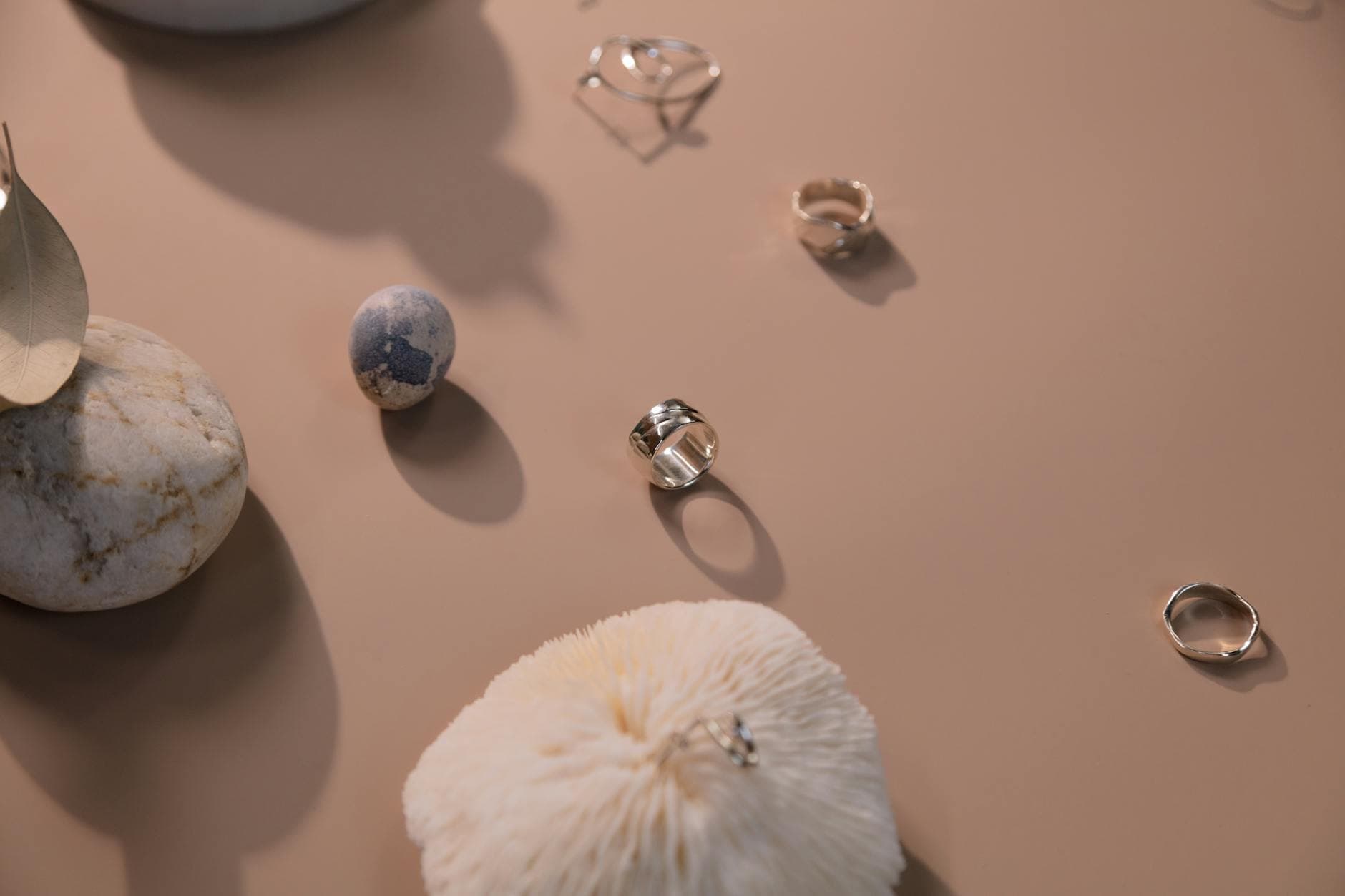
- Sterling silver that feels intentional: Buhai’s line is rooted in sterling silver, and that material works best when the design lets the metal do the talking. Look for pieces where the silver has enough mass to hold a shape, not just enough polish to reflect light.
- Silhouettes with substance: A good minimalist earring or cuff should have a clear outline from across the room. The line should look resolved from every angle, not just front-on.
- Stonework that feels organic, not decorative: Buhai’s language includes handcrafted stonework, which gives the pieces a less formulaic feel than stones cut to perform symmetry alone. In this lane, the stone should seem integrated into the form, not pasted onto it.
- A finish that matches the concept: High-shine silver can feel graphic, while a softer finish can make a piece look more tactile. Either can work, but the finish should reinforce the design rather than hide weak construction.
Sustainability claims that deserve a closer look
Buhai’s studio and stockists describe the brand as handmade in Los Angeles and made with recycled or responsibly sourced materials whenever possible. That is a better starting point than vague eco language, because it at least names place and material practice. Still, “whenever possible” is broad, so the useful question for any buyer is how often a specific piece uses recycled metal, where the silver was processed, and what the sourcing story is for any stone.
That is where minimalist jewelry often gets misunderstood. Clean design can look virtuous on its own, but true responsibility depends on the details: metal origin, labor context, repairability, and whether the piece is built to stay in circulation rather than cycle out with the season. Buhai’s emphasis on local production in Los Angeles and recycled materials gives the brand more credibility than a generic “conscious” label, yet the strongest standard is still transparency.
Why the 10-year mark matters now
A decade is a meaningful test for a jewelry house, especially one working in a language as easily copied as minimalism. Trends can mimic restraint, but they rarely sustain it. Buhai’s longevity suggests that her appeal is not about having the fewest details, but about understanding which details deserve to stay.
That is the lesson in the Paris exhibition. Minimalist jewelry at its best is not empty, and it is not plain for plainness’ sake. It is a disciplined form of design in which sterling silver, scale, and shape carry the personality, allowing a ring, bracelet, or small object to feel contemporary now and still convincing years from now.
This article was produced by Prism’s automated news system from verified source data, official records, and press releases, then run through automated quality and moderation checks before publishing. The system is built and supervised by the people who set the standards it runs under. Read our full AI policy.
Did this article answer your question?


