Spring 2026 High Jewellery Collections Embrace Romance and Delicate Design
High jewellery's spring 2026 mood is unabashedly soft: sorbet shades, South Sea pearls, and pink spinels from Cartier, Dior, and Tiffany signal a romantic new direction.
Something is shifting in the upper registers of fine jewellery. The houses that typically compete on scale and spectacle are reaching this season for a different register: softer, more intimate, and decidedly romantic. This spring, high jewellery houses are seeking out a softer colour palette, nodding to a whimsical mood board for one-of-a-kind creations in sorbet shades. The result is a survey of new work from Van Cleef & Arpels, Cartier, Tiffany & Co., Dior Joaillerie, Bulgari, Messika, Buccellati, Hermès, and Louis Vuitton that feels less like armour and more like a love letter.
A Palette Shift at the Highest Level
High jewellery has long been defined by its boldness: deep-saturated rubies, vivid sapphires, and diamonds that command attention from across a room. What makes this spring's releases notable is precisely the departure from that vocabulary. In the latest high jewellery from Van Cleef & Arpels, Cartier, and Tiffany & Co., a soft colour palette reigns. The sorbet shades arriving across maisons point to a collective mood rather than a coincidence of trends; when houses as distinct as Dior Joaillerie and Messika arrive at the same tonal conclusion independently, it signals something genuine in the creative atmosphere.
This is not minimalism in the sparse, reductive sense. Statement pieces remain very much part of the conversation. Rather, it is a refinement of emotional register: jewels that feel considered rather than declarative, intimate rather than imperial.
Playful Silhouettes and Subverted Motifs
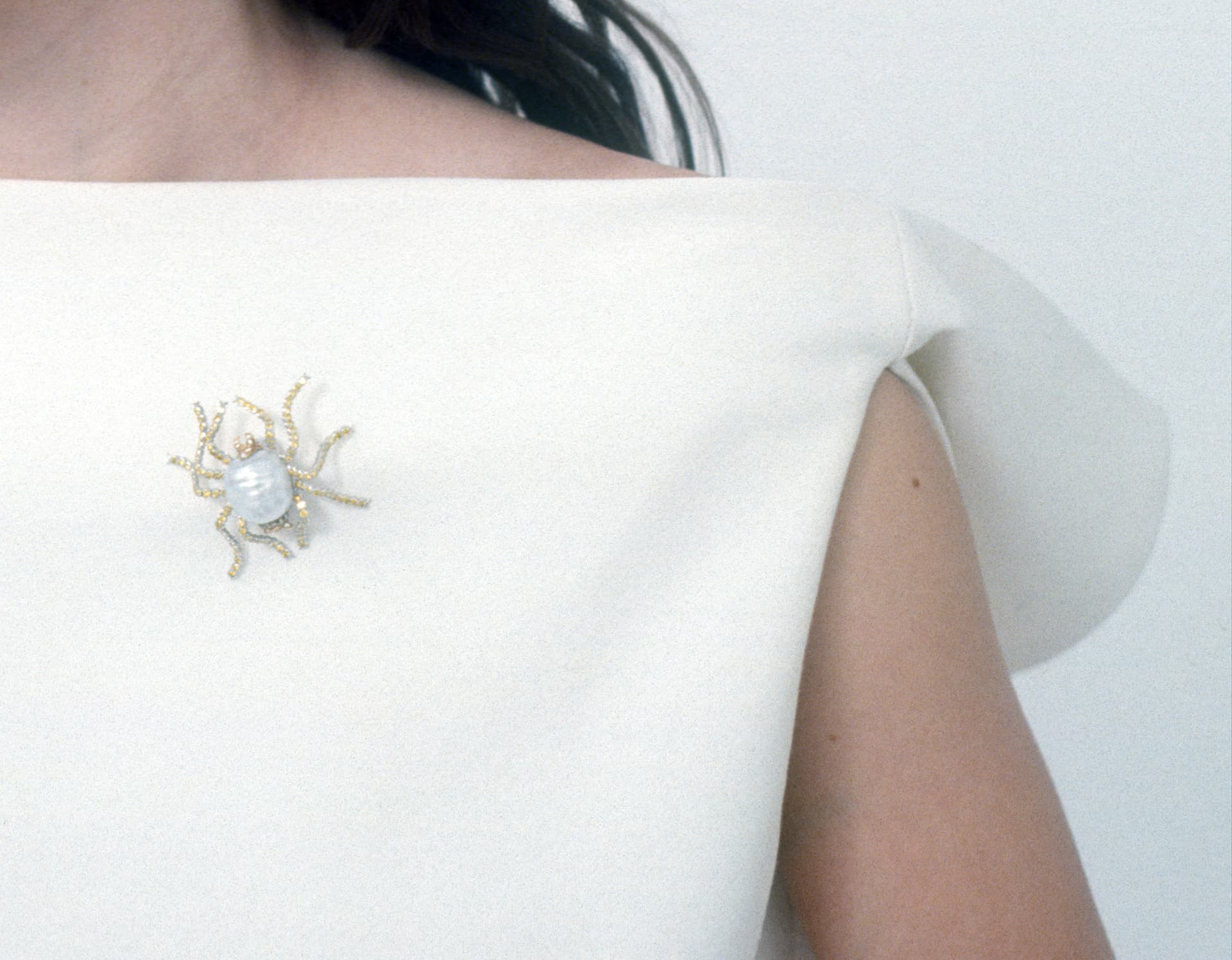
Some of the season's most compelling work comes from houses that have taken familiar jewellery grammar and quietly dismantled it. In Messika's turquoise beads, Van Cleef & Arpels's graphic gold chain, and Buccellati's golden spider, silhouettes take a playful turn, while Bulgari's pink gold necklace and Hermès' emerald ring subvert traditional jewellery motifs.
Each of those three pieces deserves a closer look. Messika's use of turquoise beads brings a material more often associated with artisanal or ethnographic jewellery into high jewellery territory, a move that feels genuinely democratic in its references. The graphic gold chain from Van Cleef & Arpels pushes the house's signature architectural precision into bolder formal territory, where structure becomes ornament. And Buccellati's golden spider is the season's most arresting image: the Milanese house, renowned for its engraved goldwork and lace-like textural vocabulary, rendering an arachnid in gold is the kind of playful darkness that separates genuine creativity from trend-following.
Bulgari's pink gold necklace and Hermès' emerald ring occupy a different register again. Pink gold is not a new material, but the way Bulgari deploys it here, in a piece framed as a subversion of traditional motifs, suggests the colour's warmth is being used to soften familiar forms rather than simply to follow the season's palette. Hermès' emerald ring, meanwhile, carries the maison's characteristic wit: a house better known for leather and equestrian hardware bringing a serious gemstone to bear in a way that reframes both the stone and the maker.
Romanticism in Stones and Settings
The season's most literally romantic pieces work through gemstone choice and arrangement rather than structural subversion. For Tiffany & Co., a string of South Sea black pearls is a romantic take, and it is easy to understand why. South Sea black pearls, grown primarily in French Polynesia and Australia, carry a depth of colour that moves between charcoal, green, and deep aubergine depending on the light. A string of them is one of jewellery's most quietly powerful gestures, and Tiffany's framing of this as a romantic piece for spring feels right.
Dior Joaillerie's contribution lands differently but with equal emotional force: a sprinkling of pink spinels and pink sapphires that reads almost like a scattered handful of petals. Spinel has had a notable resurgence among gem enthusiasts in recent years, valued for its brilliance and the fact that it is typically untreated, unlike many commercial rubies and sapphires. Pink spinel in particular sits in a warm, luminous register that pairs well with the season's overall mood. That Dior pairs it with pink sapphires speaks to a layered approach to colour, building warmth through repetition rather than a single focal stone.
The Statement End of the Spectrum
Not everything this spring is whispered. Cartier's dangling pendant of chrysoprases, spinels, turquoise, and diamonds will make a statement, and the material list alone is worth pausing over. Chrysoprase, a translucent apple-green variety of chalcedony, brings a verdant note that feels almost botanical; combined with turquoise and coloured spinels, all unified by diamonds, the pendant becomes a miniature study in chromatic complexity. It is a Cartier piece in the fullest sense: maximalist in its gemological range, controlled in its execution.
Louis Vuitton's contribution is the season's most architecturally confident: a show-stopping emerald-cut emerald ring. The emerald cut, with its long rectangular facets and open table, demands a stone of exceptional clarity and depth of colour; it is a cut that hides nothing. Choosing it for an emerald, a species notoriously prone to inclusions, suggests both confidence in the stone and a particular aesthetic commitment. In a season defined largely by soft palettes and pastel tones, a vivid green emerald-cut ring functions as a deliberate counterpoint, and a reminder that high jewellery's appetite for the extraordinary has not been displaced, only diversified.
What This Season Tells Us About High Jewellery's Direction
Reading across these eight houses together, a more nuanced picture emerges than a simple "romantic trend" framing would suggest. Yes, softer colours are dominant. Yes, there is an emotional warmth to the season's releases that contrasts with some of recent years' more austere formal experiments. But what is equally striking is the range of strategies employed to achieve that warmth: through material subversion (Messika's turquoise, Buccellati's spider), through gemstone selection (Dior's spinels, Tiffany's pearls), through structural wit (Hermès' emerald ring, Van Cleef & Arpels's chain), and through unabashed chromatic complexity (Cartier's pendant, Louis Vuitton's emerald).
High jewellery has always been the arena where a house's identity is most fully expressed, freed from the commercial constraints of entry-level pricing and the expectations of mass accessibility. What this spring's releases demonstrate is that the most interesting identity work is happening not in the loudest pieces, but in the most considered ones: jewels that ask to be understood rather than simply seen. That is, in its own way, a more demanding standard than spectacle, and a more interesting one.
This article was produced by Prism’s automated news system from verified source data, official records, and press releases, then run through automated quality and moderation checks before publishing. The system is built and supervised by the people who set the standards it runs under. Read our full AI policy.
Did this article answer your question?


