Stylist-approved everyday jewelry, from pendants to signet rings
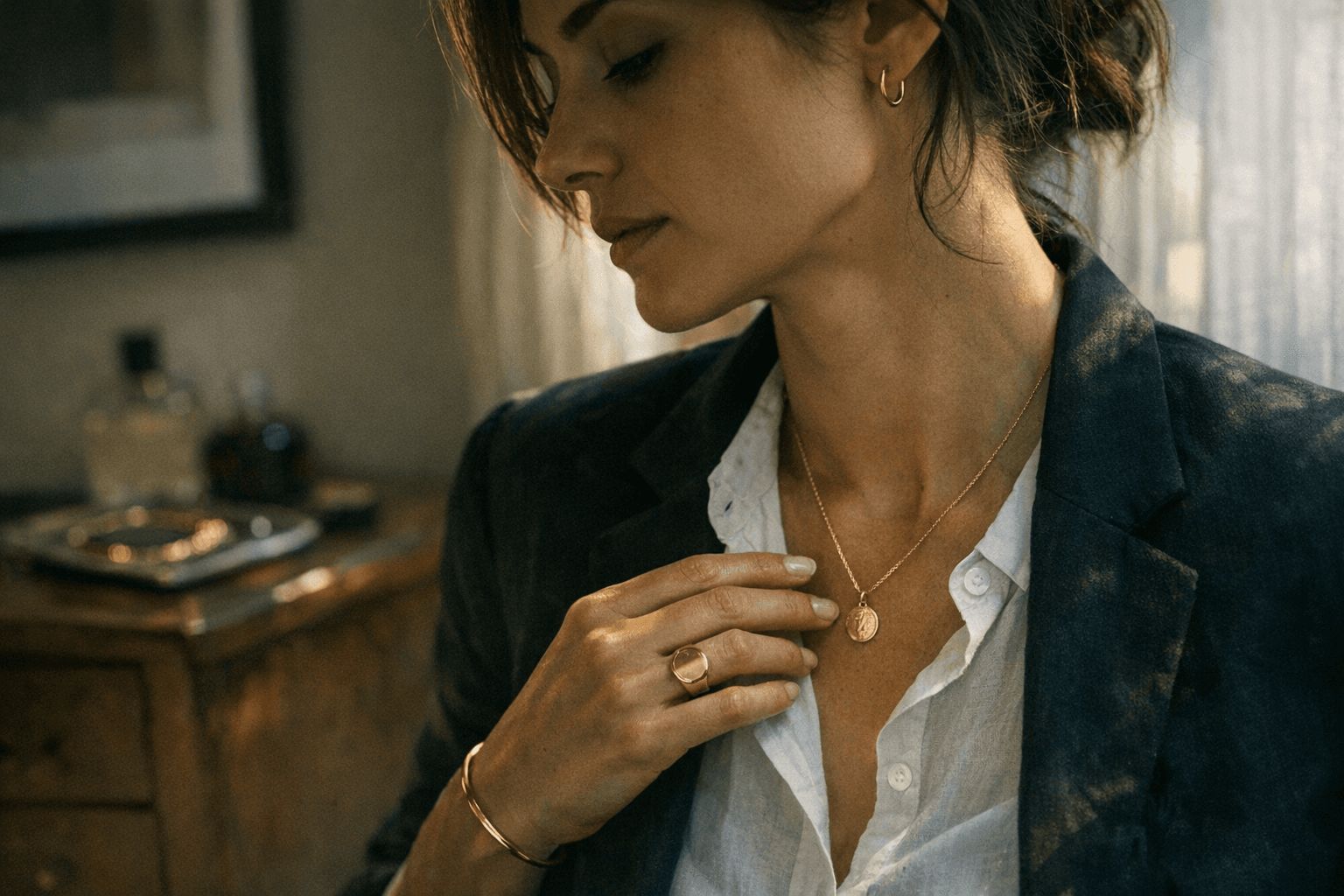
The best everyday jewelry is the piece that disappears into your routine and sharpens every outfit. Start with a pendant, then build out a small rotation of studs, a bracelet, a cuff and a signet ring.

A thin chain at the collarbone does something rare in jewelry: it makes a T-shirt look deliberate, a blouse feel finished, and a blazer read less severe. That is the promise of minimalist jewelry at its best, not decoration for decoration’s sake, but a small line of metal that earns its keep from office hours to dinner.
The necklace that does the most
If you are starting with one piece, start with the pendant. It has the widest wardrobe range of the bunch because it sits close enough to the body to feel easy, yet visible enough to change the mood of a shirt, sweater or knit dress. A charm necklace plays a similar role with a little more personality, especially when the charm carries initials, a birthstone, a symbol or another private reference that makes the piece feel lived-in rather than decorative.
The appeal of these necklaces is their precision. A single pendant gives you a focal point without the clutter of layers, while a personalized charm adds narrative without tipping into costume. That is why the most useful versions are modest in scale and strong in silhouette: a clean bezel, a slim bail, a fine chain, a pendant that rests where the eye naturally lands.
The bracelet that reads polished, not precious
On the wrist, the same rule applies. A petite tennis bracelet brings just enough flash to catch the light when you lift a coffee cup or reach for a bag, but its smaller proportions make it easier to wear every day than a heavier, formal diamond line. It is the bracelet version of a good white shirt: quietly sharp, never overworked.
A slim cuff solves a different problem. Where the tennis bracelet gives you sparkle, the cuff gives you structure, especially with rolled sleeves, knitwear or crisp shirting. It adds a clear architectural line to the wrist, and because it is usually worn alone, it can feel more modern than a stack. For readers who want one bracelet and one bracelet only, the choice comes down to mood, sparkle for softness, cuff for edge.
The stud that never argues with the outfit
Stud earrings are the least dramatic pieces in a jewelry box, and that is exactly why they keep earning a place. They work under headphones, with hair pulled back, with a high neck, with a busy print, with a tailored jacket. Their power is not in making the face compete with the jewelry, but in cleaning up the frame around it.
For everyday wear, this is where craftsmanship matters more than scale. A well-made stud sits flat, closes securely and feels balanced on the ear, whether it is a single diamond, a gold dome or a pair of small pearls. Because they do so much visual work with so little material, studs are often the first pieces to justify a move into better metals and better settings.
The ring with a story
Signet rings bring the strongest sense of identity to a minimalist rotation. They are among the oldest forms of personalized jewelry, once used to seal and authenticate documents by pressing a carved surface into wax. That history gives them a built-in authority that newer styles often try, and fail, to imitate.
Today, the appeal is less ceremonial and more personal. A signet ring can carry initials, a family crest, a symbol or simply a clean, polished face that feels quietly intentional. It is one of the few ring styles that can look equally right with denim, tailoring and eveningwear, because it does not depend on ornament to make its point.
Why dainty still dominates
The continued pull of minimalist jewelry is not an accident. Jewelers of America pointed to “dainty and delicate jewelry” as a trend to watch, and the mood around the category was visible at the 23rd Annual GEM Awards on March 14, 2025, held at Cipriani’s 42nd Street in New York City. That emphasis on smaller-scale pieces reflects a broader shift toward jewelry that can live in the daily wardrobe, not just in special-occasion boxes.
That is also why the current conversation keeps circling back to pieces that wear lightly but repeat often. A delicate pendant, a slim cuff and a discreet stud do not compete with clothes; they clarify them. In a minimalist rotation, restraint is not a lack of statement, it is the statement.
The metal that makes daily wear work
For pieces meant to be worn constantly, solid gold or platinum still makes the strongest case. The Federal Trade Commission warns that gold plating eventually wears away, and how quickly that happens depends on how often the piece is worn and how thick the plating is. That is the difference between a piece that can handle repetition and one that looks beautiful until the surface finish thins out.
GIA’s 2025 guide on everyday ring wear makes the point even more clearly: there is no one-size-fits-all answer. The best metal depends on durability, maintenance, style and lifestyle, and the guide compares gold, platinum, silver, titanium and tungsten as part of that decision. Platinum is especially associated with daily wear because of its durability, but it still scratches and should be kept away from harsh chemicals and heavy labor.
That is the real luxury distinction. Hardwearing does not mean invincible, and a well-chosen everyday piece still needs care. Even platinum asks to be removed for chores that involve abrasive surfaces or chemical exposure, which is why the smartest jewelry wardrobes are built around pieces that suit actual routines, not imagined ones.
What investment means now
There is also a growing appetite for jewelry that treats metal itself as value. Forbes reported in 2025 that Menē sells 24kt gold and platinum jewelry by the gram, a model that reflects the rise of “investment jewelry.” It is a reminder that for some buyers, the appeal of a pendant or ring is not only how it looks on the body, but how directly it holds material worth.
Luxury houses are responding with their own everyday categories. De Beers, for instance, sells studs, pendants, bracelets, rings and necklaces in fine-jewelry silhouettes that begin at about $1,450 for some pieces, while platinum eternity bands are listed at $9,550 and above. That range shows how wide the everyday jewelry spectrum has become, from approachable staples to pieces that still read as serious acquisitions.
The smartest rotation is the one that matches how you actually dress. Start with the pendant if you want the most mileage, add studs for ease, then decide whether your wrist wants the polish of a petite tennis bracelet or the clean line of a cuff. Finish with a signet ring when you want your jewelry to say something unmistakably personal, because the best minimalist pieces do not shout, they return.
This article was produced by Prism’s automated news system from verified source data, official records, and press releases, then run through automated quality and moderation checks before publishing. The system is built and supervised by the people who set the standards it runs under. Read our full AI policy.
Did this article answer your question?


