Van Cleef & Arpels turns ancient Egypt into modern high jewelry
Egyptian geometry, onyx and yellow diamonds drive a 180-piece Van Cleef & Arpels collection that turns ancient motifs into sleek modern forms.
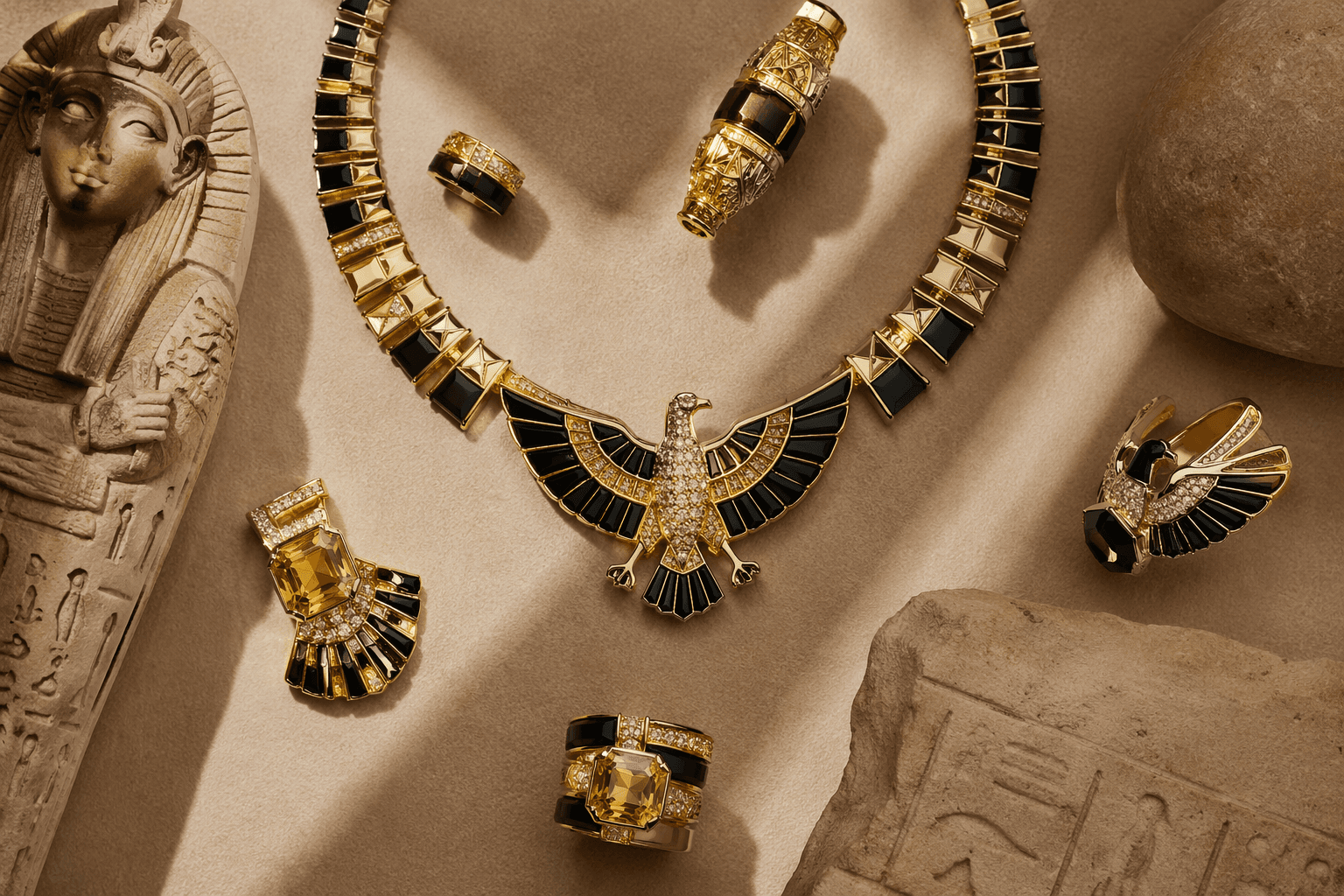
Van Cleef & Arpels has turned Ancient Egypt into a lesson in restraint. Its 180-piece Fascinating Egypt high-jewelry collection, unveiled in Paris on June 9, 2026, at the Hôtel Mona Bismark, translates pyramids, royal symbolism and temple geometry into clips, bracelets and high-jewelry forms that feel more distilled than theatrical.
That balance matters for readers watching where minimalist jewelry is headed next. The strongest pieces in the collection do not rely on literal Egyptian imagery. They rely on abstraction: geometric lines, repeated patterns, stark contrasts and polished surfaces, the same design grammar Van Cleef & Arpels says it used in its Egyptian-inspired work from 1923 to 1925. In that earlier period, Howard Carter’s 1922 discovery of Tutankhamun’s tomb helped ignite a worldwide fascination with Ancient Egypt, while the 1925 Paris Exposition internationale des arts décoratifs et industriels modernes helped push Art Deco into the mainstream. The result was a visual language that still reads cleanly today, especially when stripped down to a single contour, a contrast of black and white, or a disciplined color accent.
The maison’s own archive shows how that translation works. A 1923 bracelet listed at 191 by 10 millimeters, made of platinum with diamonds, onyx and rubies, already looks like a blueprint for modern minimalism: compact, graphic and sharply edited. That same logic runs through the new collection’s most visible pieces, including the Beauté Légendaire necklace, which centers on a 10.02-carat Fancy Vivid Yellow diamond, and cocktail rings titled Origine de l’eau, Origine florale and Origine du soleil. The names are poetic, but the forms appear to be doing the real work, channeling nature and mythology through precise surfaces and controlled color.
The historical thread is not decorative trivia. Van Cleef & Arpels also points to a major royal commission in 1939, when it designed jewelry for Princess Fawzia of Egypt, daughter of King Fouad and sister of King Farouk, for her wedding to Mohammad Reza Pahlavi at Abdeen Palace in Cairo on March 16, 1939. Born in Alexandria in 1921, Fawzia gave the maison a direct link between Egyptian identity and European luxury. That lineage is what makes Fascinating Egypt relevant beyond high jewelry: it shows how ancient references can be simplified into wearable, modern pieces, from a slim bracelet with contrast to a clip built on repeated lines.
This article was produced by Prism’s automated news system from verified source data, official records, and press releases, then run through automated quality and moderation checks before publishing. The system is built and supervised by the people who set the standards it runs under. Read our full AI policy.
Know something we missed? Have a correction or additional information?
Submit a Tip