British Museum's Pearl Collection Traces Centuries of Cross-Cultural Jewelry History
The British Museum holds one of the world's most instructive pearl archives, from Renaissance baroque pendants to seed-pearl parures, spanning centuries of cross-cultural craft.
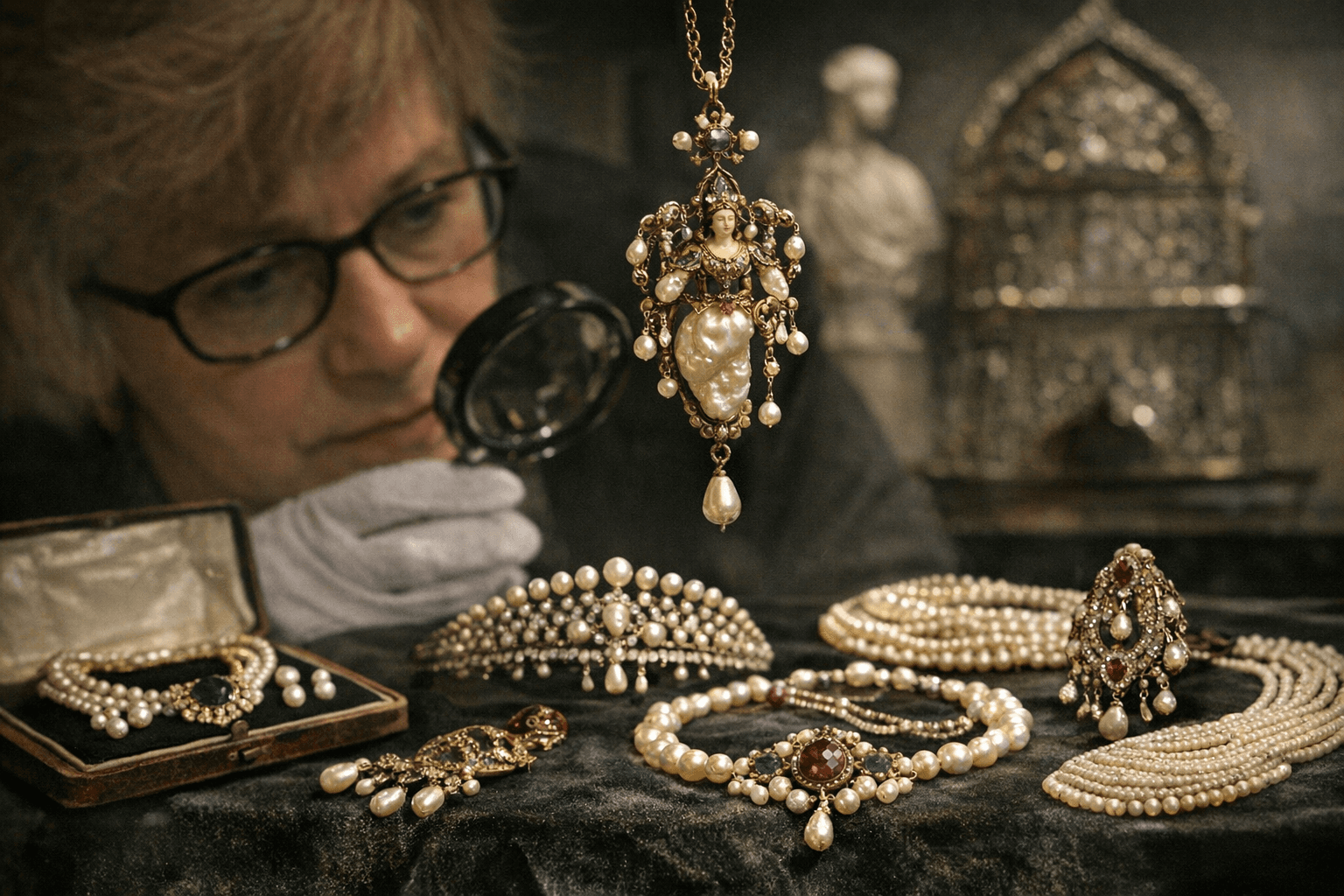
Few institutions map the full arc of pearl jewelry as comprehensively as the British Museum. Its online collection brings together object records, culture-history essays, and conservators' notes that span everything from ancient inlaid objects to fully mounted jewels, tracing how one organic gem became a universal currency of beauty across civilizations that never shared a language.
Baroque Pearls and the Renaissance Goldsmith's Imagination
The most arresting chapter of the Museum's pearl holdings lives in the Waddesdon Bequest, a collection of nearly 300 objects left to the institution in 1898 by Baron Ferdinand Rothschild from the New Smoking Room of his Buckinghamshire estate, Waddesdon Manor. Within that bequest, the Rothschilds collected 39 objects made with pearl by goldsmiths Erasmus Hornick, Daniel Mignot, and Michel Le Blon, made in Germany, Spain, and France.
The objects reveal a fundamental truth about Renaissance jewelry design: the extraordinary designs of the Renaissance period were actually created to accommodate large, irregular-shaped baroque pearls, which apparently had no use and would not fit into any traditional jewelry design. The most challenging task of the Renaissance jewelry craftsman was to create a design that would accommodate the highly irregular shape of the baroque pearl. Rather than grinding the gem to submission, the goldsmith built the jewel around it.
Usually, the craftsman combined the irregular baroque pearl with other gemstones such as emeralds, rubies, and diamonds, as well as gold and enameling, to obtain the pre-conceived shape that bore fruit in his fertile imagination. The result, exemplified by the Museum's Sea Dragon Pendant, is a category of object that reads more like miniature sculpture than wearable jewelry. The Sea Dragon Pendant in the Waddesdon Bequest, displayed in Room 2A of the British Museum, is based on Erasmus Hornick's design for pendants consisting of dragons and sea horses.
A second Waddesdon object, a toothpick pendant, demonstrates just how embedded baroque pearls were in the Renaissance luxury vocabulary. Constructed around a baroque pearl, the piece resembles a design published in 1562 by Erasmus Hornick in Nuremberg. The form of gold toothpick pendant had certainly become fashionable north of the Alps by 1562, when the Antwerp-trained goldsmith Erasmus Hornick published in Nuremberg two engraved designs for toothpicks. Its form: a mermaid with a gold head, scroll headdress enamelled, and a body built entirely from a baroque pearl. The jewel's function and its material were inseparable.
Elsewhere in the collection, the Museum holds a pendant jewel in gold, set with rubies and emeralds, in the form of a hippocamp, its body a baroque pearl set in gold enamelled green, with a head in white enamel, a collar of rubies, and four pendant pearls suspended from a slender double chain, enamelled and set with pearls. This single object is a masterclass in how Baroque-era goldsmiths treated the pearl not as a stone to be prong-set or bezel-mounted, but as an architectural element, the very skeleton around which gold, enamel, and colored gems were arranged.
Seed Pearls: The Victorian Miniaturist's Medium
Where Renaissance goldsmiths celebrated the baroque pearl's grand irregularity, Victorian jewelers embraced the opposite extreme: the seed pearl, a tiny natural pearl rarely larger than two millimeters, painstakingly drilled and threaded onto horsehair or fine wire. The British Museum's holdings include brooches and parures that use seed pearls to achieve a delicate, almost textile-like surface quality impossible with larger stones.
A parure, in formal gemological terms, is essentially a matching suite of jewelry comprising interchangeable pieces that expand the wearability of the set, typically containing a necklace, at least one pair of earrings, a brooch, bracelet, and in larger sets a ring, diadem, tiara, or aigrette. Parures were designed to be modular, allowing jewelry to be combined into new pieces to meet the ever-changing demands of fashion. Seed pearl parures from the 1820s and 1830s are among the most technically demanding objects in any museum's decorative arts collection, because their construction depends entirely on threads and adhesives that degrade over time.
The Museum also holds a bloomed and chased two-colour gold brooch set with pearls, in the form of a fruiting vine, found in its original unlabelled retailer's case, a rare survival that contextualizes not just the object but the commerce around it. That the case survives speaks to the Victorian understanding of pearl jewelry as an heirloom category, something to be stored and handed down with care.
Pearl Inlay and the Islamic Tradition
The cross-cultural reach of the Museum's pearl material extends well beyond Europe. The Siraf excavations highlight the manufacture of everyday objects, including jewellery made from mother-of-pearl shells, evidence that pearl working in the Islamic world was not confined to palatial commissions but woven into quotidian craft. Mother-of-pearl inlay, the technique of cutting the iridescent inner shell of oysters and bivalves into thin decorative panels, appears across the Museum's Islamic holdings in furniture, caskets, and smaller personal objects, a material tradition that connects Persian Gulf pearl fishing to the decorative arts of the wider Islamic world.
The Mughal court represented perhaps the most concentrated expression of pearl culture in the pre-modern world. As the Metropolitan Museum of Art's collection notes document, the Mughal emperors placed great emphasis on pearls; the longest strands were reserved for the emperor and his sons. In the folio "Shah Jahan on a Terrace, Holding a Pendant Set with His Portrait," Shah Jahan is depicted draped in pearl necklaces that stretch down to his waist. Length itself carried rank; the quantity and quality of pearl strands a courtier was permitted to wear was a codified expression of proximity to power.
Conservation: What These Objects Teach About Care
The British Museum's conservators' notes, accessible alongside individual object records in the online collection, offer practical guidance that extends directly to the care of antique pearl jewelry in private hands. Pearls are among the most environmentally sensitive of all gem materials. Unlike diamonds or sapphires, which are mineral crystals, a pearl is an organic structure: layers of aragonite platelets bound by conchiolin, a protein that reacts to humidity, acidity, and contact with cosmetics and perfumes.
The Museum's records on seed-pearl parures are particularly instructive. The silk threads on which pearls were strung at the time became worn by the weight of the pearls, and the gold wires that held the pearls together wore out with wear, requiring the jewelry to be redone. Pearl strings were often re-strung, their length was adjusted, and new clasps were added to the necklaces. For any collector who owns an antique pearl necklace, this is not a historical footnote but an active maintenance reality: silk thread that has not been re-strung in a decade or more is likely holding its load on threads stretched well past their structural limit.
The conservators' broader guidance aligns with standard gemological best practice: store pearls separately from harder gem materials that can abrade the nacre surface; avoid contact with household acids including wine and citrus; and allow pearls to absorb ambient moisture periodically rather than sealing them in airtight containers, which can cause the organic binder between nacre layers to dry and crack. The Museum's pearl inlay objects are particularly vulnerable to fluctuating humidity, which causes the substrate to expand and contract at a different rate than the shell panels set into it, leading over centuries to lifting and loss.
Why the Collection Still Matters
What makes the British Museum's pearl material so valuable as a reference is precisely its breadth. No single culture invented the pearl jewel; every civilization that had access to oyster beds or trade routes to them found a way to incorporate this organic gem into its most charged objects, from reliquary pendants in Christian Europe to court regalia in Mughal India to mother-of-pearl inlay in Islamic domestic arts. The Museum's collection holds all of these threads simultaneously, making it one of the few places where a student of jewelry can trace, in a single institution, the full cultural biography of a gem that is, at its most fundamental level, a living creature's response to an irritant transformed, by human hands, into an enduring marker of civilization.
This article was produced by Prism’s automated news system from verified source data, official records, and press releases, then run through automated quality and moderation checks before publishing. The system is built and supervised by the people who set the standards it runs under. Read our full AI policy.
Did this article answer your question?