How seed pearls, horsehair and silk made delicate jewelry durable
Seed pearls only look fragile. The Met’s 1845-50 necklace reveals the hidden engineering of horsehair, silk and mother-of-pearl beneath the lace-like surface.
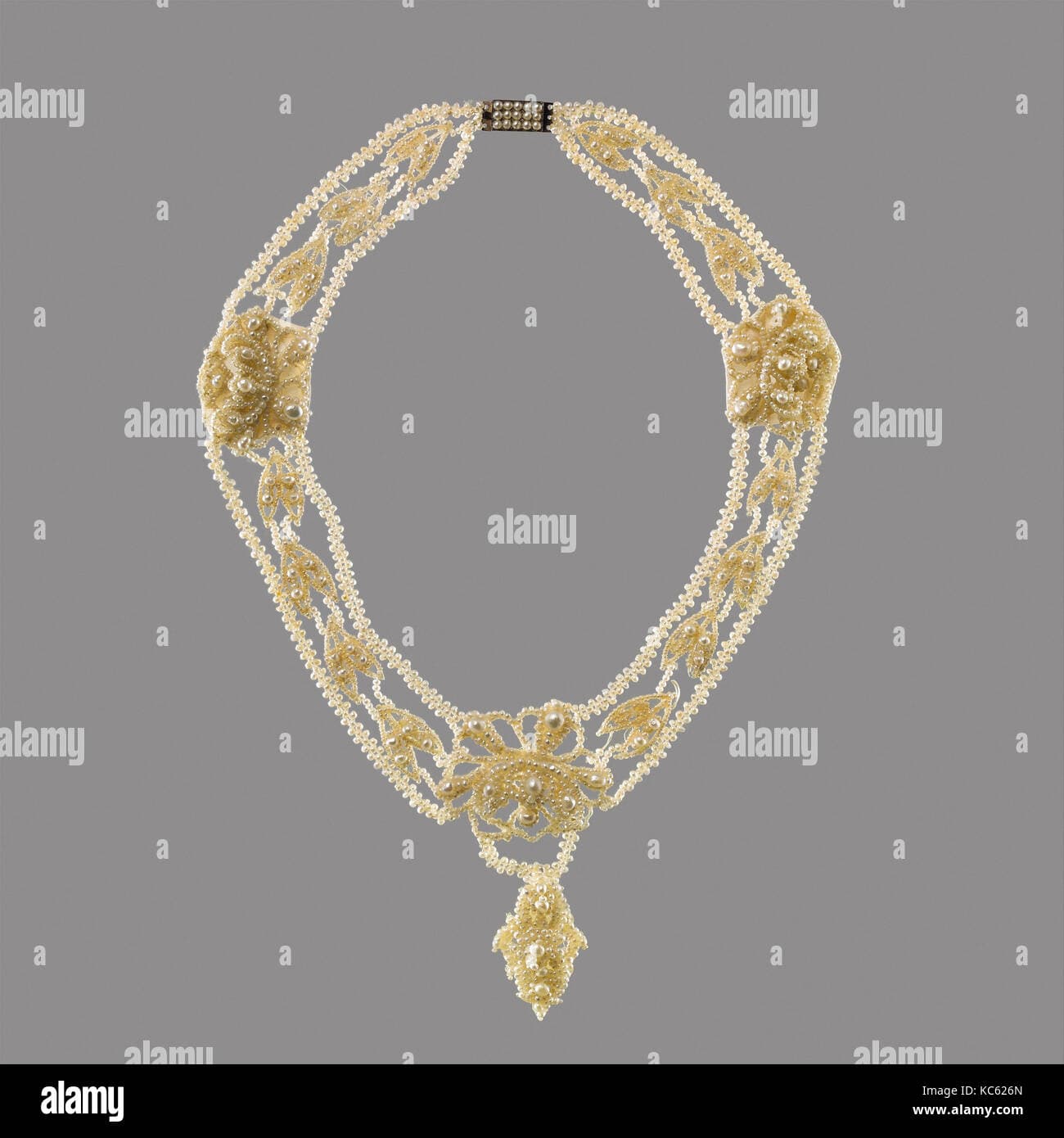
The most delicate pearl necklace in a museum case may be one of the cleverest constructions in nineteenth-century jewelry. The Metropolitan Museum of Art’s 1845-50 seed pearl necklace looks like a ribbon of flowers and leaves, yet its beauty depends on a strict inner architecture: three floral plaques mounted on thin sheets of mother-of-pearl, double strands framing leaf motifs, hundreds of seed pearls carried on fine white horsehair, and silk backing against the skin.
The engineered illusion
What makes the necklace so arresting is not only its miniature scale but the way every material solves a problem. Mother-of-pearl gives the plaques structure without bulk, the double strands create spacing and rhythm, and the seed pearls supply the lacy surface that makes the whole piece read almost like embroidery.
That illusion mattered because seed-pearl work had to be light enough to wear, flexible enough to sit at the throat, and durable enough to survive movement. The Met’s necklace shows how makers translated the language of textiles into metal-free jewelry design, using pearl, shell, horsehair and silk the way a dressmaker might use layers of fabric and lining.
Why horsehair and silk were not accidental
Horsehair was not an eccentric flourish. White horsehair was finer than silk thread, which made it ideal for carrying tiny pearls without adding visible weight. The most valued hair came from a living horse, because it was less brittle than detached hair.
Silk played a different role. The necklace’s plaques are backed in silk for comfort. Seed-pearl jewelry often sat close to the body, especially in necklaces and bridal pieces, so the underside had to feel as refined as the front. Similar work at the Victoria and Albert Museum uses gold-wire frameworks with pearls attached by horsehair or silk.
A labor-intensive luxury
Seed-pearl jewelry was never simple to make. The work demanded nimble fingers, acute vision, patience, and extraordinary care to avoid crushing the pearls. Much of it was done by seamstresses working from home, where the labor of stringing and sewing hundreds of tiny pearls became a cottage industry.
That labor helps explain the scale at which seed pearls were used. A single parure could include a necklace, bracelets, earrings, a brooch, a ring and an aigrette, all coordinated in the same miniature vocabulary.
From Federal America to the ballroom
Seed pearl necklaces were especially popular in the early to mid-nineteenth century, and they took hold in America after their introduction during the Federal period. They were often presented to a bride at the time of her wedding. By the mid-nineteenth century, the style was considered de rigueur in the ballroom, where its refined sparkle suited formal dress and candlelight.
The materials came from a global trade network as well. Seed pearls were imported from China or India, then transformed into highly localized forms of dress ornament.
What modern buyers should notice
Seed-pearl jewelry is hard to make and even harder to repair, and that is why a dainty piece often carries a price that seems out of proportion to its size. The work is fragile by design: pearls are small enough to crush, thread can fail, and original constructions often depend on materials that age differently over time. Surviving nineteenth-century examples are relatively scarce because many deteriorated or were restrung, which means originality and condition matter as much as appearance.
When you look at a seed-pearl piece today, pay attention to the structure underneath the prettiness. A well-made example should feel balanced, not clumsy, and its plaques, strands and backings should still speak to the original construction.
- Check for the integrity of the silk backing, especially where the piece rests against the skin.
- Look for even spacing and coherent geometry in the pearl strands, since that balance is part of the design.
- Examine whether the mother-of-pearl base is intact, because that shell supports the whole composition.
- Ask how much has been restrung or replaced, since repairs can change both value and fragility.
This article was produced by Prism’s automated news system from verified source data, official records, and press releases, then run through automated quality and moderation checks before publishing. The system is built and supervised by the people who set the standards it runs under. Read our full AI policy.
Did this article answer your question?