Mother-of-pearl bracelet reveals 18th-century luxury craft traditions
A coque de perle bracelet shows mother-of-pearl as a sculpted luxury material, not a novelty. Its 18th-century logic still shapes today’s shell-forward jewelry.
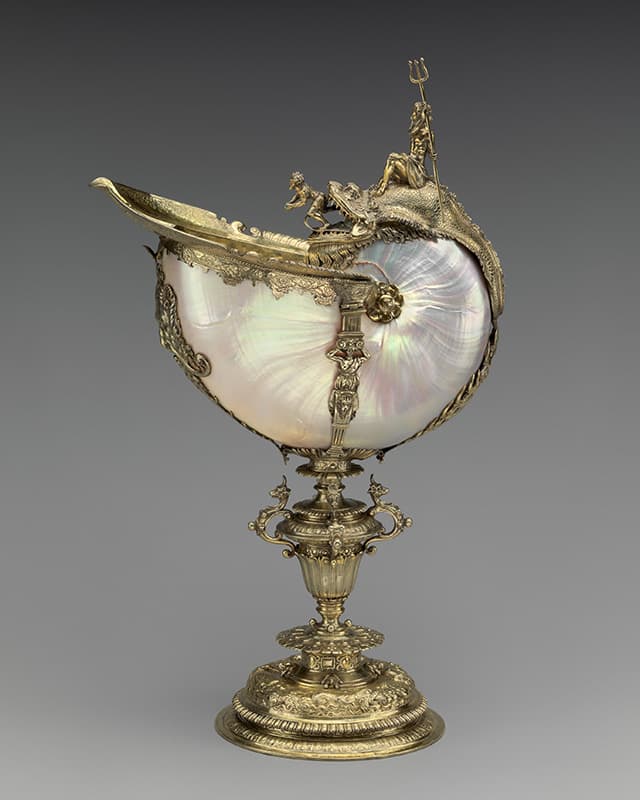
An 18th-century coque de perle bracelet sits beside nautilus cups and mother-of-pearl snuffboxes in the Decorative Arts Trust’s feature on Manipulating Mother-of-Pearl: An 18th Century Coque de Perle Bracelet. The pairing places shell within a disciplined luxury vocabulary shared across jewelry and the broader decorative arts.
Shell as a luxury material, not a souvenir
In elite European interiors, mother-of-pearl carried the same charge as gold, lacquer, and gilded mounts. It was prized for its luminous surface and for the difficulty of making it behave, since shell had to be cut, smoothed, and integrated into forms that looked inevitable once finished.
Why the snuffbox belonged in the same conversation
At the Victoria and Albert Museum, small gold boxes were "among the supreme luxuries of 18th-century Europe, essential for any stylish man or woman." Most held snuff, while some were made for small sweets or bonbons, which is where the term bonbonnière comes from.
They were gifts passed to friends and lovers, and monarchs presented them to ambassadors and courtiers. At court, they also helped shape the "language of the snuffbox," a system of gestures with hidden meanings. Cooper Hewitt, Smithsonian Design Museum calls snuffboxes "a combination of exquisite craftsmanship and subtle status symbol."
A shell bracelet belongs in the same lineage: small, portable, intimate, and engineered to be seen.
What the bracelet still teaches contemporary shell jewelry
Three design ideas from this period still echo through contemporary pearl and shell jewelry, and each one is visible in the objects around the bracelet.
First, precious-metal mounting remains essential. The Metropolitan Museum of Art’s Nautilus cup from the Netherlands, dated 1602, is fitted with gilded silver mounts, while the museum also holds a French Paris snuffbox made of gold and mother-of-pearl. Shell was rarely left to stand alone; metal gave it structure, contrast, and a sharper sense of finish. Modern jewelers still frame mother-of-pearl in yellow gold, white gold, or silver so the iridescence reads more vividly.
Second, scale matters. The Walters Art Museum’s cartouche-shaped snuffbox from the early 18th century, made in the Netherlands from gold and mother-of-pearl, shows how shell could be turned into a miniature architectural object. Contemporary shell jewelry often treats surface as a design field.
Third, shell works best when it is part of a mixed-material conversation. Mother-of-pearl was used alongside gold, gilded silver, and lacquer, which gave makers a way to balance softness and shine, opacity and shimmer. Many modern pearl and shell pieces use a single luminous panel or inlay rather than a heavily ornamented setting.
The court codes behind the shimmer
The appeal of mother-of-pearl was not just visual. It was cultural, and the objects that carried it were embedded in systems of taste, gifting, and display. Small boxes and shell-mounted vessels circulated in European courts as markers of access, refinement, and discernment, which is why their surfaces were so meticulously finished.
Those codes were not confined to one region, either. The Metropolitan Museum of Art’s exhibition Mother-of-Pearl: A Tradition in Asian Lacquer includes the earliest mother-of-pearl and lacquer object in its collection, dated to the 12th century. Another Met exhibition, Shell and Resin: Korean Mother-of-Pearl and Lacquer, traces the long and rich tradition of lacquerware with mother-of-pearl inlay in Korean art. The European bracelet sits inside a much older and broader history of shell craft, one that crosses courts, workshops, and continents.
This article was produced by Prism’s automated news system from verified source data, official records, and press releases, then run through automated quality and moderation checks before publishing. The system is built and supervised by the people who set the standards it runs under. Read our full AI policy.
Did this article answer your question?